“The Nobel Assembly at Karolinska Institutet has today decided to award the 2015 Nobel Prize in Physiology or Medicine with one half jointly to William C. Campbell and Satoshi Ōmura for their discoveries concerning a novel therapy against infections caused by roundworm parasites and the other half to Tu Youyou for her discoveries concerning a novel therapy against Malaria….
William C. Campbell and Satoshi Ōmura discovered a new drug, Avermectin, the derivatives of which [inlcuding Ivermectin] have radically lowered the incidence of River Blindness and Lymphatic Filariasis, as well as showing efficacy against an expanding number of other parasitic diseases….
“Avermectin, Artemisinin and global health”
“The discoveries of Avermectin and Artemisinin have fundamentally changed the treatment of parasitic diseases. Today the Avermectin–derivative Ivermectin is used in all parts of the world that are plagued by parasitic diseases. Ivermectin is highly effective against a range of parasites, has limited side effects and is freely available across the globe.
The importance of Ivermectin for improving the health and wellbeing ofmillions of individuals with River Blindness and Lymphatic Filariasis, primarily in the poorest regions of the world, is immeasurable. Treatment is so successful that these diseases are on the verge of eradication, which would be a major feat in the medical history of humankind.
Malaria infects close to 200 million individuals yearly. Artemisinin is
used in all Malaria-ridden parts of the world. When used in combination
therapy, it is estimated to reduce mortality from Malaria by more than
20% overall and by more than 30% in children. For Africa alone, this means that more than 100,000 lives are saved each year.
The discoveries of Avermectin and Artemisinin have revolutionized therapy for patients suffering from devastating parasitic diseases. Campbell, Ōmura and Tu have transformed the treatment of parasitic diseases. The global impact of their discoveries and theresulting benefit to mankind are immeasurable.”
This article is made available via the PMC Open Access Subset for
unrestricted research re-use and secondary analysis in any form or by
any means with acknowledgement of the original source. These
permissions are granted for the duration of the World Health
Organization (WHO) declaration of COVID-19 as a global pandemic. This article has been cited by other articles in PM
……….
“Abstract
Considering the urgency of the
ongoing COVID-19 pandemic, detection of various new mutant strains and
future potential re-emergence of novel coronaviruses, repurposing of approved drugs such as Ivermectin could be worthy of attention. This evidence-based review article aims to discuss the mechanism of action of ivermectin against SARS-CoV-2
and summarizing the available literature over the years. A schematic of
the key cellular and biomolecular interactions between Ivermectin, host
cell, and SARS-CoV-2 in COVID-19 pathogenesis and prevention of
complications have been proposed.
With the ongoing vaccine roll-out programs in full swing across the globe, the longevity of the immunity offered by these vaccines or their role in offering protection against new mutant strains is still a matter of debate. The adoption of Ivermectin as a “safety bridge” by some sections of the population that are still waiting for their turn for vaccination could be considered as a “logical” option.
Several doctor-initiated clinical trial protocols
that aimed to evaluate outcomes, such as reduction in mortality
figures, shortened length of intensive care unit stay and/or hospital
stay and elimination of the virus with ivermectin use have been registered at the US ClinicalTrials.gov[7]. Real-time data is also available with a meta-analysis of 55 studies to date. As per data available on 16 May 2021, 100% of 36 early treatment and prophylaxis studies report positive effects (96% of all 55 studies). Of these, 26 studies show statistically significant improvements in isolation. Random
effects meta-analysis with pooled effects using the most serious
outcome reported 79% and 85% improvement for early treatment and
prophylaxis respectively (RR 0.21 [0.11–0.37] and 0.15 [0.09–0.25]). The
results were similar after exclusion based sensitivity analysis: 81%
and 87% (RR 0.19 [0.14–0.26] and 0.13 [0.07–0.25]), and after
restriction to 29 peer-reviewed studies: 82% and 88% (RR 0.18
[0.11–0.31] and 0.12 [0.05–0.30]). Statistically significant
improvements were seen for mortality, ventilation, hospitalization,
cases, and viral clearance. 100% of the 17 Randomized Controlled Trials
(RCTs) for early treatment and prophylaxis report positive effects,
with an estimated improvement of 73% and 83% respectively (RR 0.27
[0.18–0.41] and 0.17 [0.05–0.61]), and 93% of all 28 RCTs. These studies
are tabulated in Table 1.
The probability that an ineffective treatment generated results as
positive for the 55 studies to date is estimated to be 1 in 23 trillion (p = 0.000000000000043). The consistency of positive results across a wide variety of cases has been remarkable. It is extremely unlikely that the observed results could have occurred by chance [8]….
Comment: This isn’t to suggest one particular CT number should become
law, rather that from day one if CT values had always been reported with PCR lab results, there wouldn’t have been as many occasions to force millions of American children and adults to suffer needlessly. Florida Governor Ron DeSantis apparently
didn’t like needless suffering and didn’t mind using his brain to look
into the matter of CT values. PCR “tests” should never have been used in the
US to begin with for several reasons including that they can’t detect
Covid, only that certain genetic material is present. Most depraved is
that the PCR “test” was the “engine” that kept 24/7 Covid scare “cases”
headlines going. Yet the PCR “test” had no national standard for its
manufacture in the US, no national standard for US labs to conduct the
tests, no national requirement to report the CT value. In fact many labs
simply refused to give CT values, said they weren’t required to do so,
that the PCR test wasn’t designed for that, was just to report very
general genetic “negative” or “positive” readings. Erroneously reported
“positive results” instantly became life threatening “cases” in 24/7
headlines used as deadly weapons against millions of defenseless
Americans.
When would US government by decree end? Our elected representatives
apparently didn’t have any laws in place to trigger “end dates” for coup
d’etats. We were thrown into a pack of wild animals. Who would have no
problem treating millions of American children and families so
cavalierly? Answer: Inhumane persons such as those in the US political
class who view the US as a two tiered society with themselves in the
upper tier.
The “engine” for the train was the PCR “test” which doesn’t detect
Covid, never should’ve been allowed in this country, was used to sell
massive numbers of alleged “cases” that didn’t exist as potentially
deadly “infections,” which were then used to force more restrictions.
Putting that aside, Trump could still have helped us enormously by
every single day drawing attention to the CT values of PCR tests, how
ignoring CT value inflated scary “case” numbers, which then made scary
headlines, which were then used to trigger more lockdowns, school
closings, masks, loss of employment, lack of normal medical and dental
treatment for children and adults, threats of worse punishments on the
horizon. But he didn’t. He's hasn't the slightest concern for humanity.
The $2 trillion CARES Act, which was preceded by
the $3.5 billion Families First Coronavirus Response Act, the $8.3
billion Coronavirus Preparedness and Response Supplemental
Appropriations Act, and the $75 billion Paycheck Protection Program and
Health Care Enhancement Act, resulted in massive Federal and State money towards expanded government aid and social programs. These included:
*$290 billion in stimulus checks. (The stimulus bills alone cost each American taxpayer $16,800 according to the Committee for a Responsible Federal Budget.)
*$260 million on extended unemployment benefits from 26 to 39 weeks, with four months of an additional $600 in weekly benefits under Pandemic Emergency Unemployment Assistance.
*Extended four weeks of paid sick leave and ten weeks of expanded family leave benefits under the Families First Coronavirus Response Act for workers impacted by Covid-19.
*$750 million for Head Start. (Since it began in 1969, the program has still not demonstrated quantifiable improved long-term academic outcomes for children, failing even after 90 studies, while costing taxpayers about $12 billion a year, according to Congressional Budget Office.)
*$3.5 billion for early learning and child care. (universal
preschool has no research to demonstrate meaningful positive outcomes
for children or to be cost-effective, as the School of Public Policy at
George Mason University reported.)
*$685 million for public housing and urban development (HUD). (This program was established in 1965 and budgeted at $59.5 billion for 2021. It has been plagued with scandal and corruption since its inception.)
*$16.5 billion to extend the Temporary Assistance for Needy Families (TANF) program.
(This is a program created in 1996 that has been shown to be a weak
safety net that does little to alleviate poverty and hardship, and
rarely lifts families out of poverty or moves parents into jobs, according to the Center on Budget and Policy Priorities.)
*$25 billion was awarded to public transportation agencies, according to the Federal Transit Administration; New Mexico got $133 million towards public transportation, which according to the NM DOT went to numerous social programs, including, for example, $84,661 to Assistance Dogs of the West, $296,269 to Adelante, $487,288 to Capacity Builders, $205,328 to Mandy’s Farm, $193,607 to Life ROOTS, and $232,265 to Tresco; $79.8 million went to Albuquerque, an amount more than 165 percent higher than the city’s total transit budget for 2020 – that’s a lot of face masks.
Americans are coming to understand that the crisis resulting from the government lockdowns and restrictions was used to convince politicians to support the CARES Act. This Act, however, was never about health or helping working Americans. It can best be described as bailouts in return for socialism.
It’s undeniably evident that the CARES Act was focused on the progressive tenet of redistribution of wealth and growing the numbers of Americans dependent upon the government. It also epitomizes imprudent government spending and spending not free from corruption by special interests. Money is taken from working taxpayers…expanding social programs and the size and power of government entities, while lining the pockets of special interests. That’s socialism.
Winners and Losers
Equally undeniable, but sacrilege to report, is that the
CARES Act was less about altruism and caring for people or the best
interests of working Americans, and more about making money for special interests. Covid-19 and the CARES Act brought huge profit potential to the largest and wealthiest corporations and individuals.
Large healthcare industry hospitals and healthcare providers stood to benefit most from the CARES Act.
The $175 billion Provider Relief Fund
was allocated to hospitals and other providers, with significant
portions supposedly targeted for safety net hospitals for indigent care
and rural hospitals. Also called the Public Health and Social Service Emergency Fund, there was no requirement that losses had to be related to Covid-19; there was no formal report to document how providers spent the money or initially any application process; and the government conducted no review of which providers qualified for the money, leading to the initial $30 billion given with no strings attached, followed by $50 billion for general distribution. Of the initial $30 billion allotments, for example, New Mexico received $169.5 million and Texas $2.1 billion. To date, a total of $10.93 billion of the $24.5 billion Phase 3 funding has been distributed, $19.6 million to New Mexico and $844 million to Texas.
This fund paid out an average of about $108,000 per hospital bed in the U.S.,according to a Kaiser Family Foundation report. Over 394,000 providers had received payments as of December 16, 2020, according to the HHS database.
Of the $100 billion going to hospitals and health facilities, the Fund included 20 percent increased reimbursements for Covid-19 patients, along with accelerated reimbursements, making it more profitable to care for patients suspected of or testing positive for Covid-19.
In August [2020], HHS added $1.4 billion for 80 children’s
hospitals, although children account for a small fraction of Covid-19
cases. Georgia’s children’s hospitals got $33 million in Covid-19 aid, for example, even though only 279 Georgian children had been hospitalized testing positive for Covid-19 (equating to $118,279 per pediatric patient).
Large major hospital networks got the largest payments, and it was later realized that poor rural hospitals had received significantly less.
One of the largest hospital systems, HCA Healthcare, reported a profit of more than $800 million during the second quarter of 2020 thanks to the CARES Act money. While it returned about $6 million of its CARES Act money, as did a few other hospitals, most didn’t.
Hospital systems tied into government managed care and
Covid-19 government funding profited the most. The University of New
Mexico Hospital, for example, received $20 million from the CARES Act; on top of increased reimbursements for Covid-19 patients and providing other pandemic-related care. This hospital, alone, finished the 2020 fiscal year with $137 million more in profits over 2019. UNM Health Sciences Center also reported a $36 million surplus in 2020 fiscal year.
By January 21, 2021, according to the Center for Healthcare Quality and Payment Reform, 897 rural hospitals across the country were at risk of closing – 40 percent of all the rural hospitals in the country.
Some 500 were financially struggling prior to Covid-19 restrictions and
their financial situations deteriorated with the pandemic, said Becker’s Hospital CFO Report. In Texas, 56 percent of its rural hospitals (82) and 25 percent in New Mexico (6), for example, are at risk of closing.
About 16,000 medical practices closed last year, around eight percent of the nation’s physicians surveyed; and another four percent plan to close this year. According to the Physicians Foundation, doctors said their closures were the result of Covid-19 regulatory burdens. In its survey, most doctors stated concerns
of serious consequences for patient health due to not receiving care
during the pandemic. They also voiced concerns that doctors are not part
of national health care conversations, as the system is being directed by policy makers and special business interests. Doctors overwhelmingly ranked
government-funded and administered single payer healthcare as the
poorest option for the country’s healthcare system and for patients.
The CARES Act became a money maker for many of the largest U.S. and international companies:
Four thousand international companies were awarded an estimated $24.8 billion for Covid-19 contracts for everything from masks, test kits, laptops and sanitizer, to audiobook and mobile tracking apps.
The pharmaceutical industry received $18 billion by October for Operation Warp Speed for vaccines. Besides these lucrative contracts, according to an Accountable Pharma report, the Securities and Exchange Commission Market Abuse Unit was alerted when it was discovered that top executives of just five of these pharmaceutical companies had personally profited by over $145 million in stock trades, and 22 executives had pocketed more than $6.6 million apiece, on top of their salaries and bonuses.
Insurance companies were provided significant tax benefits and other financial benefits
enabling them, for example, to add a five-year carryback period and
repealing the 80 percent limitation for net operating losses for the
past three years.”…
(Continuing): “Insurance companies enjoyed huge profits off the government Covid-19 mandates. Government emergency declarations restricted and cancelled all “nonessential medical care”
and countless patients were no longer able to receive needed medical
care for conditions, including heart attacks, strokes, diabetes and
cancers. Covid-19 patients were prioritized. New York physicians reported in the Journal of the American Medical Association that hospitalizations across a full range of non-Covid-19 diagnoses had plummeted during the peak of the pandemic and have continued at about half of baseline care levels. Even this past December [2020], Beckers Hospital Review reported 106 major medical centers across the U.S. were still not performing “elective” procedures.
While patients haven’t been receiving medical care as
“nonessential” medical care was cancelled and care for non-Covid-19
patients was curtailed, hospitals and doctor’s practices have sat underutilized with staff layoffs and even closures. As a result, health care payouts and insurance claims have plummeted while insurance company profits have doubled over the last year, as John Hopkins’ researchers reported in JAMA. Second quarter net profits alone for UnitedHealthcare doubled to $6.7 billion; Anthem to $2.3 billion; and Humana to $1.8 billion compared to last year. Forbes’ Infographic illustrated the massive boost in profits.
Anthem, which operates Blue Cross and Blue Shield plans in 14 states, admitted
that its $29 billion in revenue during the second quarter was gained by
reductions in healthcare during the pandemic to patients covered by its
commercial plans, Medicaid and Medicare seniors.
As the New York Post reported, profiteering off the pandemic by insurance companies and the nation’s largest insurers between April and June prompted a Congressional probe from the House Energy and Commerce Committee.
By law, insurers are only allowed to keep 15-20 percent of premiums for administration costs and profits. Blue Cross Blue Shield of Michigan announced last May it was issuing over $100 million in refunds to customers because it had paid out too little in medical claims due to the pandemic;
UnitedHealthcare issued credits of 5 to 20 percent; Harvard Pilgrim
Health Care announced $32 million in premium credits; BCBS of
Massachusetts returned $101 million to its members in August; and BCBS of New Mexico announced
in October that it was issuing $4 million in premium credits to its
insured employer customers, equating to 15 percent of group plan medical
premiums.
However, millions of unemployed Americans on COBRA who’d lost their employer group plans and were paying their own health insurance
premiums in full didn’t receive the credit. While employee members
would have received their share of the excess premium rebates, most
COBRA participants were covered through employer trusts and, under Department of Labor guidelines, the rebates went to their former employers. A
single COBRA participant covered under New Mexico’s Public Schools
Insurance, for example, paid out $17,547.78 in premiums in 2020 for
himself and his spouse, leaving the school system to pocket significant
profits off each member with no accountability.
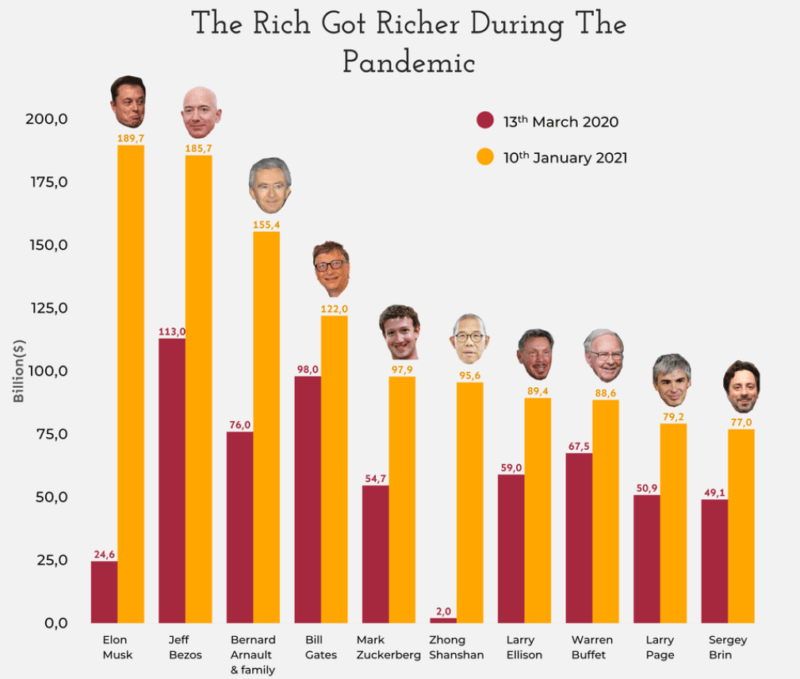
Profiteering off the pandemic mandates created a “billionaire bonanza.” Covid-19 government policies made the richest billionaires richer – making unfathomable amounts of money while Americans were struggling. By mid-April, the richest 600+ billionaires had already scored $700 billion, averaging $42 billion a week, the Americans for Tax Fairness and the Institute for Policy Studies reported. Jeff Bezos (Amazon) had made $25 billion; Elon Musk (Tesla contracted to make ventilators) made $5 billion, Eric Yuan (Zoom) $2.58 billion, and Steve Ballmer (former Microsoft, think videoconferencing) made $2.2 billion, as examples.
As the pandemic lockdowns and government policies continued, so did billionaire profiteering. By January 10, 2021,
Elon Musk had a net worth of $189.7 billion, Jeff Bezos $185.7 billion,
the Arnault Family $155.4 billion, Bill Gates $122 billion, Mark
Zuckerberg $97.9 billion, etc. Just ten billionaires had accumulated a net worth of $1.2 trillion during the pandemic, as was reported in AIER:
Big Government budgets and salaries have ballooned thanks to
Covid-19 policies. Anthony Fauci, Director of NIAID, is now the highest
paid Federal employee in the entire government, making more than even the President of the U.S., Forbesreported. Covid-19 has given him public celebrity status and power. NIH’s and NIAID’s budget had been increased in FY2020 to $41.68 billion and $5.89 billion, respectively. Initially, the FY2021 budget was to be lower, but a
July 2020 Covid-19 spending package awarded the NIH an additional $5.5
billion, giving it a budget increase twice that of other federal
institutions, including $40 million to Fauci’s lab for research on a universal influenza vaccine. [Bill Gates says the flu needs to be eradicated, 8/5/21]. The CARES Act gave $1.5 billion in supplemental money to his NIAID, $233 million of that for building infrastructure; along with $767 million for Operation Warp Speed vaccine development. His NIAID lab, Vaccine Research Center, is being doubled in size, with a $197.4 million addition on its 310-acre grounds, to be completed in 2024, and envisioned to have over 25,000 employees.
The CDC’s budget was similarly expanded last year with an additional $16.3 billion awarded to support government actions surrounding Covid-19, in addition to $39.36 billion to state health departments through the CDC. CDC’s FY2021 budget totals more than $12.6 billion. Objectivity about Covid-19 is obviously compromised when your department stands to gain so much money.
Meanwhile, at the end of the year, states and municipalities
across the country had billions of unspent CARES Act money and governors
and city officials were scrambling to figure out what to do with it: $2 billion was unspent in Texas, $2.4 billion in NJ, $818 million in Alabama, $700 million in Indiana, $819.7 million in West Virginia, $440 million in Utah, $310 million in South Dakota, $56 million in Palm Beach County, $27 million in Arkansas.
Across the country, states and localities rushed in last minute spending sprees of unused CARES Act money on everything from a football stadium and broadband to fire and police bonuses.
The CARES ACT community grants have been significantly unused in Alaska, for example, where 63 communities hadn’t accepted their grants and only 18 had applied for followup payments.
Vast amounts of CARES Act money for education have yet to be spent or even allocated, according to a January 2021 Center for American Progress report. It found $847 million hasn’t even been allocated by states and another $3 billion allocated to colleges and $463 million for students remains unspent.
CARES Act money for rent relief has also gone unspent; $108 million in Pennsylvania, $38 million for rent and small business money in Atlanta, most of the $4 million to Syracuse and Onondaga County, and $53 million in Minnesota, as examples.
“Sandy Szwarc, BSN, RN is
a graduate of U.T. Austin and a researcher and writer on health and
science issues for more than 30 years.”…Contact Sandy Szwarc, Email: sandyjfs@yahoo.com

 1,2 and