
.
“8. The
Clinton administration intervened massively across the former Soviet
satellite states of Eastern Europe, with direct interventions in the
Balkans through NATO, corporate buyouts of industry from Poland to the Czech Republic, and the notorious “shock doctrine” of neoliberal economic reforms in exchange for IMF loans.”…3. “Bill Clinton was responsible for more damaging financial deregulation-and thus, for the [2008] financial crisis-than any other president.”
6/22/2015, “15 Ways Bill Clinton’s White House Failed America and the World,” AlterNet Staff, 11 authors listed below
“Bill Clinton remains one of America’s most popular presidents. A national poll last March [2015] by NBC and the Wall Street Journal found 56
percent of Americans had a clearly favorable view of Clinton. That’s
long been true for African Americans—from novelist Toni Morrison
famously calling him the “first black president” while in office, to books explaining his appeal after his presidency ended.
[Bill] Clinton has used this popularity to build his enormously ambitious global foundation, collecting $2 billion in assets for many anti-poverty and health initiatives, as well as building a personal fortune from speechmaking estimated at $30 million or more. In recent years, most of the public has forgotten what Clinton did as president, even as he has steadily been in the news.
But for more than a year before Hillary Clinton launched her latest presidential campaign, Bill Clinton has been selectively telling media outlets that he made some mistakes as president and might have acted otherwise. He’s even tried to recast actual events and been taken to task by fact-checkers who recall his leading role in what became major crises, such as the 2008 global financial implosion.
What follows are 15 ways Bill Clinton’s presidency did not serve America or the world, and in many ways deepened and perpetuated the problems we face today.
This article was prepared by AlterNet staff members Janet Allon,
Michael Arria, Jan Frel, Tana Ganeva, Kali Holloway, Zaid Jilani, Adam
Johnson, Steven Rosenfeld, Phillip Smith, Terrell Jermaine Starr and
Carrie Weissman.
1. Prison-loving president. In May [2015], on the heels of the unrest in Baltimore sparked by Freddie Gray’s death in police custody, Clinton apologized for locking too many people up. Thanks, Bill.
The 2.4 million people in prison and the 160,000 Americans serving life in prison largely because of his policies might be excused for not accepting Clinton’s apology. Tag-teaming with ex-President Ronald Reagan, Clinton is the president most responsible for the mass incarceration of Americans on an epic scale. The gung-ho crime fighter-in-chief passed the single most damaging law with his omnibus federal crime bill in 1994, which included the infamous “three strikes” law (three felony convictions means a life sentence) and ensured that mandatory minimum sentences imprisoned even low-level, non-violent offenders for a long, long time.
Clinton discussed his regrets about the crime bill with CNN’s Christiane Amanpour. “The problem is the way it was written and implemented is we cast too wide a net and we had too many people in prison,” he said. “And we wound up…putting so many people in prison that there wasn’t enough money left to educate them, train them for new jobs and increase the chances when they came out so they could live productive lives.”
All true, except that it was not just lack of funds that eliminated education and rehabilitation programs in prison, it was a deliberate choice. Sensing the political popularity of being tough on crime, Clinton fully embraced the lock-’em-up-and-throw-away-the-key mentality, and gloated about three strikes.
It strains credulity to think that this exceptionally intelligent man
did not understand the dire consequences of what he was doing, as his
wife now says.
Clinton’s Violent Crime Control and Law Enforcement Act of 1994 helped set the national mood. Dozens of states followed with
their own mandatory minimum laws. While there is some talk today of
criminal justice reform on a minor level (like for low-level drug
offenses), no one is talking about the all-but-forgotten population doing hard time thanks in large part to Clinton.
2. Punitive welfare reform. The consequences of Bill Clinton’s welfare reform bill have been devastating for millions of American families. The Personal Responsibility and Work Opportunity Reconciliation Act of 1996 took a page directly from Republican Speaker of the House Newt Gingrich’s Contract with America. In an atmosphere steeped in decades of conservative scaremongering around the specter of sexually reckless “welfare queens,””…
[Ed. note: “Decades of conservative scaremongering” couldn’t have scared many people. Until 1994, the House had been controlled for 40 straight years by Democrats. Naturally, once they were in charge, the GOP trashed the place and was soon back in the minority, where they’re much happier. The GOP despises Republican voters, wants a different voting base, and is willing to sit in the minority “even if it takes them 15 years in the wilderness to rebuild a new base of people who don’t embarrass them.” 10/16/2013, “GOP Seeks to Rid Itself of the Tea Party,” Rush Limbaugh. (They have no interest in Trump's 63 million voters). See also, “The Sabotage Republicans," 11/8/2013].
(continuing): “Clinton’s 1992 campaign promise to “end welfare as we know it” played directly to white voters’ fears of black crime and poverty. Twenty years after scrapping the longstanding Aid to Families with Dependent Children in favor of the right wing’s underfunded and more punitive vision, the number of poor American children has exploded and black welfare recipients are subject to the system’s most stringent rules.
In 2012, the Center on Budget and Policy Priorities found
that while “in 1996, for every 100 families with children living in
poverty, TANF [Temporary Assistance for Needy Families] provided cash
aid to 68 families,” that number plunged to 27 out of every 100 families living in poverty by 2010. Conservatives trumpet these numbers, often citing the fact that nationally, TANF enrollment fell 58 percent between 1995-2010. But they neglect to mention that the number of poor families with children rose 17 percent in the same period.
Sociologist Joe Soss, who has examined the long-term racial consequences of welfare reform, which allowed states to decide how funds were allotted and eligibility determined, also noted that, “all of the states with more African Americans on the welfare rolls chose tougher rules…[E]ven
though the Civil Rights Act prevents the government from creating
different programs for black and white recipients, when states choose
according to this pattern, it ends up that large numbers of African
Americans get concentrated in the states with the toughest rules, and
large numbers of white recipients get concentrated in the states with
the more lenient rules.”
3. Wall Street’s Deregulator-in-Chief. As president, Clinton outdid the GOP when it came to unleashing Wall Street’s worst instincts, by supporting and signing into law more financial deregulation legislation than any other president, according to the Columbia Journalism Review.
He didn’t just push the Democrats controlling the House to pass a bill (Gramm-Leach-Bliley Act) that dissolved the Depression-era Glass-Steagall law, which barred investment banks from commercial banking activities. He deregulated the risky derivatives market (Commodity Futures Modernization Act), gutted state regulation of banks (Riegle-Neal) leading to a wave of banking mergers, and reappointed Alan Greenspan as Federal Reserve chair. In recent years, Clinton has ludicrously claimed that the GOP forced him to do this, which led in no small part to the global financial crisis of 2008 and the too-big-to-fail ethos, with the federal government obligated to bail out multinational banks while doing little for individual account holders.
“What happened?” he told CNN in 2013. “The American people gave the Congress to a group of very conservative Republicans.
When they passed bills with veto-proof majority with a lot of Democrats
voting for it, that I couldn’t stop, all of a sudden we turn out to be
maniacal deregulators. I mean, come on.” As CJR put it, “This is, to be kind, bullshit,” reciting a list of Clinton deregulatory actions that began while Democrats were the majority, starting with appointing “Robert Rubin and Larry Summers in the Treasury, which officially did in Glass-Steagall and the Commodity Futures Modernization Act, which left the derivatives market a laissez-faire Wild West.”
CJR concludes, “The bottom line is: Bill Clinton was responsible for more damaging financial deregulation-and thus, for the [2008] financial crisis-than any other president.”
4. Gutted manufacturing via trade agreements. Bill Clinton helped gut America’s manufacturing base by promoting and passing the North American Free Trade Agreement, or NAFTA, in 1993, when Democrats controlled Congress.
That especially resonates today, when another Democratic president,
Barack Obama, and Republicans in Congress, are allied against labor
unions and liberal Democrats to pass its like-minded descendant, the Trans Pacific Partnership. “NAFTA signaled that the Democratic Party—the “progressive” side of the U.S. two-party system—had accepted the reactionary economic ideology of Ronald Reagan,” wrote Jeff Faux, on the Economic Policy Institute Working Economics Blog.
In 1979, then-candidate Reagan proposed a trade pact between the U.S., Canada and Mexico. But the Democrats who controlled the Congress would not approve it until Clinton pushed it in his first year in office. NAFTA has affected U.S. workers in four major ways, EPI said. It caused the permanent loss of 700,000 manufacturing jobs in industrial states such as California, Texas and Michigan. It gave corporate managers an excuse to cut wages and benefits, threatening otherwise to move to Mexico. Selling U.S. farm products in Mexico “dislocated millions of Mexican workers and their families,” which “was a major cause in the dramatic increase in undocumented workers flowing into the U.S. labor market.”
And NAFTA became a “template for rules of the emerging global economy,
in which the benefits would flow to capital and the costs to labor.”
The World Trade Organization, World Bank, International Monetary Fund all applied NAFTA’s principles,
which gave corporations the power to challenge local laws protecting
health and safety if they cut into profits—like labeling tobacco
packaging. The NAFTA “doctrine of socialism for capital and free markets for labor” could also be seen in the way the U.S. government “organized the rescue of the world’s banks and corporate investors and let workers fend for themselves” in the Mexican peso crisis of 1994-’95, the Asian financial crash of 1997, and the global financial meltdown of 2008.
5. No LGBT equality: Defense of Marriage Act. The
Defense of Marriage Act (DOMA) was one of conservatives’ biggest
victories in the 1990s. Passed by Congress and signed into law by
Clinton in 1996, the bill defined spouse as “heterosexual” and deprived legally wed same-sex couples of many significant benefits, from Social Security benefits to hospital visitation rights. It allowed states to refuse legal recognition of couples married in other states.
Writing in the New Yorker, Clinton’s former advisor on gay issues, Richard Socarides, addressed why
he signed the wildly discriminatory legislation. For one thing,
Socarides said that Clinton’s political opponents outmaneuvered him. He
also chalks up the president’s decision as “a failure to imagine how
quickly gay rights would evolve.” The former president was hardly an
ardent supporter of the legislation. The New York Times noted, “Mr. Clinton considered it a gay-baiting measure, but was unwilling to risk re-election by vetoing it.”
But the damage was done. For almost a decade, same-sex
couples suffered financial and emotional hardships. Gay couples weren’t
allowed to make medical decisions for their partners, couldn’t get the
major tax breaks afforded to heterosexual couples, and faced unequal treatment in many other areas of law. In 2013, Clinton stated his opposition to the law.
That year, in a major gay rights victory, the Supreme Court declared
DOMA’s Section 3 (which defines marriage as a union between a man and a
woman) unconstitutional. Today, 37 states have legalized same-sex marriage, and in coming days, the Supreme Court is expected to do so.
6. Expanded the war on drugs. Although
Clinton called for treatment instead of prison for drug offenders
during his 1992 campaign, once in office he reverted to the same drug
war strategies of his Republican predecessors. He
rejected the U.S. Sentencing Commission’s recommendation to eliminate
the disparity between crack and powder cocaine sentences. He rejected
lifting the federal ban on funding for needle exchange programs. He
placed a permanent eligibility ban on food stamps for anyone convicted
of a felony drug offense, even marijuana possession. And he prohibited felons from living in public housing.
He also championed the 1994 crime bill, a $30 billion effort that included more mandatory minimum sentences for crack cocaine, extra funds for states that severely punished convicts, limited judges’ discretion in sentencing, and allocated billions for federal prison construction and expansion. During Clinton’s tenure, federal prison spending jumped $19 billion (171%),
while funding for public housing declined by $17 billion (61%). Under
Clinton, nearly $1 billion in state spending shifted from education to
prisons.
The U.S. prison population doubled from about 600,000 to about 1.2 million during the Clinton years, and the federal prison population swelled even more dramatically, driven almost entirely by drug war prosecutions. Yet a month before leaving office, Clinton said in a Rolling Stone interview that “we really need a re-examination of our entire policy on imprisonment” of drug users and that pot smoking “should be decriminalized.” If only he had acted on those sentiments when it mattered.
7. Expanded the death penalty. When running for president in 1992, then-Arkansas Gov. Clinton allowed his
state to execute Ricky Ray Rector, a convicted murderer with severe
mental impairments. Despite much criticism, Clinton’s decision not to
commute the sentence not only established his tough-on-crime credentials
as a national candidate, it also became a precedent to the expansion of the federal death penalty under his White House.
Clinton’s 1994 crime bill expanded the death penalty to 60 additional crimes including three that don’t involve murder: espionage, treason and drug trafficking in large amounts.
Throughout his presidency he ignored calls for a national moratorium on federal executions. In
April 1996, Clinton followed up and signed the Antiterrorism and
Effective Death Penalty Act (AEDPA) into law. Introduced by Kansas
Republican Sen. Bob Dole in response to the Oklahoma City bombings in
1995, it severely restricted the ability of federal judges to
grant relief in cases, reduced trials for convicted criminals and sped
up the sentencing process.
In 2011, Troy Davis, an African American convicted of killing an off-duty cop, was put to death in Georgia. Davis’ case sparked nationwide protests as many believed he was innocent. There was no evidence linking him to the crime and seven witnesses who helped put him on Death Row later recanted their testimony.
Many believe Bill Clinton helped seal Davis’ fate years before. Many of Davis’ appeals were denied for procedural reasons
and his 2004 petition, which included the recanted testimony and the
possible identity of the killer, was rejected by the federal judge
since, under current regulations, such evidence has to be presented
first in state court. Davis’ defense was unable to do that because,
shortly before AEDPA became law, Congress slashed $20 million from
post-conviction legal defense organizations. In a piece in Time,
Brendan Lowe quoted Dale Baich, an assistant federal public defender in
Arizona: “The bottom line is that the AEDPA is very harsh and
unforgiving.”
8. Returned to Cold War priorities. As the Soviet Union collapsed, the U.S. under President George H.W. Bush forged ahead with the same imperialist stance toward Europe. As Bush’s successor, Clinton had an historic opportunity to attempt a cooperative, non-aggressive international model based on international law. While his administration frequently gave lip service to these ideals, a far-reaching economic and political agenda to bring Eastern Europe into the NATO-E.U.-U.S. orbit was in the works.…
The Clinton administration
intervened massively across the former Soviet satellite states of
Eastern Europe, with direct interventions in the Balkans through NATO, corporate buyouts of industry from Poland to the Czech Republic, and the notorious “shock doctrine” of neoliberal economic reforms in exchange for IMF loans: cutting wages and corporate taxes, increasing working hours and slashing social programs. Bringing
the Baltic states and Eastern Bloc countries into military arrangements
associated with NATO, and establishing a major military garrison in the
Balkans, Bill Clinton set the stage for the clash on Russia’s border in Ukraine currently overseen [in 2015] by Obama, which could last for decades and undermine the process of integrating Russia into the industrialized world.
9. Joycelyn Elders and the culture war. At a 1994 U.N. Conference on AIDS, the U.S. Surgeon General, Joycelyn Elders, was asked if “a more explicit discussion and promotion of masturbation” could help limit the spread of the virus.
Elders said she was “a very strong advocate” of teaching sex education
in schools “at a very early age.” She added, “As per your specific
question in regard to masturbation, I think that it is something that is
a part of human sexuality and it’s a part of something that perhaps
should be taught. But we’ve not even taught our children the very
basics.”
Less than a month later, Elders was asked for her resignation. She had spent just 15 month serving as Surgeon General of the Public Health Service under the Clinton administration. As Arkansas governor, Clinton had appointed her director of the state’s Health Department, the first African American to hold the title.
Elders later clarified that she’d suggested not to teach
schoolchildren how to masturbate, but that masturbation is a natural
part of human sexuality. “People have taken a lot of things I’ve said in
a most unusual way,” she said. However, Clinton White House chief of staff Leon E. Panetta said her comment was, “just one too many,” and her remarks on masturbation were “not what a surgeon general should say.” Elders has also endorsed legalizing drugs and giving out birth control in high schools….
10. Turning Lincoln Bedroom into fundraising condo. The Lincoln Bedroom is an historic bedroom on the second floor of the White House that was at one time Abraham Lincoln’s personal office. Under
Clinton, it served another purpose: an overnight apartment for top
political donors. Between 1995 and 1996, donors who gave a total of $5.4 million to the Democratic National Committee—including
businessman William Rollnick, who gave $235,000 to the DNC, and
investor Dirk Ziff, who gave $411,000—stayed overnight as White House
guests.
Clinton had few doubts about the idea. When originally pitched to him in a note by deputy chief of staff Harold Ickes, the president responded, “Ready to start overnights right away.” Sadly, Clinton started a trend.
On the campaign trail, George W. Bush criticized Clinton for “virtually
renting out the Lincoln Bedroom to big campaign donors.” Yet when Bush took office he continued the practice, handing the location over to donors
who had given him over $100,000 and personal friends, including Texas
oilman Joe O’Neill and Republican National Committee fundraiser Brad
Freeman.
11. Bombed Sudanese pharmaceutical plant. On Aug. 20, 1998 the Al-Shifa pharmaceutical
factory in Khartoum North, Sudan was annihilated by a cruise missile
strike launched by the Clinton administration. President Clinton claimed the plant was making a deadly nerve agent and
maintained connections to Osama bin Laden, who was unknown to most
Americans at the time. Sudan claimed it was a factory producing
medicines that saved thousands.
The factory’s owner, Salah Idris, denied the allegations vehemently and unsuccessfully tried to sue the U.S. government. According to a U.K. Guardian story, the plant “provided 50 percent of Sudan’s medicines” and was the country’s main source of anti-malaria drugs. Germany’s ambassador to Sudan, Werner Daum, says the bombing led to “several tens of thousands of deaths”
and Human Rights Watch wrote a letter to the president explaining how
it had slowed down relief efforts in the region. In his book, Al-Qaeda: Casting a Shadow of Terror,
Jason Burke credits the bombing with bolstering terrorism: “[it]
confirmed to [bin Laden and his cohorts], and others with similar views
worldwide, that their conception of the world as a cosmic struggle
between good and evil was the right one.” Noam Chomsky has written that
the bombing’s consequences “may be comparable” to the attacks of
September 11.
12. Doubled down on Iraq sanctions. Due to President George W. Bush’s disastrous war of choice in Iraq, people
forget Bill Clinton’s Iraq humanitarian disaster: U.S. sanctions that
decimated the Iraqi economy, crippled the civilian infrastructure, and according to a 1999 UNICEF survey, ultimately led to the deaths of more than 500,000 children. Though the sanctions began under President George H.W. Bush in 1990, Clinton expanded them, insisting a week before he took office in 1993, “There is no difference between my policy and the policy of the [Bush] administration” and squashing any subsequent effort to rein them in.
In 1996, Clinton’s Secretary of State Madeleine Albright continued to defendthe sanctions. By 2000, some members of Congress cited an increasing number of reports of the humanitarian crisis, calling for an end to sanctions. House Democratic Whip David Bonior referred to it as “infanticide masquerading as policy.” But Clinton refused to budge, defending the policy until the end of his presidency in 2001. Al Qaeda leader Osama bin Laden cited the sanctions as one of his primary motives behind the 9/11 attacks on New York City and Washington, DC later that year.
13. Political smears: Sistah Souljah. Clinton
was highly regarded by African Americans during the 1992 election cycle
for his ability to articulate how racism impacted their communities. However, when it mattered most, he dropped the ball on race when it was completely unnecessary. It started when he blasted hop-hop artist Sistah Souljah over her comments in a Washington Post article about the Los Angeles riots,
which were sparked by the acquittal of several Los Angeles policemen
who beat truck driver Rodney King. “If black people kill black people
every day, why not have a week and kill white people?” she said.
Souljah claims she was misquoted. However, a few weeks later, both she and Clinton spoke at Jesse Jackson’s Rainbow Coalition conference in Washington. Clinton used his appearance to criticize her statements, saying, “We can’t get anywhere in this country pointing the finger at one another across racial lines.” He compared her remarks to former KKK wizard David Duke.
As Matt Bai wrote for Yahoo,
Clinton was not going to lose black votes by calling the rapper out.
Black people were (and still are) hyper loyal to the Democratic Party. But since Clinton is being reflective about his presidency, perhaps he needs to go back to 1992 and rethink why he used his time at the Rainbow Coalition to appeal to a segment of white voters who may have wanted to see him distance himself from Rev. Jackson, still a key leader in the Democratic Party at the time.
If you read the full Washington Post coverage and listen to some of
Sistah Souljah’s commentary on white supremacy, you’ll see she makes
some valuable points about anti-blackness and structural racism that are
worth considering. But Clinton chose not to delve into that. Instead, he preferred to sell a sistah out and play the saxophone on the Arsenio Hall show.
14. Knew about coming Rwandan genocide. This might be Clinton’s worst foreign policy failure. Intelligence analysts knew in advance about the plans for the Hutu-led genocide against Tutsis in Rwanda, yet the White House did nothing to try to stop it.
In 2013, Clinton told MSNBC that he could have sent some 10,000 U.S.
troops to the Central African nation to support a U.N. peacekeeping
force and perhaps saved 300,000 lives—about a third of those who
perished.
In retrospect, Clinton said, “You can’t stop everything bad that’s happening.” He pointed to his success ending sectarian violence in Northern Ireland, the Bosnian war and the 1993 Oslo Accord between Israel and the Palestinians. The fact remains that the White House knew one of the worst genocides since World War II was coming, and did not try to halt it.
15. Escalated America’s foreign drug wars. In Clinton’s second term, he initiated Plan Colombia, a multibillion-dollar effort to reduce that country’s coca and cocaine production and end a decades-long war between Bogota and leftist FARC rebels. While Colombian President Andres Pastrana Arango originally envisioned the initiative as an economic development, roughly 80% of U.S. aid under Plan Colombia was military assistance, making Colombia the third largest recipient of foreign aid after Israel and Egypt.
Plan Colombia strengthened the Colombian military, which was allied with rightist paramilitary groups. It made gains against the drug trade and the FARC, but at a huge cost. Tens of thousands of civilians were killed and hundreds of thousands became internal refugees.
Concern over human rights abuses in the Colombian security forces
resulted in the passage of the Leahy Provision, which barred anti-drug
aid to any military unit involved in human rights abuses.
And then there was Mexico. Early this year [2015] when in Mexico, Clinton apologized for the U.S. role in the war on drugs and also for NAFTA, both of which led to violence. “I
wish you had no narco-trafficking, but it’s not really your fault,” he
said. Clinton’s policies were a double blow for Mexico. He deepened the drug war’s efforts to reduce U.S. domestic drug use by interdicting flows from abroad, forever changing the nature of Mexico’s contraband economy from small-time mom-and-pop operations to the immensely wealthy, powerful and violent cartels of today. Meanwhile, NAFTA opened the floodgates to illegal drugs hidden in the massive flows of legitimate commerce across the border. Large corporations weren’t the only beneficiaries of free trade; so were Mexican drug traffickers.”
...........
Monday, July 27, 2020


Sunday, July 26, 2020
Rioters in Portland, Oregon use a circle saw to cut through fence protecting the federal courthouse-July 25, 2020, Andy Ngo
.
“Rioters are using a circle saw to cut apart the fence protecting the federal courthouse. Video by @livesmattershow #PortlandRiots”

Above, July 25, 2020, “Rioters are using a circle saw to cut apart the fence protecting the federal courthouse. Video by @livesmattershow #PortlandRiots. MrAndyNgo twitter
……….
Among comments to above from Andy Ngo:
“Since some Democratic Mayors are giving stand down orders to the Police, DOJ ought to explore the possibility of arresting/prosecuting the Mayors for aiding/abetting criminal-or in some cases, terrorist, acts.” [But everyone knows they won’t which is why this is happening to begin with. ed.]
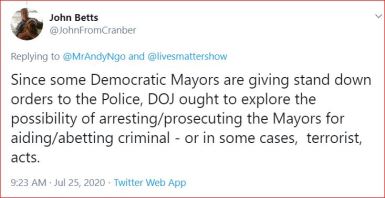
..........
Above, 7/25/20, JohnFromCanber twitter
.............
“Rioters are using a circle saw to cut apart the fence protecting the federal courthouse. Video by @livesmattershow #PortlandRiots”

Above, July 25, 2020, “Rioters are using a circle saw to cut apart the fence protecting the federal courthouse. Video by @livesmattershow #PortlandRiots. MrAndyNgo twitter
……….
Among comments to above from Andy Ngo:
“Since some Democratic Mayors are giving stand down orders to the Police, DOJ ought to explore the possibility of arresting/prosecuting the Mayors for aiding/abetting criminal-or in some cases, terrorist, acts.” [But everyone knows they won’t which is why this is happening to begin with. ed.]

..........
Above, 7/25/20, JohnFromCanber twitter
.............
Rest well, Lloyd Marcus, the ‘Unhyphenated American’
.
7/25/20, “The ‘Unhyphenated American’ is gone," American Thinker, JR Dunn
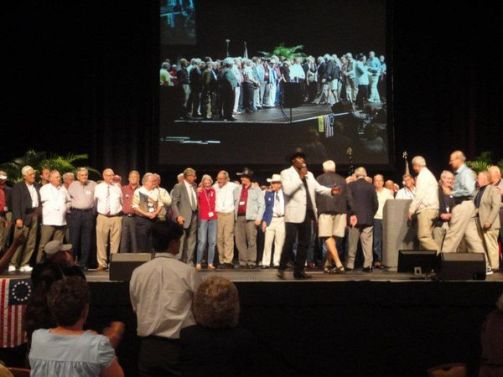
[Image: Nov. 2011, Florida State Tea Party Convention, “The great Lloyd Marcus with those who served,” image from Pamela Geller, her article, 11/6/2011, “What Really Happened at the Florida State Tea Party Convention,” Pamela Geller, Atlas Shrugs, link appears to be inactive, but I posted Pamela’s article and photos on one of my blogs for those interested., “Pictures from wonderful Florida State Tea Party Convention, sorry to disappoint doomsday media and GOP ‘consultants,’ Nov. 5, Daytona, Fla.”]
“AT readers will be shocked to learn of the passing of Lloyd Marcus, Tea Party icon, prolific AT contributor, and conservative activist extraordinaire. Lloyd proudly called himself “the unhyphenated American.”
Lloyd suffered an apparent heart attack early Friday, dying before medical assistance could arrive. His beloved wife Mary was at his side at the time.
Lloyd worked his way out of a ghetto background under the guidance of his father, the late Rev. Lloyd E. Marcus, a career firefighter and civil rights pioneer. Showing a talent for art at an early age, Lloyd gained a scholarship to the Maryland Institute College of Art, though he left before graduating. After a two-year stint in the Army, Lloyd returned to Baltimore to renew his artistic career. Working as a graphic designer for a Baltimore TV station, he established a close relationship with a young talk show host named Oprah Winfrey, with whom he worked closely as her career began to take off.
Early in the 1990s, Lloyd quit television and spent a decade working as musician, singer-songwriter, and music producer. He was also active in the local community, and after he organized a National Night Out to combat local crime, the Deltona, Florida mayor, John Masiarczyk, asked him to lend his talents to the new Deltona Arts and Historical Center. Lloyd worked with the center for several years, finally rising to the office of president.
But it was as an outspoken black conservative that Lloyd made his mark. Steadied by his heartfelt Christian convictions, Lloyd found the hard and lonely path of the black Republican to be no overwhelming challenge. Though dismissed and insulted as an “Uncle Tom,” Lloyd never once revealed a sliver of doubt about his convictions.
The Tea Party movement was Lloyd’s moment. He soon established himself as one of the most energetic and dynamic of all Tea Party activists, appearing at rallies and gatherings across the country. He performed his “Tea Party Anthem” for hundreds of audiences. Lloyd performed and spoke in support of dozens of conservative candidates across the country in repeated elections alongside fellow members of the Conservative Campaign Committee. His last such tour occurred just weeks ago, supporting campaigns by GOP candidates in Nevada and Arizona. He looked forward to yet more campaigning this summer to assure the re-election of Donald Trump. He put major effort into producing his “Trump Train” video in support of the president’s candidacy.
Lloyd’s career as a writer for AT began in 2008. He was one of AT’s most prolific contributors, occasionally writing three or more essays a week, with nearly a thousand pieces to his credit. Lloyd’s straightforward tone and non-nonsense attitude were extremely popular among readers, who also treasured his memories of the old Baltimore, particularly the stories involving his father, the man who broke the color barrier in the Baltimore Fire Department.
Lloyd’s final contribution to AT was published only this past Thursday. It is hard to believe that we will see no more of them. The man in the black hat has completed his task. It remains for us to carry it on.” image below from AT

....................
7/25/20, “The ‘Unhyphenated American’ is gone," American Thinker, JR Dunn
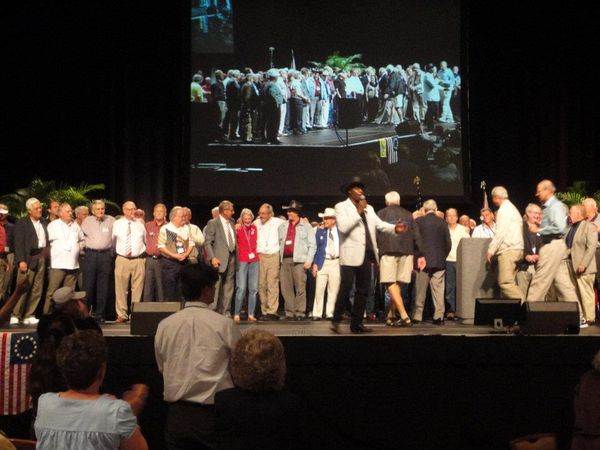
[Image: Nov. 2011, Florida State Tea Party Convention, “The great Lloyd Marcus with those who served,” image from Pamela Geller, her article, 11/6/2011, “What Really Happened at the Florida State Tea Party Convention,” Pamela Geller, Atlas Shrugs, link appears to be inactive, but I posted Pamela’s article and photos on one of my blogs for those interested., “Pictures from wonderful Florida State Tea Party Convention, sorry to disappoint doomsday media and GOP ‘consultants,’ Nov. 5, Daytona, Fla.”]
“AT readers will be shocked to learn of the passing of Lloyd Marcus, Tea Party icon, prolific AT contributor, and conservative activist extraordinaire. Lloyd proudly called himself “the unhyphenated American.”
Lloyd suffered an apparent heart attack early Friday, dying before medical assistance could arrive. His beloved wife Mary was at his side at the time.
Lloyd worked his way out of a ghetto background under the guidance of his father, the late Rev. Lloyd E. Marcus, a career firefighter and civil rights pioneer. Showing a talent for art at an early age, Lloyd gained a scholarship to the Maryland Institute College of Art, though he left before graduating. After a two-year stint in the Army, Lloyd returned to Baltimore to renew his artistic career. Working as a graphic designer for a Baltimore TV station, he established a close relationship with a young talk show host named Oprah Winfrey, with whom he worked closely as her career began to take off.
Early in the 1990s, Lloyd quit television and spent a decade working as musician, singer-songwriter, and music producer. He was also active in the local community, and after he organized a National Night Out to combat local crime, the Deltona, Florida mayor, John Masiarczyk, asked him to lend his talents to the new Deltona Arts and Historical Center. Lloyd worked with the center for several years, finally rising to the office of president.
But it was as an outspoken black conservative that Lloyd made his mark. Steadied by his heartfelt Christian convictions, Lloyd found the hard and lonely path of the black Republican to be no overwhelming challenge. Though dismissed and insulted as an “Uncle Tom,” Lloyd never once revealed a sliver of doubt about his convictions.
The Tea Party movement was Lloyd’s moment. He soon established himself as one of the most energetic and dynamic of all Tea Party activists, appearing at rallies and gatherings across the country. He performed his “Tea Party Anthem” for hundreds of audiences. Lloyd performed and spoke in support of dozens of conservative candidates across the country in repeated elections alongside fellow members of the Conservative Campaign Committee. His last such tour occurred just weeks ago, supporting campaigns by GOP candidates in Nevada and Arizona. He looked forward to yet more campaigning this summer to assure the re-election of Donald Trump. He put major effort into producing his “Trump Train” video in support of the president’s candidacy.
Lloyd’s career as a writer for AT began in 2008. He was one of AT’s most prolific contributors, occasionally writing three or more essays a week, with nearly a thousand pieces to his credit. Lloyd’s straightforward tone and non-nonsense attitude were extremely popular among readers, who also treasured his memories of the old Baltimore, particularly the stories involving his father, the man who broke the color barrier in the Baltimore Fire Department.
Lloyd’s final contribution to AT was published only this past Thursday. It is hard to believe that we will see no more of them. The man in the black hat has completed his task. It remains for us to carry it on.” image below from AT
....................
Contrary to popular belief, the British Empire, not the US, took control after WWII and remains in charge today. Kissinger, knighted by the Queen in 1995, bragged that he kept the British Foreign Office more informed than the US State Dept.-Matthew Ehret, 8/17/2019
.
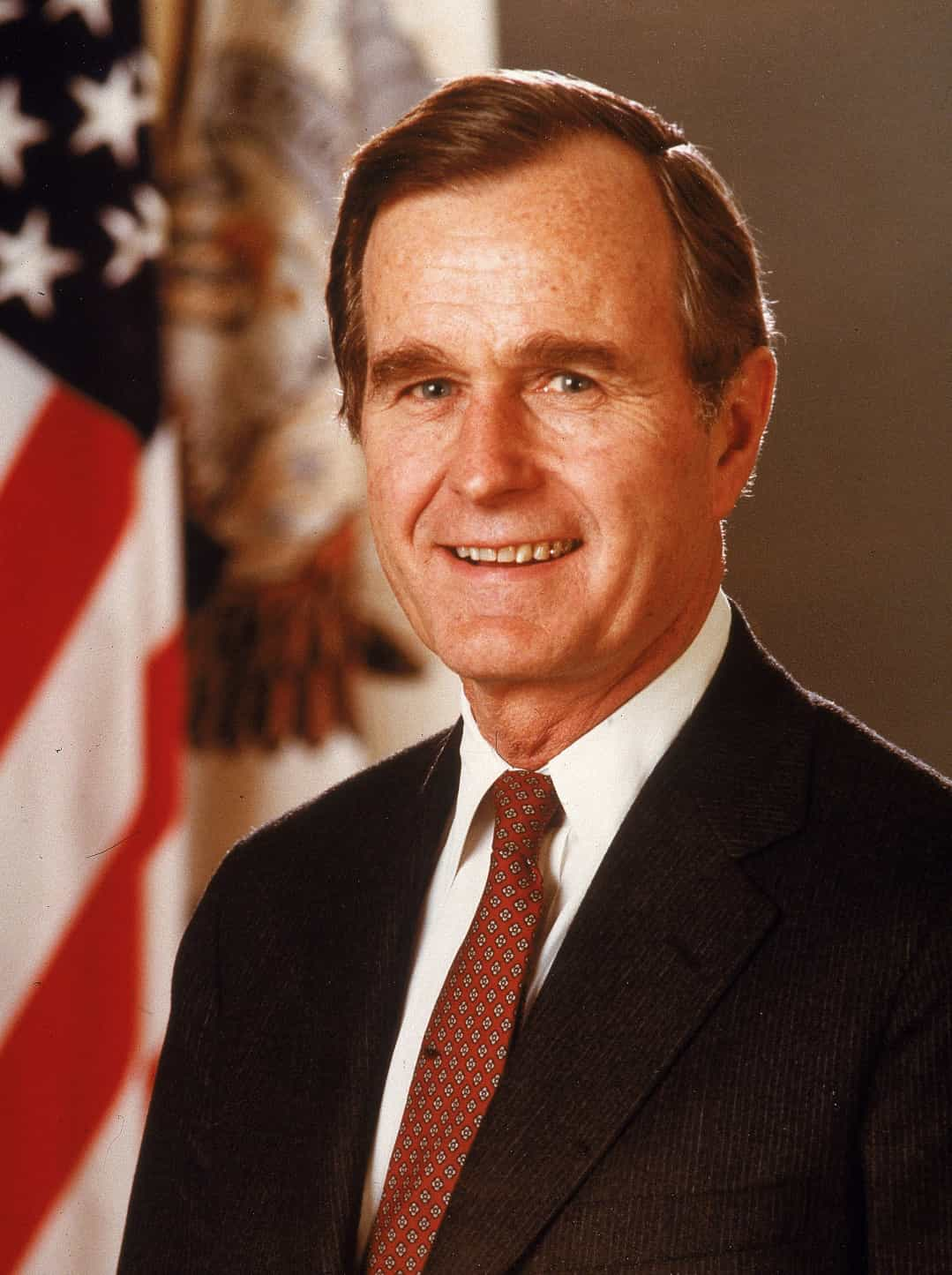
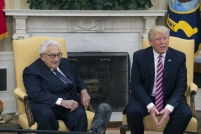 “The New World Order was announced by Bush Sr. and Kissinger– both of whom were rewarded with knighthoods for their service to the Crown in 1992 and 1995 respectively.” In 1993 former Pres. George H. W. Bush was made a Knight Grand Cross of the Most Honorable Order of the Bath–or GCB-the highest honorary rank Britain can give a foreigner. Reagan had received the same “honor” in 1989. In 1995 Kissinger was knighted by the Queen “in recognition of Kissinger’s contribution to Anglo- American relations.”…"Because Kissinger is an American he did not have to kneel and be tapped on the shoulders by the monarch.” image with Trump, 5/17, upi
 8/17/2019, “The Anglo-American Origins of Color Revolutions and NED [National Endowment for Democracy],” Matthew Ehret, Strategic Culture
“A few years ago, very few people understood the concept behind color revolutions.
Had Russia and China’s leadership not decided to unite in solidarity in 2012 when they began vetoing the overthrow of Bashar al Assad in Syria– followed by their alliance around the Belt and Road Initiative, then it is doubtful that the color revolution concept would be as well-known as it has become today.
At that time [2012], Russia and China realized that they had no choice but to go on the counter offensive, since the regime change operations and colour revolutions orchestrated by such organizations as the CIA-affiliated National Endowment for Democracy (NED) and Soros Open Society Foundations were ultimately designed to target them as those rose, orange, green or yellow revolution efforts in Georgia, Ukraine, Iran or Hong Kong were always recognized as weak points on the periphery of the threatened formation of a great power alliance of sovereign Eurasian nations that would have the collective power to challenge the power of the Anglo-American elite based in London and Wall Street.
Russia’s 2015 expulsion of 12 major conduits of color revolution included Soros’ Open Society Foundation as well as the NED [yet in 2018 NED spent $6,347,976 million on the ground in Russia working to sow discord, and has continued through 2019] was a powerful calling out of the enemy with the Foreign Ministry calling them “a threat to the foundations of Russia’s Constitutional order and national security”. This resulted in such fanatical calls by George Soros for a $50 billion fund to counteract Russia’s interference in defense of Ukraine’s [still 80-85% owned by Ukraine oligarchs as of 2015] democracy. Apparently the $5 billion spent by the NED in [bloody overthrow of] Ukraine was not nearly enough (1).
In spite of the light falling upon these cockroaches, NED and Open Society operations continued in full force focusing on the weakest links the Grand Chessboard unleashing what has become known as a “strategy of tension”. Venezuela, Kashmir, Hong Kong, Tibet and Xinjian (dubbed East Turkistan by NED) have all been targeted in recent years with millions of NED dollars pouring into separatist groups, labour unions, student movements and fake news “opinion shapers” under the guise of “democracy building”. $1.7 million in grants was spent by NED in Hong Kong since 2017 which was a significant increase from their $400 000 spent to coordinate the failed “Occupy HK” protest in 2014.
The Case of China
In response to over two months of controlled chaos, the Chinese government has kept a remarkably restrained posture, allowing the Hong Kong authorities to manage the situation with their police deprived of use of lethal weapons and even giving into the protestors’ demand that the changes to the extradition treaty that nominally sparked this mess be annulled. In spite of this patient tone, the rioters who have run havoc on airports and public buildings have created lists of demands that are all but impossible for mainland China to meet including 1) an “independent committee to investigate the abuses of Chinese authorities”, 2) for China to stop referring to rioters as “rioters”, 3) for all charges against rioters to be dropped, and 4) universal suffrage- including candidates promoting independence or rejoining the British Empire.
As violence continues to grow, and as it has become an increasing reality that some form of intervention from the mainland may occur to restore order,the British Foreign Office has taken an aggressive tone threatening China with “severe consequences” unless “a fully independent investigation” into police Brutality were permitted. The former Colonial Governor of China Christopher Patten attacked China by saying “Since president Xi has been in office, there’s been a crackdown on dissent and dissidents everywhere, the party has been in control of everything.”
The Chinese Foreign Ministry responded saying “the UK has no sovereign jurisdiction or right of supervision over Hong Kong… it is simply wrong for the British Government to exert pressure. The Chinese side seriously urges the UK to stop its interference in China’s internal affairs and stop making random and inflammatory accusations on Hong Kong.”
The British have not been able to conduct their manipulation of Hong Kong without the vital role of America’s NGO dirty ops, and in true imperial fashion, the political class from both sides of the aisle have attacked China with Senate Majority leader Mitch McConnell and Nancy Pelosi making the loudest noise driving the American House Foreign Affairs Committee to threaten “universal condemnation and swift consequences” if Beijing intervenes. This has only made the photographs of Julie Eadeh, the head of Political Office at the American Consulate in Hong Kong meeting with leaders of the Hong Kong demonstrations that much more disgusting to any onlooker.
While both Britain and America have been caught red handed organizing this colour revolution, it is important to keep in mind who is controlling who.
The Foreign Origins of the NED
Contrary to popular opinion, the British Empire did not go away after WWII, nor did it hand over the “keys to the kingdom” to America. It didn’t even become America’s Junior Partner in a new Anglo-American special relationship. Contrary to popular belief, it stayed in the drivers’ seat.
The post WWII order was largely shaped by a British coup which didn’t take over America without a fight. Nests of Oxford-trained Rhodes Scholars, Fabians and other ideologues embedded within the American establishment had a lot of work ahead of them as they struggled to purge all nationalist impulses from the American intelligence community. While the most aggressive purging of patriotic Americans from the intelligence community occurred during the dissolution of the OSS and creation of CIA in 1947 and the Communist witch hunt that followed, there were other purges that were less well known.
As an organization which was beginning to take form which was to become known as the Trilateral Commission organized by Britain’s “hand in America” called the Council on Foreign Relations and international Bilderberg Group, another purge occurred in 1970 under the direction of James Schlesinger during his six month stint as CIA director. At that time 1000 top CIA officials deemed “unfit” were fired. This was followed nine years later [1979] as another 800 were fired under a list drafted by CIA “spymaster” Ted Shackley. Both Schlesinger and Shackley were high level Trilateral Commission members who took part in the group’s 1973 formation and fully took power of America during Jimmy Carter’s 1977-1981 presidency which unleashed a dystopian reorganization of American foreign and internal policy outlined in my previous report.
Project Democracy Takes Over
By the 1970s, the CIA’s dirty hand funding anarchist operations both within America and abroad had become too well known as media coverage of their dirty operations at home and abroad spoiled the patriotic image which the intelligence community then desired. While the internal resistance to fascist behaviour from within the intelligence Community itself was dealt with through purges, the reality was that a new agency had to be created to take over those functions of covert destabilization of foreign governments.
What became Project Democracy herein originated with a Trilateral Commission meeting in May 31, 1975 in Kyoto Japan as a protégé of Trilateral Commission director Zbigniew Brzezinski named Samuel (Clash of Civilizations) Huntington delivered the results of his Task Force on the Governability of Democracies. This project was supervised by Schlesinger and Brzezinski and presented the notion that democracies could not function adequately in the crisis conditions which the Trilateral Commission was preparing to impose onto America and the world through a process dubbed “the Controlled Disintegration of Society”.
The Huntington report featured at the Trilateral meeting stated: “One might consider…means of securing support and resources from foundations, business corporations, labor unions, political parties, civic associations, and, where possible and appropriate, governmental agencies for the creation of an institute for the strengthening of democratic institutions.”
It took 4 years for this blueprint to become reality. In 1979 three Trilateral Commission members named William Brock (RNC Chairman), Charles Manatt (DNC Chairman) and George Agree (head of Freedom House) established an organization called the American Political Foundation (APF) which attempted to fulfill the objective laid out by Huntington in 1975.
The APF was used to set up a program using federal funds called the Democracy Program which issued an interim report “The Commitment to Democracy” which said: “No theme requires more sustained attention in our time than the necessity for strengthening the future chances of democratic societies in a world that remains predominantly unfree or partially fettered by repressive governments.…There has never been a comprehensive structure for a non-governmental effort through which the resources of America’s pluralistic constituencies…could be mobilized effectively.”
In May 1981, Henry Kissinger who had replaced Brzezinski as head of the Trilateral Commission and had many operatives planted around President Reagan, gave a speech at Britain’s Chatham House (the controlling hand behind the Council on Foreign Relations) where he described his work as Secretary of State saying that the British “became a participant in internal American deliberations, to a degree probably never practiced between sovereign nations… In my White House incarnation then, I kept the British Foreign Office better informed and more closely engaged than I did the American State Department…It was symptomatic”. In his speech, Kissinger outlined the battle between Churchill vs FDR during WWII and made the point that he favored the Churchill worldview for the post war world (And ironically also that of Prince Metternich who ran the Congress of Vienna that snuffed out democratic movements across Europe in 1815).
In June 1982, Reagan’s Westminster Palace speech officially inaugurated the NED and by November 1983, the National Endowment for Democracy Act was passed bringing this new covert organization into reality with $31 million of [US taxpayer] funding under four subsidiary organizations (AFL-CIO Free Trade Union Institute, The US Chamber of Commerce’s Center for International Private Enterprise, the International Republican Institute and the International Democratic Institute) (2).
Throughout the 1980s, this organization went to work managing Iran-Contra, destabilizing Soviet states and unleashing the first “official” modern color revolution in the form of the Yellow revolution that ousted Philippine president Ferdinand Marcos. Speaking more candidly than usual, NED [acting] President David Ignatius said in 1991 “a lot of what we do today was done covertly 25 years ago by the CIA.”
With the collapse of the Soviet Union, the NED was instrumental in bringing former Warsaw Pact nations into NATO/WTO system and the New World Order was announced by Bush Sr. and Kissinger- both of whom were rewarded with knighthoods for their service to the Crown in 1992 and 1995 respectively.
Of course, the vast web of NGOs permeating the geopolitical terrain can only be effective as long as no one says the truth and “names the game”. The very act of calling out their nefarious motives renders them impotent and this simple fact has made the recently announced China-Russia arrangement to formulate a proper strategic response to color revolutions so important in the current fight.”
___________________________
“(1) Undoubtedly President Trump’s gutting of NED funding by two thirds in 2018 only re-enforced Soros’ accusations that Putin is the guiding hand in America while pouring millions into anti-Trump regime change operations in America. While neocons such as Bolton, Pompeo and Senate leader Mitch Mcconnell have taken a hardline stance against China in support of the color revolution, it should be noted that Trump has continuously taken an opposite line Tweeting on August 14 [2019] that “China is not our problem” and that “the problem is with the FED.” [Sadly, both Jared and Trump are deeply indebted to Soros. In 2015 Jared’s business accepted a $250 million line of credit from Soros who is also an investor in Jared’s company. Trump himself is indebted to Soros because in 2004, Soros loaned him $160 million to build his Chicago hotel. “Trump Adviser Kushner’s Undisclosed Partners Include Goldman and Soros,” Wall St. Journal, May 3, 2017, Jean Eaglesham, Juliet Chung, Lisa Schwartz]
(2) At the beginning of 1984, a similar re-organization had occurred in Canada under the guidance of Privy Council Clerk/Trilateral Commission member Michael Pitfield who created CSIS when the RCMP’s “dirty operations” during the FLQ crisis were made known in a series of newspaper reports.”
…………………………………..
Added: In 1995 Kissinger was knighted by the Queen “in recognition of Kissinger’s contribution to Anglo- American relations.”…"Because Kissinger is an American he did not have to kneel and be tapped on the shoulders by the monarch.”
June 20, 1995, “Henry Kissinger Knighted," AP, London
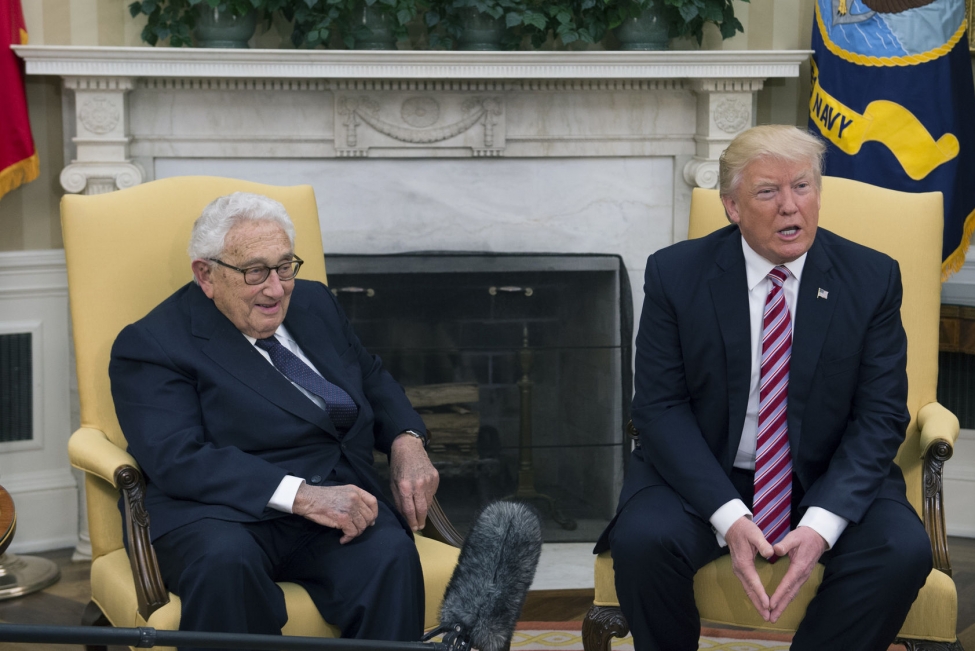 “The New World Order was announced by Bush Sr. and Kissinger– both of whom were rewarded with knighthoods for their service to the Crown in 1992 and 1995 respectively.” In 1993 former Pres. George H. W. Bush was made a Knight Grand Cross of the Most Honorable Order of the Bath–or GCB-the highest honorary rank Britain can give a foreigner. Reagan had received the same “honor” in 1989. In 1995 Kissinger was knighted by the Queen “in recognition of Kissinger’s contribution to Anglo- American relations.”…"Because Kissinger is an American he did not have to kneel and be tapped on the shoulders by the monarch.” image with Trump, 5/17, upi
 8/17/2019, “The Anglo-American Origins of Color Revolutions and NED [National Endowment for Democracy],” Matthew Ehret, Strategic Culture
 “A few years ago, very few people understood the concept behind color revolutions.
Had Russia and China’s leadership not decided to unite in solidarity in 2012 when they began vetoing the overthrow of Bashar al Assad in Syria– followed by their alliance around the Belt and Road Initiative, then it is doubtful that the color revolution concept would be as well-known as it has become today.
At that time [2012], Russia and China realized that they had no choice but to go on the counter offensive, since the regime change operations and colour revolutions orchestrated by such organizations as the CIA-affiliated National Endowment for Democracy (NED) and Soros Open Society Foundations were ultimately designed to target them as those rose, orange, green or yellow revolution efforts in Georgia, Ukraine, Iran or Hong Kong were always recognized as weak points on the periphery of the threatened formation of a great power alliance of sovereign Eurasian nations that would have the collective power to challenge the power of the Anglo-American elite based in London and Wall Street.
Russia’s 2015 expulsion of 12 major conduits of color revolution included Soros’ Open Society Foundation as well as the NED [yet in 2018 NED spent $6,347,976 million on the ground in Russia working to sow discord, and has continued through 2019] was a powerful calling out of the enemy with the Foreign Ministry calling them “a threat to the foundations of Russia’s Constitutional order and national security”. This resulted in such fanatical calls by George Soros for a $50 billion fund to counteract Russia’s interference in defense of Ukraine’s [still 80-85% owned by Ukraine oligarchs as of 2015] democracy. Apparently the $5 billion spent by the NED in [bloody overthrow of] Ukraine was not nearly enough (1).
In spite of the light falling upon these cockroaches, NED and Open Society operations continued in full force focusing on the weakest links the Grand Chessboard unleashing what has become known as a “strategy of tension”. Venezuela, Kashmir, Hong Kong, Tibet and Xinjian (dubbed East Turkistan by NED) have all been targeted in recent years with millions of NED dollars pouring into separatist groups, labour unions, student movements and fake news “opinion shapers” under the guise of “democracy building”. $1.7 million in grants was spent by NED in Hong Kong since 2017 which was a significant increase from their $400 000 spent to coordinate the failed “Occupy HK” protest in 2014.
The Case of China
In response to over two months of controlled chaos, the Chinese government has kept a remarkably restrained posture, allowing the Hong Kong authorities to manage the situation with their police deprived of use of lethal weapons and even giving into the protestors’ demand that the changes to the extradition treaty that nominally sparked this mess be annulled. In spite of this patient tone, the rioters who have run havoc on airports and public buildings have created lists of demands that are all but impossible for mainland China to meet including 1) an “independent committee to investigate the abuses of Chinese authorities”, 2) for China to stop referring to rioters as “rioters”, 3) for all charges against rioters to be dropped, and 4) universal suffrage- including candidates promoting independence or rejoining the British Empire.
As violence continues to grow, and as it has become an increasing reality that some form of intervention from the mainland may occur to restore order,the British Foreign Office has taken an aggressive tone threatening China with “severe consequences” unless “a fully independent investigation” into police Brutality were permitted. The former Colonial Governor of China Christopher Patten attacked China by saying “Since president Xi has been in office, there’s been a crackdown on dissent and dissidents everywhere, the party has been in control of everything.”
The Chinese Foreign Ministry responded saying “the UK has no sovereign jurisdiction or right of supervision over Hong Kong… it is simply wrong for the British Government to exert pressure. The Chinese side seriously urges the UK to stop its interference in China’s internal affairs and stop making random and inflammatory accusations on Hong Kong.”
The British have not been able to conduct their manipulation of Hong Kong without the vital role of America’s NGO dirty ops, and in true imperial fashion, the political class from both sides of the aisle have attacked China with Senate Majority leader Mitch McConnell and Nancy Pelosi making the loudest noise driving the American House Foreign Affairs Committee to threaten “universal condemnation and swift consequences” if Beijing intervenes. This has only made the photographs of Julie Eadeh, the head of Political Office at the American Consulate in Hong Kong meeting with leaders of the Hong Kong demonstrations that much more disgusting to any onlooker.
While both Britain and America have been caught red handed organizing this colour revolution, it is important to keep in mind who is controlling who.
The Foreign Origins of the NED
Contrary to popular opinion, the British Empire did not go away after WWII, nor did it hand over the “keys to the kingdom” to America. It didn’t even become America’s Junior Partner in a new Anglo-American special relationship. Contrary to popular belief, it stayed in the drivers’ seat.
The post WWII order was largely shaped by a British coup which didn’t take over America without a fight. Nests of Oxford-trained Rhodes Scholars, Fabians and other ideologues embedded within the American establishment had a lot of work ahead of them as they struggled to purge all nationalist impulses from the American intelligence community. While the most aggressive purging of patriotic Americans from the intelligence community occurred during the dissolution of the OSS and creation of CIA in 1947 and the Communist witch hunt that followed, there were other purges that were less well known.
As an organization which was beginning to take form which was to become known as the Trilateral Commission organized by Britain’s “hand in America” called the Council on Foreign Relations and international Bilderberg Group, another purge occurred in 1970 under the direction of James Schlesinger during his six month stint as CIA director. At that time 1000 top CIA officials deemed “unfit” were fired. This was followed nine years later [1979] as another 800 were fired under a list drafted by CIA “spymaster” Ted Shackley. Both Schlesinger and Shackley were high level Trilateral Commission members who took part in the group’s 1973 formation and fully took power of America during Jimmy Carter’s 1977-1981 presidency which unleashed a dystopian reorganization of American foreign and internal policy outlined in my previous report.
Project Democracy Takes Over
By the 1970s, the CIA’s dirty hand funding anarchist operations both within America and abroad had become too well known as media coverage of their dirty operations at home and abroad spoiled the patriotic image which the intelligence community then desired. While the internal resistance to fascist behaviour from within the intelligence Community itself was dealt with through purges, the reality was that a new agency had to be created to take over those functions of covert destabilization of foreign governments.
What became Project Democracy herein originated with a Trilateral Commission meeting in May 31, 1975 in Kyoto Japan as a protégé of Trilateral Commission director Zbigniew Brzezinski named Samuel (Clash of Civilizations) Huntington delivered the results of his Task Force on the Governability of Democracies. This project was supervised by Schlesinger and Brzezinski and presented the notion that democracies could not function adequately in the crisis conditions which the Trilateral Commission was preparing to impose onto America and the world through a process dubbed “the Controlled Disintegration of Society”.
The Huntington report featured at the Trilateral meeting stated: “One might consider…means of securing support and resources from foundations, business corporations, labor unions, political parties, civic associations, and, where possible and appropriate, governmental agencies for the creation of an institute for the strengthening of democratic institutions.”
It took 4 years for this blueprint to become reality. In 1979 three Trilateral Commission members named William Brock (RNC Chairman), Charles Manatt (DNC Chairman) and George Agree (head of Freedom House) established an organization called the American Political Foundation (APF) which attempted to fulfill the objective laid out by Huntington in 1975.
The APF was used to set up a program using federal funds called the Democracy Program which issued an interim report “The Commitment to Democracy” which said: “No theme requires more sustained attention in our time than the necessity for strengthening the future chances of democratic societies in a world that remains predominantly unfree or partially fettered by repressive governments.…There has never been a comprehensive structure for a non-governmental effort through which the resources of America’s pluralistic constituencies…could be mobilized effectively.”
In May 1981, Henry Kissinger who had replaced Brzezinski as head of the Trilateral Commission and had many operatives planted around President Reagan, gave a speech at Britain’s Chatham House (the controlling hand behind the Council on Foreign Relations) where he described his work as Secretary of State saying that the British “became a participant in internal American deliberations, to a degree probably never practiced between sovereign nations… In my White House incarnation then, I kept the British Foreign Office better informed and more closely engaged than I did the American State Department…It was symptomatic”. In his speech, Kissinger outlined the battle between Churchill vs FDR during WWII and made the point that he favored the Churchill worldview for the post war world (And ironically also that of Prince Metternich who ran the Congress of Vienna that snuffed out democratic movements across Europe in 1815).
In June 1982, Reagan’s Westminster Palace speech officially inaugurated the NED and by November 1983, the National Endowment for Democracy Act was passed bringing this new covert organization into reality with $31 million of [US taxpayer] funding under four subsidiary organizations (AFL-CIO Free Trade Union Institute, The US Chamber of Commerce’s Center for International Private Enterprise, the International Republican Institute and the International Democratic Institute) (2).
Throughout the 1980s, this organization went to work managing Iran-Contra, destabilizing Soviet states and unleashing the first “official” modern color revolution in the form of the Yellow revolution that ousted Philippine president Ferdinand Marcos. Speaking more candidly than usual, NED [acting] President David Ignatius said in 1991 “a lot of what we do today was done covertly 25 years ago by the CIA.”
With the collapse of the Soviet Union, the NED was instrumental in bringing former Warsaw Pact nations into NATO/WTO system and the New World Order was announced by Bush Sr. and Kissinger- both of whom were rewarded with knighthoods for their service to the Crown in 1992 and 1995 respectively.
Of course, the vast web of NGOs permeating the geopolitical terrain can only be effective as long as no one says the truth and “names the game”. The very act of calling out their nefarious motives renders them impotent and this simple fact has made the recently announced China-Russia arrangement to formulate a proper strategic response to color revolutions so important in the current fight.”
___________________________
“(1) Undoubtedly President Trump’s gutting of NED funding by two thirds in 2018 only re-enforced Soros’ accusations that Putin is the guiding hand in America while pouring millions into anti-Trump regime change operations in America. While neocons such as Bolton, Pompeo and Senate leader Mitch Mcconnell have taken a hardline stance against China in support of the color revolution, it should be noted that Trump has continuously taken an opposite line Tweeting on August 14 [2019] that “China is not our problem” and that “the problem is with the FED.” [Sadly, both Jared and Trump are deeply indebted to Soros. In 2015 Jared’s business accepted a $250 million line of credit from Soros who is also an investor in Jared’s company. Trump himself is indebted to Soros because in 2004, Soros loaned him $160 million to build his Chicago hotel. “Trump Adviser Kushner’s Undisclosed Partners Include Goldman and Soros,” Wall St. Journal, May 3, 2017, Jean Eaglesham, Juliet Chung, Lisa Schwartz]
(2) At the beginning of 1984, a similar re-organization had occurred in Canada under the guidance of Privy Council Clerk/Trilateral Commission member Michael Pitfield who created CSIS when the RCMP’s “dirty operations” during the FLQ crisis were made known in a series of newspaper reports.”
…………………………………..
Added: In 1995 Kissinger was knighted by the Queen “in recognition of Kissinger’s contribution to Anglo- American relations.”…"Because Kissinger is an American he did not have to kneel and be tapped on the shoulders by the monarch.”
June 20, 1995, “Henry Kissinger Knighted," AP, London
“Former U.S. Secretary of State Henry Kissinger received an honorary knighthood Tuesday from Queen Elizabeth II.
In a private ceremony at Windsor Castle, Kissinger became an Honorary Knight Commander of the Most Honorable Order of St. Michael and St. George, a distinction given for achievement in foreign affairs.
Because Kissinger is an American he did not have to kneel and be tapped on the shoulders by the monarch,
and for the same reason he is not entitled to use “sir″ as a title.
Foreigners may use the initials of their honor after their names.
Kissinger later rode in the queen’s lead carriage to the Royal Ascot horse races, one of the most colorful events in the royal calendar.”
...........
Subscribe to:
Posts (Atom)