
.
Media was furious at Dr. King for his April 4, 1967 anti war speech:
“Time magazine called the speech “demagogic slander that sounded like a script for Radio Hanoi.”
The Washington Post wrote that King had “diminished his usefulness to his cause, his country, his people.””…
On April 4, 1967, Dr. Martin Luther King Jr. gave his famous speech at Riverside Cathedral in NY City urging an immediate end to US government’s war in Vietnam, and accurately calling the United States “the greatest purveyor of violence in the world today.”…Exactly one year later, April 4, 1968, Dr. King was murdered. He was only 39....On April 15, 1967, he had led an antiwar march from Central Park to the United Nations.
“President Johnson let it be known that the FBI is closely watching all anti-war activity,” @2:00…

(Above, You Tube, @ 1:05, 4/18/1967, Universal Newsreels)
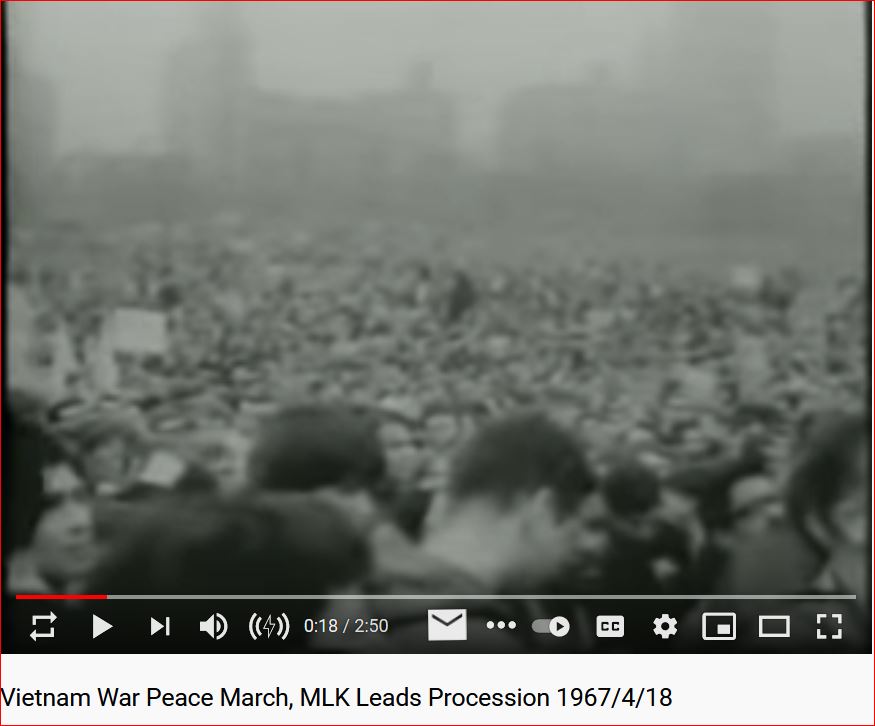
(Above, You Tube, @ 1:05, 4/18/1967, Universal Newsreels)
He had been awarded the Nobel Peace Prize in 1964.
 Image: 4/4/1968, Body of Dr. King lays dead on balcony of Lorraine Motel, Memphis, Tennessee. From video taken by Joseph Louw, the only photographer present at the time.
……………………………………………….
Added: Posted below, text of Dr. King’s April 4, 1967 anti-war speech at Riverside Church, in which he said the United States was “the greatest purveyor of violence in the world today.”…
“By 1967, King had become the country’s most prominent opponent of the Vietnam War,
and a staunch critic of overall U.S. foreign policy,
which he deemed militaristic.”
He delivered his “Beyond Vietnam” speech at New York’s Riverside Church on April 4, 1967. Exactly one year later, on April 4, 1968, Dr. King was murdered.

4/4/1968, Lorraine Motel, Memphis, Tennessee: “Civil rights leader Andrew Young and others on balcony of Lorraine motel pointing in direction of assailant after assassination of Dr. Martin Luther King, Jr., who is lying mortally wounded at their feet. Joseph Louw—The LIFE Images Collection/Getty Images”
……………………………
April 4, 1967, New York City, Dr. King’s speech:
“Beyond Vietnam: A Time to Break Silence,“ Martin Luther King, Jr.
“I come to this magnificent house of worship tonight because my conscience leaves me no other choice. I join with you in this meeting because I am in deepest agreement with the aims and work of the organization which has brought us together: Clergy and Laymen Concerned about Vietnam. The recent statement of your executive committee are the sentiments of my own heart and I found myself in full accord when I read its opening lines: “A time comes when silence is betrayal.” That time has come for us in relation to Vietnam.
The truth of these words is beyond doubt but the mission to which they call us is a most difficult one. Even when pressed by the demands of inner truth, men do not easily assume the task of opposing their government’s policy, especially in time of war. Nor does the human spirit move without great difficulty against all the apathy of conformist thought within one’s own bosom and in the surrounding world. Moreover when the issues at hand seem as perplexed as they often do in the case of this dreadful conflict we are always on the verge of being mesmerized by uncertainty; but we must move on.
Some of us who have already begun to break the silence of the night have found that the calling to speak is often a vocation of agony, but we must speak. We must speak with all the humility that is appropriate to our limited vision, but we must speak. And we must rejoice as well, for surely this is the first time in our nation’s history that a significant number of its religious leaders have chosen to move beyond the prophesying of smooth patriotism to the high grounds of a firm dissent based upon the mandates of conscience and the reading of history. Perhaps a new spirit is rising among us. If it is, let us trace its movement well and pray that our own inner being may be sensitive to its guidance, for we are deeply in need of a new way beyond the darkness that seems so close around us.
Over the past two years, as I have moved to break the betrayal of my own silences and to speak from the burnings of my own heart, as I have called for radical departures from the destruction of Vietnam, many persons have questioned me about the wisdom of my path. At the heart of their concerns this query has often loomed large and loud: Why are you speaking about war, Dr. King? Why are you joining the voices of dissent?
Peace and civil rights don’t mix, they say.
Aren’t you hurting the cause of your people, they ask?
And when I hear them, though I often understand the source of their concern, I am nevertheless greatly saddened, for such questions mean that the inquirers have not really known me, my commitment or my calling. Indeed, their questions suggest that they do not know the world in which they live.
In the light of such tragic misunderstandings, I deem it of signal importance to try to state clearly, and I trust concisely, why I believe that the path from Dexter Avenue Baptist Church — the church in Montgomery, Alabama, where I began my pastorate — leads clearly to this sanctuary tonight.
I come to this platform tonight to make a passionate plea to my beloved nation. This speech is not addressed to Hanoi or to the National Liberation Front. It is not addressed to China or to Russia.
Nor is it an attempt to overlook the ambiguity of the total situation and the need for a collective solution to the tragedy of Vietnam. Neither is it an attempt to make North Vietnam or the National Liberation Front paragons of virtue, nor to overlook the role they can play in a successful resolution of the problem. While they both may have justifiable reason to be suspicious of the good faith of the United States, life and history give eloquent testimony to the fact that conflicts are never resolved without trustful give and take on both sides.
Tonight, however, I wish not to speak with Hanoi and the NLF,
but rather to my fellow Americans, who, with me,
bear the greatest responsibility in ending a conflict that has exacted a heavy price on both continents.
The Importance of Vietnam
Since I am a preacher by trade, I suppose it is not surprising that I have seven major reasons for bringing Vietnam into the field of my moral vision. There is at the outset a very obvious and almost facile connection between the war in Vietnam and the struggle I, and others, have been waging in America. A few years ago there was a shining moment in that struggle. It seemed as if there was a real promise of hope for the poor — both black and white — through the poverty program. There were experiments, hopes, new beginnings. Then came the buildup in Vietnam and I watched the program broken and eviscerated as if it were some idle political plaything of a society gone mad on war, and
I knew that America would never invest the necessary funds or energies in rehabilitation of its poor
so long as adventures like Vietnam continued to draw men and skills and money like some demonic destructive suction tube.
So I was increasingly compelled to see the war as an enemy of the poor and to attack it as such.
Perhaps the more tragic recognition of reality took place when it became clear to me that the war was doing far more than devastating the hopes of the poor at home. It was sending their sons and their brothers and their husbands
to fight and to die in extraordinarily high proportions
relative to the rest of the population.
We were taking the black young men who had been crippled by our society and sending them eight thousand miles away
to guarantee liberties in Southeast Asia which they had not found
in southwest Georgia and East Harlem.
So we have been repeatedly faced with the cruel irony of watching Negro and white boys on TV screens as they kill and die together for a nation that has been unable to seat them together in the same schools. So we watch them in brutal solidarity burning the huts of a poor village, but we realize that they would never live on the same block in Detroit. I could not be silent in the face of
such cruel manipulation of the poor.
My third reason moves to an even deeper level of awareness, for it grows out of
my experience in the ghettoes of the North over the last three years —
especially the last three summers. As I have walked
among the desperate, rejected and angry young men
I have told them that Molotov cocktails and rifles would not solve their problems. I have tried to offer them my deepest compassion while maintaining my conviction that social change comes most meaningfully through nonviolent action. But they asked — and rightly so — what about Vietnam?
They asked if our own nation wasn’t using massive doses of violence to solve its problems, to bring about the changes it wanted.
Their questions hit home, and I knew that I could never again raise my voice against the violence of the oppressed in the ghettos
without having first spoken clearly to the greatest purveyor of violence in the world today —
my own government. For the sake of those boys, for the sake of this government,
for the sake of hundreds of thousands trembling under our violence, I cannot be silent.
For those who ask the question, “Aren’t you a civil rights leader?” and thereby mean to exclude me from the movement for peace, I have this further answer. In 1957 when a group of us formed the Southern Christian Leadership Conference, we chose as our motto: “To save the soul of America.” We were convinced that we could not limit our vision to certain rights for black people, but instead affirmed the conviction that America would never be free or saved from itself unless the descendants of its slaves were loosed completely from the shackles they still wear. In a way we were agreeing with Langston Hughes, that black bard of Harlem, who had written earlier:
“O, yes, I say it plain, America never was America to me, And yet I swear this oath– America will be!”
Now, it should be incandescently clear that no one who has any concern for the integrity and life of America today can ignore the present war. If America’s soul becomes totally poisoned, part of the autopsy must read Vietnam. It can never be saved so long as it destroys the deepest hopes of men the world over. So it is that those of us who are yet determined that America will be are led down the path of protest and dissent, working for the health of our land.
As if the weight of such a commitment to the life and health of America were not enough, another burden of responsibility was placed upon me in 1964; and I cannot forget that the Nobel Prize for Peace was also a commission — a commission to work harder than I had ever worked before for “the brotherhood of man.” This is a calling that takes me beyond national allegiances, but even if it were not present I would yet have to live with the meaning of my commitment to the ministry of Jesus Christ. To me the relationship of this ministry to the making of peace is so obvious that I sometimes marvel at those who ask me why I am speaking against the war. Could it be that they do not know that the good news was meant for all men — for Communist and capitalist, for their children and ours, for black and for white, for revolutionary and conservative? Have they forgotten that my ministry is in obedience to the one who loved his enemies so fully that he died for them? What then can I say to the “Vietcong” or to Castro or to Mao as a faithful minister of this one? Can I threaten them with death or must I not share with them my life?
Finally, as I try to delineate for you and for myself the road that leads from Montgomery to this place I would have offered all that was most valid if I simply said that I must be true to my conviction that I share with all men the calling to be a son of the living God. Beyond the calling of race or nation or creed is this vocation of sonship and brotherhood, and because I believe that the Father is deeply concerned especially for his suffering and helpless and outcast children, I come tonight to speak for them.
This I believe to be the privilege and the burden of all of us who deem ourselves bound by allegiances and loyalties which are broader and deeper than nationalism and which go beyond our nation’s self-defined goals and positions. We are called to speak for the weak, for the voiceless, for victims of our nation and for those it calls enemy, for no document from human hands can make these humans any less our brothers.
Strange Liberators
And as I ponder the madness of Vietnam and search within myself for ways to understand and respond to compassion my mind goes constantly to the people of that peninsula. I speak now not of the soldiers of each side, not of the junta in Saigon, but simply of the people who have been living under the curse of war for almost three continuous decades now. I think of them too because it is clear to me that there will be no meaningful solution there until some attempt is made to know them and hear their broken cries.
They must see Americans as strange liberators. The Vietnamese people proclaimed their own independence in 1945 after a combined French and Japanese occupation, and before the Communist revolution in China. They were led by Ho Chi Minh. Even though they quoted the American Declaration of Independence in their own document of freedom, we refused to recognize them. Instead, we decided to support France in its reconquest of her former colony.
Our government felt then that the Vietnamese people were not “ready” for independence, and we again fell victim to the deadly Western arrogance that has poisoned the international atmosphere for so long. With that tragic decision we rejected a revolutionary government seeking self-determination, and a government that had been established not by China (for whom the Vietnamese have no great love) but by clearly indigenous forces that included some Communists. For the peasants this new government meant real land reform, one of the most important needs in their lives.
For nine years following 1945 we denied the people of Vietnam the right of independence. For nine years we vigorously supported the French in their abortive effort to recolonize Vietnam.
Before the end of the war we were meeting eighty percent of the French war costs. Even before the French were defeated at Dien Bien Phu, they began to despair of the reckless action, but we did not. We encouraged them with our huge financial and military supplies to continue the war even after they had lost the will. Soon we would be paying almost the full costs of this tragic attempt at recolonization.
After the French were defeated it looked as if independence and land reform would come again through the Geneva agreements. But instead there came the United States, determined that Ho should not unify the temporarily divided nation, and the peasants watched again as we supported one of the most vicious modern dictators — our chosen man, Premier Diem. The peasants watched and cringed as Diem ruthlessly routed out all opposition, supported their extortionist landlords and refused even to discuss reunification with the north. The peasants watched as all this was presided over by U.S. influence and then by increasing numbers of U.S. troops who came to help quell the insurgency that Diem’s methods had aroused. When Diem was overthrown they may have been happy, but the long line of military dictatorships seemed to offer no real change — especially in terms of their need for land and peace.
The only change came from America as we increased our troop commitments in support of governments which were singularly corrupt, inept and without popular support. All the while the people read our leaflets and received regular promises of peace and democracy — and land reform. Now they languish under our bombs and consider us — not their fellow Vietnamese –the real enemy. They move sadly and apathetically as we herd them off the land of their fathers into concentration camps where minimal social needs are rarely met. They know they must move or be destroyed by our bombs. So they go — primarily women and children and the aged.
They watch as we poison their water, as we kill a million acres of their crops. They must weep as the bulldozers roar through their areas preparing to destroy the precious trees. They wander into the hospitals, with at least twenty casualties from American firepower for one “Vietcong”-inflicted injury. So far we may have killed a million of them — mostly children. They wander into the towns and see thousands of the children, homeless, without clothes, running in packs on the streets like animals. They see the children, degraded by our soldiers as they beg for food. They see the children selling their sisters to our soldiers, soliciting for their mothers.
What do the peasants think as we ally ourselves with the landlords and as we refuse to put any action into our many words concerning land reform? What do they think as we test our latest weapons on them, just as the Germans tested out new medicine and new tortures in the concentration camps of Europe? Where are the roots of the independent Vietnam we claim to be building? Is it among these voiceless ones?
We have destroyed their two most cherished institutions: the family and the village. We have destroyed their land and their crops. We have cooperated in the crushing of the nation’s only non-Communist revolutionary political force — the unified Buddhist church. We have supported the enemies of the peasants of Saigon. We have corrupted their women and children and killed their men. What liberators?
Now there is little left to build on — save bitterness. Soon the only solid physical foundations remaining will be found at our military bases and in the concrete of the concentration camps we call fortified hamlets. The peasants may well wonder if we plan to build our new Vietnam on such grounds as these? Could we blame them for such thoughts? We must speak for them and raise the questions they cannot raise. These too are our brothers.
Perhaps the more difficult but no less necessary task is to speak for those who have been designated as our enemies. What of the National Liberation Front — that strangely anonymous group we call VC or Communists? What must they think of us in America when they realize that we permitted the repression and cruelty of Diem which helped to bring them into being as a resistance group in the south? What do they think of our condoning the violence which led to their own taking up of arms? How can they believe in our integrity when now we speak of “aggression from the north” as if there were nothing more essential to the war? How can they trust us when now we charge them with violence after the murderous reign of Diem and charge them with violence while we pour every new weapon of death into their land? Surely we must understand their feelings even if we do not condone their actions. Surely we must see that the men we supported pressed them to their violence. Surely we must see that our own computerized plans of destruction simply dwarf their greatest acts.
How do they judge us when our officials know that their membership is less than twenty-five percent Communist and yet insist on giving them the blanket name? What must they be thinking when they know that we are aware of their control of major sections of Vietnam and yet we appear ready to allow national elections in which this highly organized political parallel government will have no part? They ask how we can speak of free elections when the Saigon press is censored and controlled by the military junta. And they are surely right to wonder what kind of new government we plan to help form without them — the only party in real touch with the peasants. They question our political goals and they deny the reality of a peace settlement from which they will be excluded. Their questions are frighteningly relevant. Is our nation planning to build on political myth again and then shore it up with the power of new violence?
Here is the true meaning and value of compassion and nonviolence when it helps us to see the enemy’s point of view, to hear his questions, to know his assessment of ourselves. For from his view we may indeed see the basic weaknesses of our own condition, and if we are mature, we may learn and grow and profit from the wisdom of the brothers who are called the opposition.
So, too, with Hanoi. In the north, where our bombs now pummel the land, and our mines endanger the waterways, we are met by a deep but understandable mistrust. To speak for them is to explain this lack of confidence in Western words, and especially their distrust of American intentions now. In Hanoi are the men who led the nation to independence against the Japanese and the French, the men who sought membership in the French commonwealth and were betrayed by the weakness of Paris and the willfulness of the colonial armies. It was they who led a second struggle against French domination at tremendous costs, and then were persuaded to give up the land they controlled between the thirteenth and seventeenth parallel as a temporary measure at Geneva. After 1954 they watched us conspire with Diem to prevent elections which would have surely brought Ho Chi Minh to power over a united Vietnam, and they realized they had been betrayed again.
When we ask why they do not leap to negotiate, these things must be remembered. Also it must be clear that the leaders of Hanoi considered the presence of American troops in support of the Diem regime to have been the initial military breach of the Geneva agreements concerning foreign troops, and they remind us that they did not begin to send in any large number of supplies or men until American forces had moved into the tens of thousands.
Hanoi remembers how our leaders refused to tell us the truth about the earlier North Vietnamese overtures for peace, how the president claimed that none existed when they had clearly been made. Ho Chi Minh has watched as America has spoken of peace and built up its forces, and now he has surely heard of the increasing international rumors of American plans for an invasion of the north. He knows the bombing and shelling and mining we are doing are part of traditional pre-invasion strategy. Perhaps only his sense of humor and of irony can save him when he hears the most powerful nation of the world speaking of aggression as it drops thousands of bombs on a poor weak nation more than eight thousand miles away from its shores.
At this point I should make it clear that while I have tried in these last few minutes to give a voice to the voiceless on Vietnam and to understand the arguments of those who are called enemy, I am as deeply concerned about our troops there as anything else. For it occurs to me that what we are submitting them to in Vietnam is not simply the brutalizing process that goes on in any war where armies face each other and seek to destroy. We are adding cynicism to the process of death, for they must know after a short period there that none of the things we claim to be fighting for are really involved. Before long they must know that their government has sent them into a struggle among Vietnamese, and the more sophisticated surely realize that we are on the side of the wealthy and the secure while we create hell for the poor.
This Madness Must Cease
Somehow this madness must cease. We must stop now. I speak as a child of God and brother to the suffering poor of Vietnam. I speak for those whose land is being laid waste, whose homes are being destroyed, whose culture is being subverted. I speak for the poor of America who are paying the double price of smashed hopes at home and death and corruption in Vietnam. I speak as a citizen of the world, for the world as it stands aghast at the path we have taken. I speak as an American to the leaders of my own nation. The great initiative in this war is ours. The initiative to stop it must be ours.
This is the message of the great Buddhist leaders of Vietnam. Recently one of them wrote these words:
“Each day the war goes on the hatred increases in the heart of the Vietnamese and in the hearts of those of humanitarian instinct. The Americans are forcing even their friends into becoming their enemies. It is curious that the Americans, who calculate so carefully on the possibilities of military victory, do not realize that in the process they are incurring deep psychological and political defeat. The image of America will never again be the image of revolution, freedom and democracy, but the image of violence and militarism.”
If we continue, there will be no doubt in my mind and in the mind of the world that we have no honorable intentions in Vietnam. It will become clear that our minimal expectation is to occupy it as an American colony and men will not refrain from thinking that our maximum hope is to goad China into a war so that we may bomb her nuclear installations. If we do not stop our war against the people of Vietnam immediately the world will be left with no other alternative than to see this as some horribly clumsy and deadly game we have decided to play.
The world now demands a maturity of America that we may not be able to achieve. It demands that we admit that we have been wrong from the beginning of our adventure in Vietnam, that we have been detrimental to the life of the Vietnamese people. The situation is one in which we must be ready to turn sharply from our present ways.
In order to atone for our sins and errors in Vietnam, we should take the initiative in bringing a halt to this tragic war. I would like to suggest five concrete things that our government should do immediately to begin the long and difficult process of extricating ourselves from this nightmarish conflict:
- End all bombing in North and South Vietnam.
- Declare a unilateral cease-fire in the hope that such action will create the atmosphere for negotiation.
- Take immediate steps to prevent other battlegrounds in Southeast Asia by curtailing our military buildup in Thailand and our interference in Laos.
- Realistically accept the fact that the National Liberation Front has substantial support in South Vietnam and must thereby play a role in any meaningful negotiations and in any future Vietnam government.
- Set a date that we will remove all foreign troops from Vietnam in accordance with the 1954 Geneva agreement.
Part of our ongoing commitment might well express itself in an offer to grant asylum to any Vietnamese who fears for his life under a new regime which included the Liberation Front. Then we must make what reparations we can for the damage we have done. We most provide the medical aid that is badly needed, making it available in this country if necessary.
Protesting The War
Meanwhile we in the churches and synagogues have a continuing task while we urge our government to disengage itself from a disgraceful commitment. We must continue to raise our voices if our nation persists in its perverse ways in Vietnam. We must be prepared to match actions with words by seeking out every creative means of protest possible.
As we counsel young men concerning military service we must clarify for them our nation’s role in Vietnam and challenge them with the alternative of conscientious objection. I am pleased to say that this is the path now being chosen by more than seventy students at my own alma mater, Morehouse College, and I recommend it to all who find the American course in Vietnam a dishonorable and unjust one. Moreover I would encourage all ministers of draft age to give up their ministerial exemptions and seek status as conscientious objectors. These are the times for real choices and not false ones. We are at the moment when our lives must be placed on the line if our nation is to survive its own folly. Every man of humane convictions must decide on the protest that best suits his convictions, but we must all protest.
There is something seductively tempting about stopping there and sending us all off on what in some circles has become a popular crusade against the war in Vietnam. I say we must enter the struggle, but I wish to go on now to say something even more disturbing. The war in Vietnam is but a symptom of a far deeper malady within the American spirit, and if we ignore this sobering reality we will find ourselves organizing clergy- and laymen-concerned committees for the next generation. They will be concerned about Guatemala and Peru. They will be concerned about Thailand and Cambodia. They will be concerned about Mozambique and South Africa. We will be marching for these and a dozen other names and attending rallies without end unless there is a significant and profound change in American life and policy. Such thoughts take us beyond Vietnam, but not beyond our calling as sons of the living God.
In 1957 a sensitive American official overseas said that it seemed to him that our nation was on the wrong side of a world revolution. During the past ten years we have seen emerge a pattern of suppression which now has justified the presence of U.S. military “advisers” in Venezuela. This need to maintain social stability for our investments accounts for the counter-revolutionary action of American forces in Guatemala. It tells why American helicopters are being used against guerrillas in Colombia and why American napalm and green beret forces have already been active against rebels in Peru. It is with such activity in mind that the words of the late John F. Kennedy come back to haunt us. Five years ago he said, “Those who make peaceful revolution impossible will make violent revolution inevitable.”
Increasingly, by choice or by accident, this is the role our nation has taken –– the role of those who make peaceful revolution impossible by refusing to give up the privileges and the pleasures that come from the immense profits of overseas investment.
I am convinced that if we are to get on the right side of the world revolution, we as a nation must undergo a radical revolution of values. We must rapidly begin the shift from a “thing-oriented” society to a “person-oriented” society. When machines and computers, profit motives and property rights are considered more important than people, the giant triplets of racism, materialism, and militarism are incapable of being conquered.
A true revolution of values will soon cause us to question the fairness and justice of many of our past and present policies. On the one hand we are called to play the good Samaritan on life’s roadside; but that will be only an initial act. One day we must come to see that the whole Jericho road must be transformed so that men and women will not be constantly beaten and robbed as they make their journey on life’s highway. True compassion is more than flinging a coin to a beggar; it is not haphazard and superficial. It comes to see that an edifice which produces beggars needs restructuring. A true revolution of values will soon look uneasily on the glaring contrast of poverty and wealth. With righteous indignation, it will look across the seas and see individual capitalists of the West investing huge sums of money in Asia, Africa and South America, only to take the profits out with no concern for the social betterment of the countries, and say: “This is not just.” It will look at our alliance with the landed gentry of Latin America and say: “This is not just.” The Western arrogance of feeling that it has everything to teach others and nothing to learn from them is not just. A true revolution of values will lay hands on the world order and say of war: “This way of settling differences is not just.” This business of burning human beings with napalm, of filling our nation’s homes with orphans and widows, of injecting poisonous drugs of hate into veins of people normally humane, of sending men home from dark and bloody battlefields physically handicapped and psychologically deranged, cannot be reconciled with wisdom, justice and love. A nation that continues year after year to spend more money on military defense than on programs of social uplift is approaching spiritual death.
America, the richest and most powerful nation in the world, can well lead the way in this revolution of values. There is nothing, except a tragic death wish, to prevent us from reordering our priorities, so that the pursuit of peace will take precedence over the pursuit of war. There is nothing to keep us from molding a recalcitrant status quo with bruised hands until we have fashioned it into a brotherhood.
This kind of positive revolution of values is our best defense against communism. War is not the answer. Communism will never be defeated by the use of atomic bombs or nuclear weapons. Let us not join those who shout war and through their misguided passions urge the United States to relinquish its participation in the United Nations. These are days which demand wise restraint and calm reasonableness. We must not call everyone a Communist or an appeaser who advocates the seating of Red China in the United Nations and who recognizes that hate and hysteria are not the final answers to the problem of these turbulent days. We must not engage in a negative anti-communism, but rather in a positive thrust for democracy, realizing that our greatest defense against communism is to take offensive action in behalf of justice. We must with positive action seek to remove those conditions of poverty, insecurity and injustice which are the fertile soil in which the seed of communism grows and develops.
The People Are Important
These are revolutionary times. All over the globe men are revolting against old systems of exploitation and oppression and out of the wombs of a frail world new systems of justice and equality are being born. The shirtless and barefoot people of the land are rising up as never before. “The people who sat in darkness have seen a great light.” We in the West must support these revolutions. It is a sad fact that, because of comfort, complacency, a morbid fear of communism, and our proneness to adjust to injustice, the Western nations that initiated so much of the revolutionary spirit of the modern world have now become the arch anti-revolutionaries. This has driven many to feel that only Marxism has the revolutionary spirit. Therefore, communism is a judgement against our failure to make democracy real and follow through on the revolutions we initiated. Our only hope today lies in our ability to recapture the revolutionary spirit and go out into a sometimes hostile world declaring eternal hostility to poverty, racism, and militarism. With this powerful commitment we shall boldly challenge the status quo and unjust mores and thereby speed the day when “every valley shall be exalted, and every moutain and hill shall be made low, and the crooked shall be made straight and the rough places plain.”
A genuine revolution of values means in the final analysis that our loyalties must become ecumenical rather than sectional. Every nation must now develop an overriding loyalty to mankind as a whole in order to preserve the best in their individual societies.
This call for a world-wide fellowship that lifts neighborly concern beyond one’s tribe, race, class and nation is in reality a call for an all-embracing and unconditional love for all men. This oft misunderstood and misinterpreted concept — so readily dismissed by the Nietzsches of the world as a weak and cowardly force — has now become an absolute necessity for the survival of man. When I speak of love I am not speaking of some sentimental and weak response. I am speaking of that force which all of the great religions have seen as the supreme unifying principle of life. Love is somehow the key that unlocks the door which leads to ultimate reality. This Hindu-Moslem-Christian-Jewish-Buddhist belief about ultimate reality is beautifully summed up in the first epistle of Saint John:
Let us love one another; for love is God and everyone that loveth is born of God and knoweth God. He that loveth not knoweth not God; for God is love. If we love one another God dwelleth in us, and his love is perfected in us.
Let us hope that this spirit will become the order of the day. We can no longer afford to worship the god of hate or bow before the altar of retaliation. The oceans of history are made turbulent by the ever-rising tides of hate. History is cluttered with the wreckage of nations and individuals that pursued this self-defeating path of hate. As Arnold Toynbee says : “Love is the ultimate force that makes for the saving choice of life and good against the damning choice of death and evil. Therefore the first hope in our inventory must be the hope that love is going to have the last word.”
We are now faced with the fact that tomorrow is today. We are confronted with the fierce urgency of now. In this unfolding conundrum of life and history there is such a thing as being too late. Procrastination is still the thief of time. Life often leaves us standing bare, naked and dejected with a lost opportunity. The “tide in the affairs of men” does not remain at the flood; it ebbs. We may cry out desperately for time to pause in her passage, but time is deaf to every plea and rushes on. Over the bleached bones and jumbled residue of numerous civilizations are written the pathetic words: “Too late.” There is an invisible book of life that faithfully records our vigilance or our neglect. “The moving finger writes, and having writ moves on…” We still have a choice today; nonviolent coexistence or violent co-annihilation.
We must move past indecision to action. We must find new ways to speak for peace in Vietnam and justice throughout the developing world — a world that borders on our doors. If we do not act we shall surely be dragged down the long dark and shameful corridors of time reserved for those who possess power without compassion, might without morality, and strength without sight.
Now let us begin. Now let us rededicate ourselves to the long and bitter — but beautiful — struggle for a new world. This is the calling of the sons of God, and our brothers wait eagerly for our response. Shall we say the odds are too great? Shall we tell them the struggle is too hard? Will our message be that the forces of American life militate against their arrival as full men, and we send our deepest regrets? Or will there be another message, of longing, of hope, of solidarity with their yearnings, of commitment to their cause, whatever the cost? The choice is ours, and though we might prefer it otherwise we must choose in this crucial moment of human history.
As that noble bard of yesterday, James Russell Lowell, eloquently stated:
Once to every man and nation
Comes the moment to decide,
In the strife of truth and falsehood,
For the good or evil side;
Some great cause, God’s new Messiah,
Off’ring each the bloom or blight,
And the choice goes by forever
Twixt that darkness and that light.Though the cause of evil prosper,
Yet ’tis truth alone is strong;
Though her portion be the scaffold,
And upon the throne be wrong:
Yet that scaffold sways the future,
And behind the dim unknown,
Standeth God within the shadow
Keeping watch above his own.
And if we will only make the right choice, we will be able to transform this pending cosmic elegy into a creative psalm of peace. If we will make the right choice, we will be able to transform the jangling discords of our world into a beautiful symphony of brotherhood. If we will but make the right choice, we will be able to speed up the day, all over America and all over the world, when “justice will roll down like waters, and righteousness like a mighty stream.””
………………………………………………..
…………………………………….
“Martin Luther King, Jr. was an American clergyman, activist, and prominent leader in the African-American Civil Rights Movement. He is best known for being an iconic figure in the advancement of civil rights in the United States and around the world, using nonviolent methods following the teachings of Mahatma Gandhi. In 1964, King became the youngest person to receive the Nobel Peace Prize for his work to end racial segregation and racial discrimination through civil disobedience and other nonviolent means. By the time of his death in 1968, he had refocused his efforts on ending poverty and stopping the Vietnam War. King was assassinated on April 4, 1968, in Memphis, Tennessee.”
………………………………………………….
Added: New York City, 4/15/1967: Dr. King led anti-war march of 125,000 to the UN:
“Dr. King “urges UN pressure to force the US to stop bombing North Vietnam,” @1:10. “President Johnson let it be known that the FBI is closely watching all anti-war activity,” @2:00…
“Nearly all of King’s advisers had discouraged him from his antiwar activities, arguing that it would ally him with a range of marginalized peaceniks, dilute his campaigns for racial equality, and ruin his relationship with President Lyndon Baines Johnson. Sure enough, King’s Riverside Church speech garnered widespread criticism from media outlets and other civil rights figures. The New York Times called it “wasteful and self-defeating,” and King’s relationship with Johnson soured. Critics argued that civil rights and antiwar activism should remain separate.”...
Image: Dr. King leads 125,000 in anti-war march to the UN, 4/15/67, Universal Newsreels
April 4, 2021, “The Assassination and Resurrection of Martin Luther King,” Edward Curtin, Off Guardian
“Among his greatest declared enemies was FBI Director J. Edgar Hoover, who seemed convinced that King’s backers were Communists out to damage America’s interests. In the late 1960s, the FBI’s COINTELPRO program created a network of informants and agent provocateurs to undermine the civil rights and anti-war movements with a special focus on King.[3]
After King’s “I Have a Dream” speech in 1963, William Sullivan, the head of the FBI’s domestic intelligence division, wrote in a post-speech memo:
“Personally, I believe in the light of King’s powerful, demagogic speech that he stands head and shoulders over all other Negro leaders put together when it comes to influencing great masses. We must mark him now, if we have not done so before, as the most dangerous Negro of the future in this Nation from the standpoint of communism, the Negro and national security.[4]”
The FBI, after extensive eavesdropping on King, subsequently sent him an anonymous letter urging him to kill himself or else his extramarital sex life would be exposed. The FBI’s and its Director J Edgar Hoover’s hatred for King was so great that nothing was too low for them.[5]
This history is common knowledge as reported in the Washington Post, The New York Times, etc.
During the Senate Church Committee hearings in the mid-1970s, a parallel group within the CIA, code-named CHAOS, was uncovered. Despite its charter disallowing it from operating inside the United States, the CIA similarly used illegal means to disrupt the civil rights and anti-war movements.
Because MLK, in his Riverside Church speech, spoke clearly to what he identified there as “the greatest purveyor of violence in the world today – my own government” and continued to relentlessly confront his own government on its criminal war against Vietnam, he was universally condemned by the mass media and the government that later –
once he was long and safely dead and no longer a threat – praised him to the heavens.
This has continued to the present day of historical amnesia.
Today Martin Luther King’s birthday is celebrated with a national holiday, but his death day disappears down the memory hole. Across the country – in response to the King Holiday and Service Act passed by Congress and signed by President Bill Clinton in 1994 – people are encouraged to make the day one of service (from Latin, servus = slave).
Etymological irony aside, such service does not include King’s commitment to protesting a decadent system of racial and economic injustice or non-violently resisting the warfare state that is the United States.
Government-sponsored service is
cultural neo-liberalism at its finest.
The word service is a loaded word; it has become a smiley face and vogue word over the past thirty-five years.
Its use for MLK Day is clear: individuals are encouraged to volunteer for activities such as tutoring children, painting senior centers, delivering meals to the elderly, etc., activities that are good in themselves but far less good when
used to conceal an American prophet’s message.
After all, Martin Luther King’s work was not volunteering at the local food pantry with Oprah Winfrey cheering him on.
But service without truth is slavery. It is propaganda aimed at convincing decent people into thinking that they are serving the essence of MLK’s message while they are following a message of misdirection.
Educating people about who killed King, and why, and why it matters today, is the greatest service we can render to his memory.
What exactly is the relationship between King’s saying that
“the greatest purveyor of violence in the world today –
and his murder?
Let’s look at the facts
Martin Luther King Jr was assassinated on April 4, 1968, at 6:01 PM as he stood on the balcony of the Lorraine Motel in Memphis, Tennessee. He was shot in the lower right side of his face by one rifle bullet that shattered his jaw, damaged his upper spine, and came to rest below his left shoulder blade.
The US government claimed the assassin was a racist loner named James Earl Ray, who had escaped from the Missouri State Penitentiary on April 23, 1967. Ray was alleged to have fired the fatal shot from a second-floor bathroom window of a rooming house above the rear of Jim’s Grill across the street.
Running to his rented room, Ray allegedly gathered his belongings, including the rifle, in a bedspread-wrapped bundle, rushed out the front door onto the adjoining street, and in a panic dropped the bundle in the doorway of the Canipe Amusement Company a few doors down. He was then said to have jumped into his white Mustang and to have driven to Atlanta where he abandoned the car.
From there he fled to Canada and then to England and then to Portugal and back to England where he was eventually arrested at Heathrow Airport on June 8, 1968, and extradited to the US.
The state claims that the money Ray needed to purchase the car and for all his travel was secured through various robberies and a bank heist. Ray’s alleged motive was racism and that he was a bitter and dangerous loner.
When Ray, under extraordinary pressure, coercion, and a payoff from his lawyer to take a plea, pleaded guilty (only a few days later to request a trial that was denied) and was sentenced to 99 years in prison, the case seemed to be closed, and was dismissed from public consciousness. Another hate-filled lone assassin, as the government also termed Lee Harvey Oswald and Sirhan Sirhan, had committed a despicable deed.
Ray had received erroneous advice from his attorney, Percy Foreman. Foreman had a long history representing government, corporate, intelligence, and mafia figures, including Jack Ruby, in cases where the government wanted to keep people silent. Ray was told that the government would go after Ray’s father and brother, Jerry, and that he’d get the electric chair if he didn’t plead guilty,
Ray initially acquiesced. He entered what is known as an Alford plea before Judge Preston Battle. In making his plea, Ray did not admit to any criminal act and asserted his innocence. The following day, he fired Percy Foreman, who, by offering money to induce a guilty plea, had committed a criminal offense.
Foreman had also lied to Judge Battle about his contract with Ray. And, the transcript of Ray’s testimony was doctored to help support the government’s case. Ray was sentenced to life in prison. After three days, Ray tried to retract his plea and maintained his innocence for almost 30 years until his death.
The United State government’s case against James Earl Ray was extremely weak from the start, and in the intervening years has grown so weak that it is no longer believable. A vast body of evidence has accumulated that renders it patently false.
But before examining such evidence, it is important to point out that MLK, Jr, his father, Rev. ML King Sr, and his maternal grandfather, Rev. AD Williams, all pastors of Atlanta’s Ebenezer Baptist Church, were spied on by Army Intelligence and the FBI since 1917.[6]
All were considered dangerous because of their espousal of racial and economic equality. None of this had to do with war or foreign policy, but such spying was connected to their religious opposition to racist and economic policies that stretched back to slavery, realities that have been officially acknowledged today.
But when MLK Jr forcefully denounced unjust and immoral war-making as well, especially the Vietnam war, and announced his Poor People’s Campaign and intent to lead a massive peaceful encampment of hundreds of thousands in Washington, D.C., he set off panic in the inner sanctums of the government.
Seventy-five years of spying on black religious leaders here found its ultimate “justification.”
The corporate mass media has for more than fifty years echoed the government’s version of the King assassination. Here and there, however, mainly through the alternative media, and also through the monumental work and persistence of the King family lawyer, William Pepper, the truth about the assassination has surfaced.
Through decades of research, a TV trial, a jury trial, and three meticulously researched books, Pepper has documented the parts played in the assassination by F.B.I. Director J. Edgar Hoover, the FBI, Army Intelligence, Memphis Police, and southern Mafia figures. In his last two books, An Act of State (2003) and later The Plot to Kill King (2016), Pepper presents his comprehensive case.
William Pepper’s decades-long investigation not only refutes the flimsy case against James Earl Ray, but definitively proves that King was killed by a government conspiracy led by J. Edgar Hoover and the FBI, Army Intelligence, and Memphis Police, assisted by southern Mafia figures. He is right to assert that :
we have probably acquired more detailed knowledge about this political assassination than we have ever had about any previous historical event.”
This makes the silence around this case even more shocking.
This shock is accentuated when one is reminded (or told for the first time) that in 1999 a Memphis jury, after a thirty-day trial with over seventy witnesses, found the US government guilty in the killing of MLK.
In that 1999 Memphis civil trial (see complete transcript) brought by the King family, the jury found that King was murdered by a conspiracy that included governmental agencies.[7]
The corporate media, when they reported it at all, dismissed the jury’s verdict and those who accepted it, including the entire King family led by Coretta Scott King[8], as delusional.
Time magazine called the verdict a confirmation of the King family’s “lurid fantasies.” The Washington Post compared those who believed it with those who claimed that Hitler was unfairly accused of genocide. A smear campaign ensued that has continued to the present day and then the fact that a trial ever occurred disappeared down the memory hole so that today most people never heard of it and assume MLK was killed by a crazy white racist, James Earl Ray, if they know even that.
The civil trial was the King family’s last resort to get a public hearing to disclose the truth of the assassination. They and Pepper knew, and proved, that Ray was an innocent pawn, but Ray had died in prison in 1998 after trying for thirty years to get a trial and prove his innocence.
During all these years, Ray had maintained that he had been manipulated by a shadowy figure named Raul, who supplied him with money and his white Mustang and coordinated all his complicated travels, including having him buy a rifle and come to Jim’s Grill and the boarding house on the day of the assassination to give it to Raul. The government has always denied Raul existed. Pepper proved that that was a lie.
Slowly, however, glimmers of light have been shed on that trial and truth of the assassination.
On March 30, 2018, The Washington Post’s crime reporter, Tom Jackman, published a four-column front-page article, “Who killed Martin Luther King Jr? His family believes James Earl Ray was framed.”
While not close to an endorsement of the trial’s conclusions, it is a far cry from past nasty dismissals of those who agreed with the jury’s verdict as conspiracy nuts or Hitler supporters. After decades of clouding over the truth of MLK’s assassination, some rays of truth have come peeping through, and on the front page of the WP at that.
Jackman makes it very clear that all the surviving King family members – Bernice, Dexter, and Martin III – are in full agreement that James Earl Ray, the accused assassin, did not kill their father, and that there was and continues to be a conspiracy to cover up the truth. He adds to that the words of the highly respected civil rights icon and now deceased US Congressman from Georgia, Rep. John Lewis (D-Ga.), who said:
I think there was a major conspiracy to remove Dr King from the American scene,
and former U.N. ambassador and Atlanta mayor Andrew Young, who was with King at the Lorraine Motel when he was shot, who concurs:
I would not accept the fact that James Earl Ray pulled the trigger, and that is all that matters.
Additionally, Jackman adds that Andrew Young emphasized that the assassination of King came after that of President Kennedy, Malcolm X, and a few months before that of Senator Robert Kennedy.
“We were living in a period of assassinations,” he quotes Young as saying, a statement clearly intimating their linkages and coming from a widely respected and honorable man.
In the years leading up to Pepper’s 1978 involvement in the MLK case, only a few lonely voices expressed doubts about the government’s case, such as, Harold Weisberg’s Frame Up in 1971 and Mark Lane’s and Dick Gregory’s Code Name “Zorro” in 1977. While other lonely researchers dug deeper, most of the country put themselves and the case to sleep.
As with the assassinations of President Kennedy and his brother, Robert (two months after MLK), all evidence points to the construction of scapegoats to take the blame for government executions. Ray, Oswald, and Sirhan Sirhan all bear striking resemblances in the ways they were chosen and moved as pawns over long periods of time into positions where their only reactions could be stunned surprise when they were accused of the murders.
It took Pepper many years to piece together the essential truths, once he and Reverend Ralph Abernathy, Dr King’s associate, interviewed Ray in prison in 1978. The first giveaway that something was seriously amiss came with the 1979 House Select Committee on Assassinations’ report on the King assassination.
Led by Robert Blakey, suspect in his conduct of the other assassination inquiries, who had replaced Richard Sprague, who was deemed to be too independent, “this multi-million-dollar investigation ignored or denied all evidence that raised the possibility that James Earl Ray was innocent,”
and that government forces might be involved.
Pepper lists in his book over twenty such omissions that rival the absurdities of the magical thinking of the Warren Commission. The HSCA report became the template “for all subsequent disinformation in print and visual examinations of this case” for the past forty-two years.
Blocked at every turn by the authorities and unable to get Ray a trial, Pepper arranged an unscripted, mock TV trial that aired on April 4, 1993, the twenty-fifth anniversary of the assassination. Jurors were selected from a pool of US citizens, a former US Attorney and a federal judge served as prosecutor and judge, with Pepper serving as defense attorney.
He presented extensive evidence clearly showing that authorities had withdrawn all security for King; that the state’s chief witness was falling down drunk; that the alleged bathroom sniper’s nest was empty right before the shot was fired; that three eyewitnesses, including the New York Times’ Earl Caldwell, said that the shot came from the bushes behind the rooming house;
and that two eyewitnesses saw Ray drive away in his white Mustang before the shooting, etc.
The prosecution’s feeble case was rejected by the jury that found Ray not guilty.
As with all Pepper’s work on the case, the mainstream media responded with silence. And though this was only a TV trial, increasing evidence emerged that the owner of Jim’s Grill, Loyd Jowers, was deeply involved in the assassination. Pepper dug deeper, and on December 16, 1993, Loyd Jowers appeared on ABC’s Primetime Live that aired nationwide.
Pepper writes:
Loyd Jowers cleared James Earl Ray, saying that he did not shoot MLK but that he, Jowers, had hired a shooter after he was approached by Memphis produce man Frank Liberto and paid $100,000 to facilitate the assassination. He also said that he had been visited by a man named Raul who delivered a rifle and asked him to hold it until arrangements were finalized…The morning after the Primetime Live broadcast there was no coverage of the previous night’s program, not even on ABC… Here was a confession, on prime-time television, to involvement in one of the most heinous crimes in the history of the Republic, and virtually no American mass-media coverage.
In the twenty-eight years since that confession, Pepper has worked tirelessly on the case and has uncovered a plethora of additional evidence that refutes the government’s claims and indicts it
and the media for a continuing cover-up.
The evidence he has gathered, detailed and documented in An Act of State and The Plot to Kill King, proves that Martin Luther King was killed by a conspiracy masterminded by the U.S. government. The foundation of his case proving that was presented at the 1999 trial, while other supporting documentation was subsequently discovered.
Since the names and details involved make clear that, as with the murders of JFK and RFK, the conspiracy was very sophisticated with many moving parts organized at the highest level, I will just highlight a few of his findings in what follows.
- Pepper refutes the government and proves, through multiple witnesses, telephonic, and photographic evidence, that Raul existed; that his full name is Raul Coelho and that he was James Earl Ray’s intelligence handler, who provided him with money and instructions from their first meeting in the Neptune Bar in Montreal, where Ray had fled in 1967 after his prison escape, until the day of the assassination. It was Raul who instructed Ray to return from Canada to the U.S. (an act that makes no sense for an escaped prisoner who had fled the country), gave him money for the white Mustang, helped him attain travel documents, and moved him around the country like a pawn on a chess board. The parallels to Lee Harvey Oswald are startling.
- He presents the case of Donald Wilson, a former FBI agent working out of the Atlanta office in 1968, who went with a senior colleague to check out an abandoned white Mustang with Alabama plates (Ray’s car, to which Raul had a set of keys) and opened the passenger door to find that an envelope and some papers fell out onto the ground. Thinking he may have disturbed a crime scene, the nervous Wilson pocketed them. Later, when he read them, their explosive content intuitively told him that if he gave them to his superiors they would be destroyed. One piece was a torn-out page from a 1963 Dallas telephone directory with the name Raul written at the top, and the letter “J” with a Dallas telephone number for a club run by Jack Ruby, Oswald’s killer. The page was for the letter H and had numerous phone numbers for H. L. Hunt, Dallas oil billionaire and a friend of FBI Director J. Edgar Hoover. Both men hated MLK. The second sheet contained Raul’s name and a list of names and sums and dates for payment. On the third sheet was written the telephone number and extension for the Atlanta FBI office. (Read James W. Douglass’s important interview with Donald Wilson in The Assassinations, pp.479-491.)
- Pepper shows that the alias Ray was given and used from July 1967 until April 4, 1968 – Eric Galt – was the name of a Toronto U.S. Army Intelligence operative, Eric St. Vincent Galt, who worked for Union Carbide with Top Secret clearance. The warehouse at the Canadian Union Carbide Plant in Toronto that Galt supervised “housed a top-secret munitions project funded jointly by the CIA, the U.S. Naval Surface Weapons Center, and the Army Electronics Research and Development Command …. In August 1967, Galt met with Major Robert M. Collins, a top aide to the head of the 902nd Military Intelligence Group (MIG), Colonel John Downie.” Downie selected four members for an Alpha 184 Sniper Unit that was sent to Memphis to back up the primary assassin of MLK. Meanwhile, Ray, set up as the scapegoat, was able to move about freely since he was protected by the pseudonymous NSA clearance for Eric Galt.
- To refute the government’s claim that Ray and his brother robbed the Alton, Illinois Bank to finance his travels and car purchase (therefore no Raul existed), Pepper “called the sheriff in Alton and the president of the bank; they gave the same statement. The Ray brothers had nothing to do with the robbery. No one from the HSCA, the FBI, or The New York Times had sought their opinion.” CNN later reiterated the media falsehood that became part of the official false story.
- Pepper shows that the fatal shot came from the bushes behind Jim’s Grill and the rooming house, not from the bathroom window. He presents overwhelming evidence for this, showing that the government’s claim, based on the testimony on a severely drunk Charlie Stephens, was absurd. His evidence includes the testimony of numerous eyewitnesses and that of Loyd Jowers (a nine-and-a-half-hour deposition), the owner of Jim’s Grill, who said he joined another person in the bushes, and after the shot was fired to kill King, he brought the rifle back into the Grill through the back door. Thus, Ray was not the assassin.
- He presents conclusive evidence that the bushes were cut down the morning after the assassination in an attempt to corrupt the crime scene. The order to do so came from Memphis Police Department Inspector Sam Evans to Maynard Stiles, a senior administrator of the Memphis Department of Public Works.
- He shows how King’s room was moved from a safe interior room, 201, to balcony room, 306, on the upper floor; how King was conveniently positioned alone on the balcony by members of his own entourage for the easy mortal head shot from the bushes across the street. (Many people only remember the iconic photograph taken after-the-fact with Jesse Jackson, Andrew Young, et al., standing over the fallen King and pointing across the street.) He uncovers the role of black Memphis Police Department Domestic Intelligence and military intelligence agent Marrell McCollough, attached to the 111th MIG, within the entourage. McCollough can be seen kneeling over the fallen King, checking to see if he’s dead. McCollough officially joined the CIA in 1974 (see Douglass Valentine’s “Deconstructing Kowalski: The DOJ’s Strange MLK Report”)
- Pepper confirms that all of this, including that the assassin in the bushes was dutifully photographed by Army Intelligence agents situated on the nearby Fire House roof.
- He presents evidence that all security for Dr. King was withdrawn from the area by the Memphis Police Department, including a special security unit of black officers, and four tactical police units. A black detective at the nearby fire station, Ed Redditt, was withdrawn from his post on the afternoon of April 4th, allegedly because of a death threat against him. And the only two black firemen at Fire Station No. 2 were transferred to another station.
- He confirms the presence of “Operation Detachment Alpha 184 team,” a Special Forces sniper team in civilian disguise at locations high above the Lorraine Motel balcony, and he names one soldier, John D. Hill, as part of Alpha 184 and another military team, Selma Twentieth SFG, that was in Memphis.
- He explains the use of two white mustangs in the operation to frame Ray.
- He proves that Ray had driven off before the shooting; that Lloyd Jowers took the rifle from the shooter who was in the bushes; that the Memphis police were working in close collaboration with the FBI, Army Intelligence, and the “Dixie Mafia,” particularly local produce dealer Frank Liberto and his New Orleans associate Carlos Marcello; and that every aspect of the government’s case was filled with holes that any person familiar with the details and possessing elementary logical abilities could refute.
- So importantly, Pepper shows how the mainstream media and government flacks have spent years covering up the truth of MLK’s murder through lies and disinformation, just as they have done with the Kennedy and Malcom X assassinations that are of a piece with this one.
There is such a mass of evidence through depositions, documents, interviews, photographs, etc. in Pepper’s An Act of State and The Plot to Kill King that makes it abundantly clear that the official explanation that James Earl Ray killed Martin Luther King is false and that there was a conspiracy to assassinate him that involved the FBI and other government agencies. Only those inoculated against the truth can ignore such evidence and continue to believe the official version.
Martin Luther King was a transmitter of a radical non-violent spiritual and political energy so plenipotent that
his very existence was a threat to an established order based on institutionalized violence, racism, and economic exploitation.
Revolutionaries are, of course, anathema to the power elites who, with all their might,
resist such rebels’ efforts to transform society.
If they can’t buy them off,
they knock them off.
Fifty-three years after King’s assassination, the causes he fought for – civil rights, the end to US wars of aggression, and economic justice for all – remain not only unfulfilled, but have worsened in so many respects.
They will not be resolved until this nation decides to confront the truth of
why and by whom he was killed.
For the government that honors Dr. King with a national holiday killed him. This is the suppressed truth behind the highly promoted MLK Day of service. It is what you are not supposed to know.
But it is what we need to know in order to resurrect his spirit in us, so we can carry on his mission and emulate his witness. The time is now.”
………………
“Many thanks to my good friends Dave Ratcliffe and Jim Douglass for all their help. Edward Curtin is an independent writer whose work has appeared widely over many years. His website is edwardcurtin.com and his new book is Seeking Truth in a Country of Lies.”
………………………………………………
……………………………


