More than 100,000 Chinese have poured at least $24 billion in the last decade into “golden visa” programs across the world that offer residence in exchange for investment, an Associated Press analysis has found. Nowhere is Chinese demand greater than in the United States, which has taken in at least $7.7 billion and issued more than 40,000 visas to Chinese investors and their families in the past decade, the AP found.
The Chinese investors flocking to these programs
are people like Jenny Liu, a doctoral student in the eastern city of
Nanjing, who sold her apartment two years ago and moved in with her
parents. She used the money from the sale to invest $500,000 in a hotel project in the United States. If the project creates enough jobs in two years, she’ll get a prized “green card” and a pathway for a less stressful education for her 9-year-old son.
“My son has a lot of
homework to do every day, but I don’t think he has learned a lot from
school,” Liu said. “I hope he can actually pick up some useful knowledge
or skills rather than only learn how to pass tests.”
The flood of
investors reflects how China’s rise has catapulted tens of millions of
families into the middle class. But at the same time, it shows how these
families are increasingly becoming restless as cities remain choked by
smog, home prices multiply and schools impose ever-greater pressure on
children. They also feel insecure about being able to protect their
property and savings.
Their money goes toward government bonds, businesses, mountain ski resorts, new schools and real estate projects, including a Trump-branded tower in New Jersey built by the Kushner Companies, once run by Jared Kushner, now a White House senior adviser. But the industry is murky, loosely regulated and sometimes fraud-ridden — in the U.S., federal regulators have linked the EB-5 visa program to fraud cases involving more than $1 billion in investment in the last four years.
Despite criticism from Congress, Trump signed a spending bill that included a renewal of the program through September,
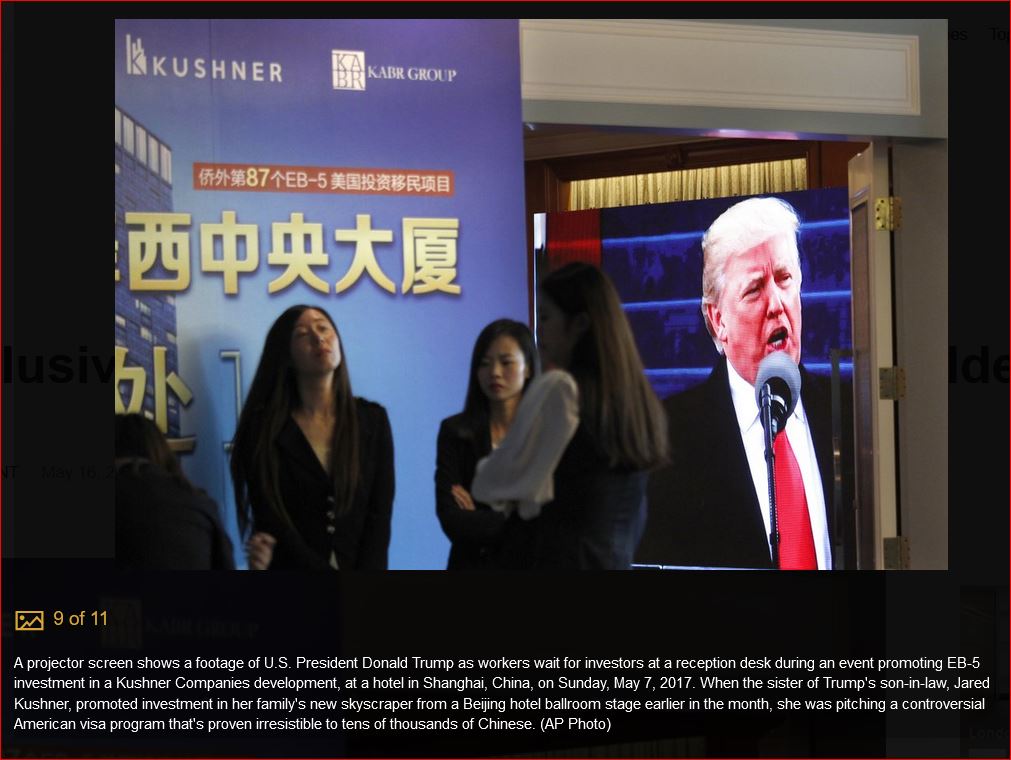
although federal authorities have proposed more than doubling the minimum investment. Just one day later, Kushner’s sister, Nicole Meyer, was in Beijing courting Chinese for a new project funded by EB-5. That’s raised complaints about conflicts of interest and new calls to revise or even end the program.
“It is a growing
industry and we do need more oversight,” said Stephen Yale-Loehr, an
expert on the program and a professor at Cornell Law School. “EB-5, when
it is done properly, can and does benefit the economy.”
THE LURE OF A GOLDEN VISA
The number of Chinese using investment migration programs worldwide tripled between 2010 and 2015, the AP found among the countries in its survey . In the last decade, Chinese have taken 75 percent of the investor visas issued by the United States,
70 percent for Portugal and 85 percent for Australia. China also
remains the top recipient of investor visas in Canada, the United
Kingdom, New Zealand, Spain, Hungary and Malta.
To be sure, those
migrating make up only a small fraction of the around 18 million
households that could be considered upper-middle-class or wealthier in
China, but they echo the laments of many better-educated, urban Chinese.
“Middle-class
investors’ choosing to leave shows that their confidence in their
future, their dreams and the regime in China is fading,” said Zhang
Lifan, an independent political scholar in Beijing.
China’s “golden
visa” investors are part of a wave characterized not by poverty,
persecution or war, but by people with steady jobs and homes who are pursuing happiness that’s eluded them in their homeland.
After decades of
economic mismanagement and political upheaval, the ruling Communist
Party reversed some of its most destructive policies and unleashed a
four-decade-long economic boom in the 1970s. That growth lifted 500
million people out of poverty and vaulted generations of Chinese from
peasantry into relatively well-paying manufacturing or service jobs.
More than 3 million households in China now have an income of more than
$34,000 a year, according to the consultancy McKinsey & Company.
Key to their
spending power is China’s real estate boom. Real estate prices in
China’s largest cities have more than tripled in the last decade,
with prices in Beijing rising by an average of 25 percent a year during
that time. Since late 2015 alone, Beijing’s home prices have jumped 63
percent, making a 1,300 square-foot (120 square-meter) apartment worth
more than $1 million.
A family that gained ownership of an ordinary apartment more than a decade ago can now sell it for the price of a “golden visa.” And as their dissatisfaction with China’s problems grows, more families are choosing to do so.
Like Liu, many of
about a dozen investors or prospective investors interviewed by the AP
say they don’t want their children to struggle in China’s rigid and intensely competitive education system, which emphasizes rote learning and can stifle creativity.
Cherry Deng, the mother of a 10-year-old boy in Sichuan province, invested in a port construction project in North Carolina through the U.S. EB-5 program. Deng, who used funds from her car dealership business, said she wants her son to learn from the American emphasis on self-reliance.
Deng said she sees Chinese parents supporting their children even after
they’ve graduated from college — securing for them homes, jobs and,
sometimes, even spouses….
Urban Chinese have also been disgusted by scandals ranging from tainted baby formula
to toxic running tracks, and alarmed that even the most prosperous
cities are not safe from deadly factory explosions and other man-made
disasters.
Despite her success
running an online clothing business in the southwestern Chinese city of
Chengdu, Peng Jie isn’t confident in her future in China. She sees the
prices of property and schools rising and the value of the yuan falling,
and fears that success could be taken away.
“In China, we have family and friends, and daily life is convenient,” Peng said. But, she added, “someone in the middle class can become poor in one second.”
WOOING CHINESE INVESTORS
China is central to the success of almost every major investment migration program in the world, so many countries are going out of their way to court Chinese investors….
Agents selling U.S. projects to Chinese take great pains to prove their expertise on the states, the EB-5 program and perceived ties to American leaders. Some marketing materials include photos of Chinese posing with former President Barack Obama.
Now, they’re competing directly against the current president’s relatives.
Meyer, Kushner’s sister, appeared this month at events in Beijing and Shanghai to promote One Journal Square, a New Jersey tower project planned by the Kushner family that would be partially funded through EB-5 investment. The presentation included a photo of Trump and vague promises that the project had “government support” and was “founded by celebrity developers.” The company later apologized for any implication that her brother was supporting the project, and Meyer pulled out of a presentation to Chinese investors scheduled for this past weekend.
Trump’s name already appears on another New Jersey residential tower, Trump Bay Street, built with the help of EB-5 funding. And one month before the November [2016] election, an ad appeared on a Chinese website catering to foreigners seeking a “white American to join our team” for a new project: “A 200 million dollar hotel developed by The Trump Organization in Austin.” A brochure posted online described Trump as the “king of real estate” and included a photo of him giving a speech.
White House press secretary Sean Spicer this month said Kushner would follow government policies on potential conflicts of interest, and that Trump and Congress would review “all the various visa programs and whether or not they are serving the purpose that they were intended to.”
The AP obtained data from officials in 13 countries on how many Chinese have used their investor programs
since 2007. To estimate money spent, the AP multiplied the numbers of
Chinese investors in each country by the minimum investment required,
making the figures an undercount.
The market leader is the United States’ EB-5 program, which gives green cards to anyone who invests $500,000 in a business that creates or saves at least 10 jobs. Several others market themselves as cheaper or quicker alternatives.
Portugal has drawn
at least $1.7 billion over four years from Chinese investors willing to
buy property to support its faltering real estate market. Spain and
Greece offer similar programs. Chinese have bought the most visas in all
three countries.
Five Caribbean nations offer passports for as little as $100,000. Chinese are the top buyers in Antigua and Barbuda, according to government statistics.
Australia goes the more expensive route,
requiring an investment of 5 million Australian dollars (nearly $3.7
million). Despite a price nearly eight times as high as the EB-5
program, Australia is estimated to have attracted more than $6 billion in Chinese investment in just four years.
But problems in the industry worldwide are rife.
FRAUGHT WITH RISK
The U.S.’s EB-5 program has been heavily criticized by government watchdogs and targeted by lawmakers of both parties in Congress, who say it promotes fraud and helps developers building megaprojects more than struggling communities.
Sen. Dianne Feinstein, a California Democrat who has introduced
legislation to end the program, has called EB-5 a “Ponzi scheme.” Her
Republican counterpart, Sen. Charles Grassley of Iowa, has said EB-5 “poses significant national security risks” and “may be facilitating terrorist travel, economic espionage, money laundering and investment fraud.”
Federal investigators said in April [2017] they found that at least three Chinese investors who obtained green cards through the program were fugitives wanted by Beijing. And
the U.S. Securities and Exchange Commission has opened more than a
dozen civil cases since 2013 alleging fraud in projects involving around
2,000 investors and more than $1 billion in funds.
Defenders of the EB-5 program say it creates jobs and provides vital funding for projects
across the United States, from massive developments in New York to
hotels, restaurants and small businesses in the Midwest and on the West
Coast….
Canada’s program drew an estimated $2.4 billion through Chinese investors over the past decade, but the national government ended it in 2014, saying that it “significantly undervalued” Canadian residency and created little economic benefit. The province of Quebec has kept in place its separate program, which has drawn at least $1.9 billion from Chinese investment.
And a former Portuguese interior minister and other senior government officials have been on trial since February for corruption, influence-peddling and misconduct in handling “golden visa” applications of investors linked to three Chinese businessmen. Hungary suspended its program selling visas for government bonds earlier this year after opposition parties and watchdogs accused it of corruption.
Ironically, calls to end investment migration programs often end up as marketing tools for the hundreds of agents selling them in China. One agent made note of proposals to change the EB-5 program by saying, “Do not hesitate, and act quickly!”…
If China,
which doesn’t recognize dual nationality, can’t keep entrepreneurs and
middle-class families from leaving, it risks endangering its economic
future. That includes people like Joey, a 30-year-old Beijing
resident who works for a major Chinese state-owned conglomerate. He
shared his story on the condition that his last name not be used because
he hadn’t told his employer of his plans.
Joey and his fiancee
have a two-bedroom apartment and plan to get married and have a child
in China. Despite their seemingly bright future, they want to raise that child elsewhere. His friends and relatives helped him move enough money offshore to invest in the American EB-5 program.
Joey says he’s seen parents and children struggling to breathe outside in China’s smoggy air, and signs that China’s economy is headed for deeper trouble.
“In China, you have
to plan ahead,” Joey said. “You cannot just leave today, whenever you
want. You never know what happens next.””
……………………
“Associated Press
researchers Liu Zheng and Yu Bing in Beijing and Fu Ting in Shanghai,
and reporters Pablo Gorondi in Budapest, Hungary, and Barry Hatton in
Lisbon, Portugal, and data journalist Larry Fenn in New York contributed
to this report.”
__









Facebook informed me yesterday that my link to something by Max Blumenthal [Max Blumenthal, TheGrayZone, Max Blumenthal twitter] was blocked because it was “spam.”
People just don’t get it. As long as Trump and and Alex Jones are banned they are happy. And they could care less about all the other people who are censored on Twitter and Facebook.”…[image of Max Blumenthal added by Susan]