Tuesday, February 5, 2019

Democrat Rep. Tulsi Gabbard slams Neocon and Neoliberal warmongers after their NBC propaganda selling permanent enslavement of US taxpayers to Endless Unwinnable War Industry profiteers-zero hedge…(Tulsi Gabbard for President in 2020–The only candidate who hasn’t wavered about ending US military intervention in Syria)

.
To disqualify a US presidential candidate, just be a known pro-war advocacy group backed by the multi-trillion dollar War Industry and claim anonymous “chatter” possibly took place on anonymous online message boards that might be considered anti-war. No wars=No free US taxpayer cash. (Today Putin's their meal ticket, tomorrow it will be someone else. The War Industry is a massive, full time operation that exists only by enslaving US taxpayers). 

2/4/19, Tulsi Gabbard Slams “Neocon/Neolib Warmongers” After NBC Propaganda Exposed," zero hedge 

“Tulsi Gabbard lashed out at “neocon” and “neolib warmongers” after NBC News was exposed trying to smear her as a Kremlin stooge. The network was called out over the weekend for relying on a Democrat-run firm that created fake Russian twitter bots to stage a “false flag” campaign against Republic Roy Moore in the 2017 Alabama special election – New Knowledge. 
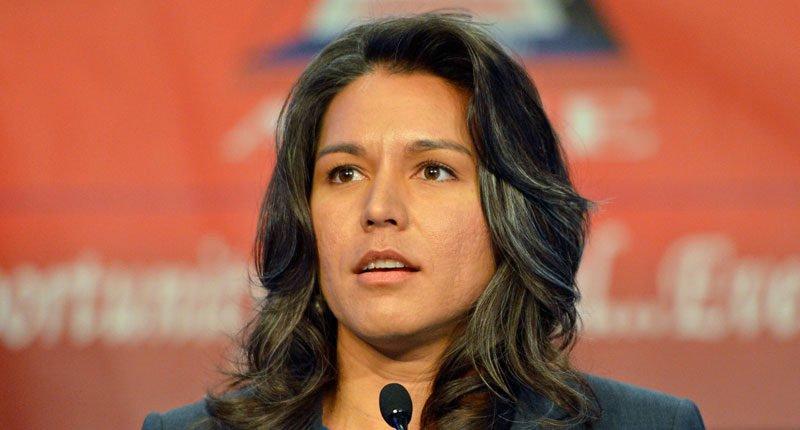
To justify its claim that Tulsi Gabbard is the Kremlin’s candidate, NBC writes:

“analysts at New Knowledge, the company the Senate Intelligence Committee used to track Russian activities in the 2016 election, told NBC News they’ve spotted ‘chatter’ related to Gabbard in anonymous online message boards, including those known for fomenting right-wing troll campaigns.”
Only to be called out hard by journalist Glenn Greenwald: 
 

“@ggreenwald exposes that @NBC used journalistic fraud to discredit our campaign. But more important is their motive: “to smear any adversary of the establishment wing of the Democratic Party whether on the left or the right – as a stooge or asset of the Kremlin.”” 

She later added:

“As commander-in-chief, I will work to end the new cold war, nuclear arms race and slide into nuclear war. That is why the neocon/neolib warmongers will do anything to stop me. 

“As commander-in-chief, I will work to end the new cold war, nuclear arms race and slide into nuclear war. That is why the neocon/neolib warmongers will do anything to stop me. https://t.co/MPybv8AZ5p— Tulsi Gabbard (@TulsiGabbard) February 4, 2019″ 

“The term “neoliberal warmongers” is thus born. https://t.co/xiB7qkkao9— zerohedge (@zerohedge) February 4, 2019″ 

Disturbingly, the [deeply corrupt] Senate Intelligence Committee has relied on a report by New Knowledge on Russian social media election interference, while the firm has created a “Hamilton 68” offshoot, “Disinfo2018” referenced in the NBC article, which claims that three of the top URLs propagated throughout social media by Kremlin bots were about Gabbard. 

“Three of the top 15 URL’s shared over the past 24 hours by 800 Russian-linked disinformation accounts tracked by Disinfo2018 are about Tulsi Gabbard, the pro-Putin, pro-Assad congresswoman who just announced she’s running for POTUS in 2020. (One URL is an article; 2 are tweets). 
pic.twitter.com/SG43IGt9ZV Caroline Orr (@RVAwonk) January 15, 2019″ 

In short; NBC relied on a known propagandist who created a Russian bot “false flag” to meddle in an election, who claims to track pro-Kremlin Twitter activity, in order to smear Tulsi Gabbard as a Putin puppet. 

“That’s a lot of hot talk, Mike.— Ben Popken (@bpopken) [NBC News “reporter”] February 4, 2019″ 

“And your article is one of the hottest piles of garbage masquerading as “journalism” that I’ve ever seen, so congratulations on that. You’re a pathetic joke— Michael Tracey (@mtracey) February 4, 2019″ 

“Except they’re not “experts” NBC–they’re admitted forgers. You’re a rabble NBC. A complete rabble. Go back to school: https://t.co/e9KJU2oisvpic.twitter.com/1XnfMmjqgh— WikiLeaks (@wikileaks) February 3, 2019″ 

It’s uncanny what lengths the establishment will go to in order to eliminate threats. For example, take a look at this Vanity Fair hit piece from Jan 30, which uses perhaps the most unflattering photo Gabbard has ever taken and starts off (emphasis not ours): 

“The presidential campaign of Rep. Tulsi Gabbard, the renegade Democrat known as much for her chummy relationship with Bashar al-Assad as for supporting Bernie Sanders, is beginning to resemble the candidate herself: confusing, disorganized, and, according to Politico, falling apart.” –Vanity Fair 

“If you squint hard, you can almost tell they don’t like her. Very subtle pic.twitter.com/duwKhrrUd1— Michael Tracey (@mtracey) February 2, 2019″ 

One question remains; will Gabbard become a Democrat puppet like Bernie Sanders if the DNC colludes with their chosen candidate to cheat against her?”
………………………………………..

Added: “Being right isn’t enough.” Storytelling by plutocrat media is the only reason the Endless Unwinnable US Taxpayer Funded War Industry is alive today: 

“The ability of the plutocratic class and their allied government agencies to manipulate the way people think, act and vote is the only thing holding the ecocidal, omnicidal unipolar world order in place, which is why billions and billions of dollars are poured into the plutocratic media, think tanks, the agenda to censor the internet, and other influence campaigns. Any attempt to replace that world order with a system that serves humanity instead of a few wealthy sociopaths must necessarily understand and interact with this dynamic….

Anyone who wants to legitimately challenge the status quo will necessarily find themselves up against this protective wall of narrative that the ruling power establishment has surrounded itself with, so it’s important to know how to fight against it. 

There are a lot of great alternative media outlets out there, and a lot of good dissident politicians and activists, but the problem they run into again and again is that they often stay calm and monotonous while repeating cold, hard facts. This is a problem because while they’re trying to calmly fight the status quo using raw data, the establishment is using sparkly narratives in all the right places. They’re appealing to emotions, they’re condensing their stories into catchy 20-second sound bytes, and they’re using facts only when facts help advance the narrative. 

I am not saying that dissidents should abandon truth and facts; if you’re not trying to build a world that is based on truth then what the hell are you fighting for? But it is absolutely essential not just to tell the truth, but to seize control of the narrative as well. Get all your facts right, then tell their story. Make it interesting. Make it funny. Activists can be some of the most dry, boring people you’ll ever encounter, believing that their rightness compensates for the fact that nobody’s ever interested in listening to what they’ve got to say. Bollocks! If you want to convey a message, make that message pop!

What’s the point of speaking out if nobody’s even listening? Being right isn’t enough…. 

What the establishment understands and most dissidents do not is that people listen to stories, not data, and the more interesting the story the better. Russiagate didn’t gain traction because it’s factually accurate, it gained traction because it’s a scandalous story [allegedly] about the president of the United States conspiring with nefarious forces and being blackmailed over a night of [alleged] water sports with Russian prostitutes [peeing on a bed in a hotel in Moscow].”… 

2/3/19, “Dissidents Must Be Clear On The Difference Between Fact And Narrative,” Caitlin Johnstone, Medium.com


................


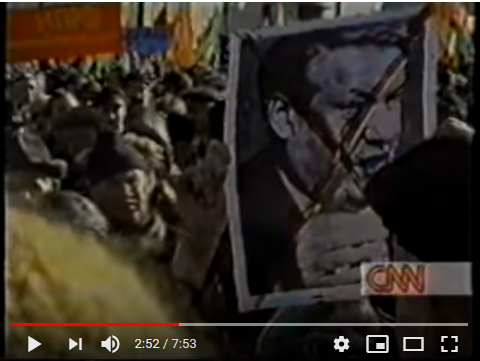
Under Yeltsin millions of Russians from coal miners and soldiers to doctors and nuclear scientists had to wait months for their meager wages due to chronic shortage of state funds-Oct. 7, 1998, Russian national protest called for resignation of Yeltsin, video, CNN

.


Yeltsin Resign already 1998," Oct. 7, 1998 mass demonstrations against Yeltsin in Russia, posted May 1, 2007 on You Tube. Audio includes clips of news accounts from around the world. Above is screen shot from You Tube video.

At 2:11: (US announcer): Seeking an end to President Boris Yeltsin’s 7 year rule. Thousands of citizens have gone for weeks even months without being paid. The Russian government is appealing.”…

At 2:48: (English speaking announcer): “Communists and trade unions who organized the protest were demanding payment of back wages and the resignation of President Boris Yeltsin.”…

At 3:50: “Their anger at the government’s failure to come up with long unpaid wages.”

At 5:31: (Translation of Russian woman protester): I’m here because I was robbed by this regime. I have nothing left. It’s all because of Yeltsin and his government of young bandits.”


Above, anti-Yeltsin sign, screen shot from video, 10/7/1998
……………………………..

Added: Millions of Russians from coal miners and soldiers to doctors and nuclear scientists have to wait months for their meager wages because of a chronic shortage of state funds.”

Oct. 7, 1998, “Russians start anti-Yeltsin protests,” CNN, Vladivostok, Russia

Millions of Russians from coal miners and soldiers to doctors and nuclear scientists have to wait months for their meager wages because of a chronic shortage of state funds and a complex web of debt straddling both public and private sectors….

[Prime Minister] Primakov asks for calm in television address

On the eve of the protests, Prime Minister Yevgeny Primakov made a nationally televised appeal to Russians to remain calm, both during the demonstrations and for the duration of the economic crisis.

Primakov promised there would be no food shortages this winter and said the government would start paying overdue wages and pensions.

“The populace will be fully provided with vegetables, fruit and potatoes,” Primakov said. “I appeal to everyone not to rock our common boat in today’s too-turbulent sea.”

But the protesters are not demanding Primakov’s resignation. Unlike Yeltsin, the former spymaster and foreign minister still enjoys strong public approval, according to opinion surveys.

His espousal of more measured reforms, including more help for the poor and for industry, has struck a chord among Russians dismayed by the post-communist gulf between haves and have-nots.

Many regional governors like Vladivostok’s Yevgeny Nazdratenko, actively courted by Primakov, also approve of Primakov while generally backing Wednesday’s planned protests.

Trust of the people, trust of the creditors

Primakov faces a tougher task winning the trust of global creditors, still reeling from the previous Cabinet’s decision on August 17 to default on some foreign debt repayments, devalue the ruble and unilaterally restructure the GKO short-term domestic debt market.

On Tuesday Finance Minister Mikhail Zadornov, locked in tough talks in Washington with the International Monetary Fund, vowed Russia would pay $3.2 billion in foreign debt owed by the end of 1998.

Zadornov, a liberal, said the new government would present a new tax program to parliament this month and that he expected the ruble to trade at around 20 to 23 to the dollar until the end of this year, well below the current rate of around 15.8.

Before its devaluation one dollar bought about six rubles….

One new element in Wednesday’s protests may be the pain that has hit Moscow’s embryonic white-collar middle class, hundreds of thousands of whom have lost well-paid jobs in recent weeks.

In Yeltsin’s home city of Yekaterinburg in the Urals, off-duty police officers are also due to join the marchers to demand overdue wages.”…


...............

Monday, February 4, 2019

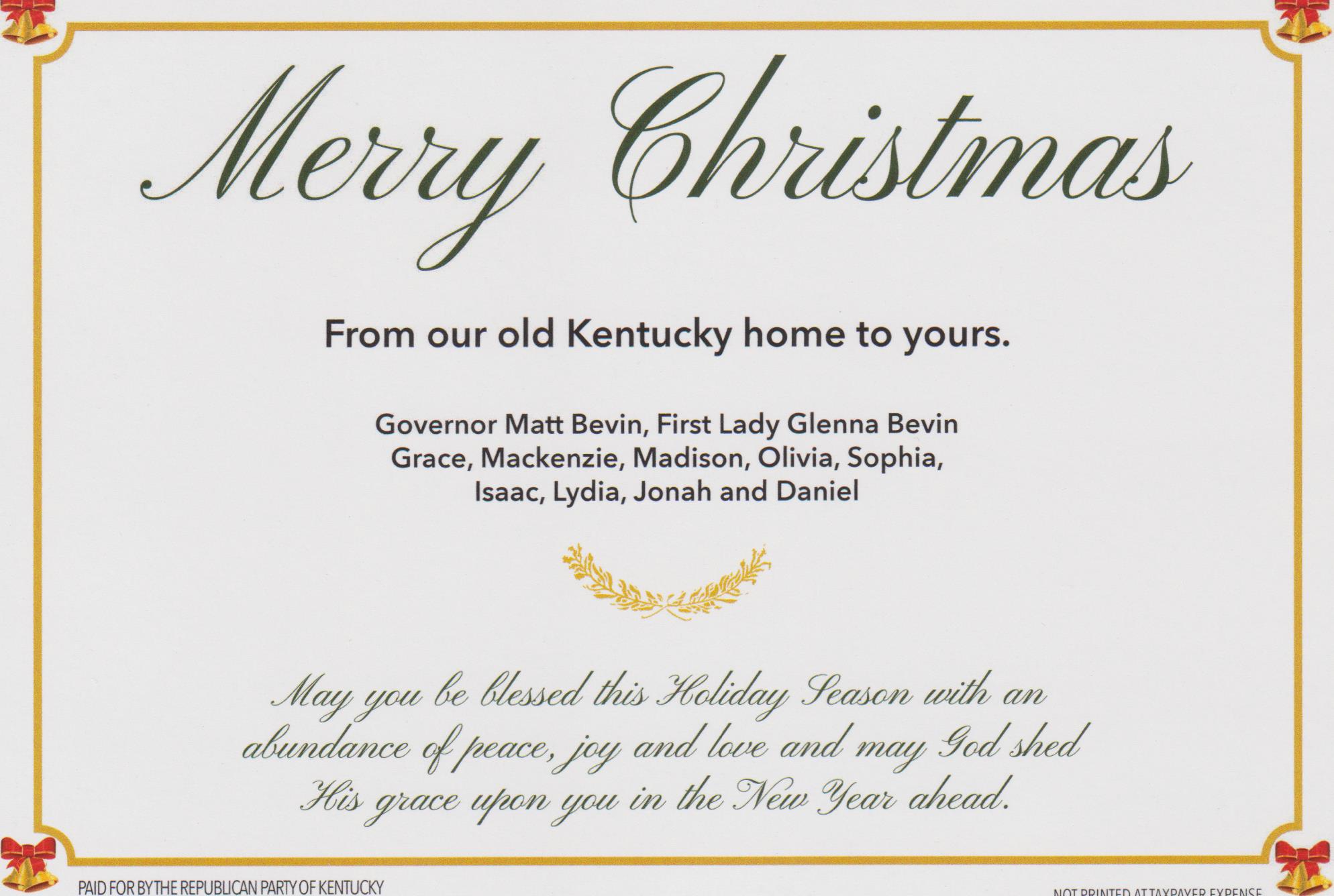
Kentucky Governor Matt Bevin’s 2018 Christmas card

.


Four of Bevin’s children were adopted from Ethiopia. 

Bevin and his wife had tried to adopt an 11 year old girl from Kentucky foster care: Bevin wants to overhaul the state’s troubled child-welfare system, inspired by his own family’s failed attempt to adopt a young girl. The Bevins started the process of trying to adopt a young girl from Kentucky’s child-welfare system. They had their fingerprints taken, three times and opened their home to an inspection. The state ultimately rejected their application because, the Bevins said, they had five children and officials worried the girl wouldn’t get enough attention….So the Bevins “gave up” and went to Ethiopia to adopt four children” in 2008…ap, 4/25/2017


………………………….

Comment: How I received the above Christmas card: Though I don’t live in Kentucky, I donated to Mr. Bevin’s campaign in 2014 when he was running in the Kentucky Republican primary for US Senate against Mitch McConnell. Unfortunately, that didn’t work out, but in 2015 Mr. Bevin was back and won the Kentucky governorship. Susan


...............

New York Times continues to push pernicious racialism. Its critic at large views the world almost entirely through prism of race or gender instead of focusing on economic inequality-Worldwide Socialist Website, David Walsh

.
"It was the Obama administration that oversaw the largest transfer of wealth in history during its eight-year reign."
......................

1/28/19, Why does the New York Times keep pushing pernicious racialism?” Worldwide Socialist Website, David Walsh

“The New York Times critic-at-large Wesley Morris published an article January 23 headlined “Why Do the Oscars Keep Falling for Racial Reconciliation Fantasies?”

The article does not precisely argue that “reconciliation” between blacks and whites is itself a “fantasy,” but that is unquestionably Morris’s implication. He suggests that there is simply too much “bad blood” inherited from America’s past for blacks and whites ever to get along.

Morris, who began writing for the Times in 2015 after a stint with the Boston Globe, belongs to the group of film and arts commentators at the newspaper, including A. O. Scott, Manohla Dargis and others, who view the world almost entirely through the prism of race or gender, or both.

Their work, whatever their conscious intentions may be, amounts to a relentless cover-up of economic inequality in America, as well as an argument for already affluent black and other minority layers to advance themselves farther.

These journalists, unsurprisingly in light of their considerable have no interest in examining the great economic and class divide in the US. In the present degraded cultural climate, their type of self-serving and self-justifying material is treated as legitimate social commentary. No one bats an eye in these circles about the reactionary logic of the politics of “race and blood.”

Much of Morris’s January article is devoted to criticizing a number of films that offend him, including Driving Miss Daisy (Bruce Beresford, 1989), which collected four Academy Awards in 1990 (including Best Picture and Best Actress), and, in more recent times, The Upside (Neil Burger) and Green Book (Peter Farrelly), whose nomination in five Academy Awards categories was announced last week. All three films deal with relations between individual black and white characters—the first two, between a white employer and a black employee. In the Green Book, an African American musician hires an Italian American to chauffeur him through the Jim Crow South in the early 1960s.

To those movies, Morris counterposes in particular the work of African American director Spike Lee, including the latter’s Do the Right Thing (1989), which lost out at the 1990 Academy Awards in two categories, and BlacKkKlansman, nominated this year for Best Picture and five other awards. He defines Lee’s artistic efforts as a “cold shower” of realism about race relations in the US.

Morris adorns his criticism with certain “left” phrases. He complains, for instance, that The Upside and Green Book “symbolize a style of American storytelling in which the wheels of interracial friendship are greased by employment, in which prolonged exposure to the black half of the duo enhances the humanity of his white, frequently racist counterpart.” Adding Driving Miss Daisy to the mix, he asserts that “the bond” in all three films “is conditionally transactional, possible only if it’s mediated by money.”

Speaking of the money involved in the various film relationships, Morris writes that it “seems to paper over all that’s potentially fraught about race.” He continues: “The relationship is entirely conscripted as service and bound by capitalism and the fantastically presumptive leap is, The money doesn’t matter because I like working for you. And if you’re the racist in the relationship: I can’t be horrible because we’re friends now. That’s why the hug Sandra Bullock gives Yomi Perry, the actor playing her maid, Maria, at the end of Crash, remains the single most disturbing gesture of its kind. It’s not friendship. Friendship is mutual. That hug is cannibalism.”

This is simply throwing dust in the readers’ eyes, intended to persuade the susceptible (and there are many such among the New York Times readership) that there is an oppositional or “progressive” side to Morris’s racialism.

Throughout his piece, Morris seeks to take advantage, so to speak, of Hollywood’s fumbling, inadequate liberalism and its rather large ideological contradictions for his own purposes. The phenomenon he identifies speaks to the “do-gooder” limitations of many of the film industry’s treatments not only of race, but a host of other social issues. The garden variety liberal writer, director or producer views such matters from “on high,” regards him or herself as open-minded and tolerant and often organizes the dramatic material so that a given “backward” character is put in circumstances where he or she grows more “enlightened.”

Such films can be clumsily or more artfully done, and they tend to ignore the fact that great social advances in thinking are the product of mass experiences in which people change themselves, sometimes overnight, in the process of changing their social conditions. However, it remains a fact that individuals are also altered by their interactions with other individuals that can have an improving effect. (The increasing recourse to the employer-employee motif is more a sign of the growing wealth of Hollywood’s upper echelons than anything else. It is the relationship to which such people are most accustomed these days.)

And there is no question either, frankly, but that people belonging to communities that have suffered greatly, such as blacks and Jews, and who have learned compassion for others as a result, frequently have had that sort of impact on their fellow human beings in the course of daily life. Morris is essentially heaping scorn on that kind of humanizing influence, the influence of the oppressed, which has also played a large role in American life and literature. When he argues contemptuously that most “of these black-white-friendship adventures were foretold by Mark Twain. Somebody is white Huck and somebody else is his amusingly dim black sidekick, Jim,” he reveals an appalling upper-middle-class insensitivity and obtuseness.

Morris’s attack on bourgeois liberalism, in other words, is a right-wing attack, from the standpoint of racialism, communalism and the strivings of a social layer “on the make.”

Whatever the failings of Green Book, for example, its elementary notion that people of varying ethnic and cultural backgrounds can overcome their differences and find common ground is in a different intellectual league from Morris’s pernicious racialism.

His defense of Spike Lee, a millionaire many times over, is telling in this regard. Lee is one of the more unpleasant figures in American filmmaking over the past three decades. In Do the Right Thing, Mo’ Better Blues, Jungle Fever, He Got Game, Summer of Sam and other films, Lee has specialized in crude ethnic stereotyping and racial self-promotion. If a white director indulged in the type of degradation and humiliation of black characters that Lee has submitted his white characters to, he or she would rightly come under severe fire. Lee’s works are cold, poorly constructed and generally tedious. Racialism cannot provide the basis for a realistic and rich portrait of life because it is a false outlook that points the viewer in the diametrically wrong direction.

Morris describes Do the Right Thing as Lee’s “masterpiece about a boiled-over pot of racial animus in Brooklyn.” The movie, he asserts, “dramatized a starker truth—we couldn’t all just get along.” In 1989, Lee “was pretty much on his own as a voice of black racial reality … He helped plant the seeds for an environment in which black artists can look askance at race.” As opposed to those who “had been reared on racial-reconciliation fantasies,” Lee understood, according to Morris, that “closure is impossible because the blood is too bad, too historically American.”

What a foul and even sinister perspective—and one that Morris’s fellow reviewers, Scott and Dargis, incidentally, fully endorse.

Morris tells his readers that “the black version of these interracial relationships tends to head in the opposite direction … [T]hey’re not about money or a job but about the actual emotional, psychological work of being black among white people. Here, the proximity to whiteness is toxic, a danger, a threat.” He adds that “scarcely any of the work I’ve seen in the last year by black artists …  emphasizes the smoothness and joys of interracial friendship and certainly not through employment. The health of these connections is iffy, at best.”

In so far as this is true—and it is manifestly not true in the case of one of the films he mentions, Boots Riley’s Sorry to Bother You, which has a decidedly anti-racialist take on things—it is a commentary on the infection of the artistic community by political reaction.

Morris, true to social type, is clearly drawn to the successful and the wealthy in particular. His numerous sycophantic tributes to the billionaire couple Beyoncé and Jay-Z, including to their obscene flaunting of wealth in last year’s “Apeshit” video shot at the Louvre museum in Paris, are especially repugnant.

This is from “Morality Wars,” Morris’s October 2018 Times essay: “An aspect of Beyoncé’s cultural vitality is the moral power she wields. She performs, but she also represents—as a feminist, a black person and a black woman. She operates as a solo artist but thrives in sisterhood—as a bandleader, dancer and conjurer of histories. She has come to take herself, that power and what it can do, very seriously. There is activism in her art and a real disdain, from its consumers, for critique of it. ‘Lemonade,’ for instance, arrived with a demand that white people refrain from commenting until black people had had their say.”

And from his “Best Performances of 2018,”—“Last April, the universe genuflected before Beyoncé after she wrapped a major music festival around her baby toe. Some of us are still on our knees.”

This is the sort of toadyism that a leading newspaper would have been embarrassed to print in an earlier day. Now, anything goes.”
…………………………..

Two among comments
……………………………


As a socialist I resent the way vacuous “liberals ” have denigrated the cultural achievements of frequently excoriated Western Civilization. The flowers of great culture and the Enlightenment are nothing but odious fruit of dead white males? Whatever their flaws as we perceive them today, these artists, scientists, writers, musicians ,explorers, theologians, philosophers, even emperors advanced CIVILIZATION. Try establishing socialism in a cultural wasteland. Contempt for THE PAST is no way to advance social progress.”
……………………….


The problem is that we live in an age of moral degradation….The New York Times is a fine example of this moral rot in our country. The writers have not a single moral bone in their body and they mislead their readership time and time again. Do they ever feel guilty that they’re paid frauds? I sincerely doubt it.”

…………………………


...................

Sunday, February 3, 2019

Isn’t NY Times interested that Jared Kushner has an outstanding personal guarantee on hundreds of millions in debt to Deutsche Bank or that Jared and his Mom have a personal line of credit with Deutsche Bank of up to $25 million?

.
Jared Kushner’s interests “include loans totaling at least $1 billion from more than 20 lenders, to properties and companies part-owned by Mr. Kushner…. He has also provided personal guarantees on more than $300 million of the debt….Deutsche Bank and RBS are among entities to whom he’s given personal guarantees.Cadre also secured a $250 million line of credit from the family office of Mr. Soros, a top Democratic donor.….Mr. Soros’s family office said it had invested [in Kushner’s business] in early 2015 before Mr. Trump declared his presidential candidacy.“…Kushner has business “ties to a broad swath of U.S. and foreign banks, private-equity firms, real-estate companies and government-owned lenders.”….Jared and his Mom have a personal line of credit with Deutsche Bank worth up to $25 million.

May 3, 2017, Trump Adviser Kushner’s Undisclosed Partners Include Goldman and Soros,” Wall St. Journal, Jean Eaglesham, Juliet Chung, Lisa Schwartz

“Investments show ties to major finance and technology names.”

“Jared Kushner, the president’s son-in-law and senior adviser, is currently in business with Goldman Sachs Group Inc. and billionaires George Soros and Peter Thiel, according to people familiar with the matter and securities filings.

The previously undisclosed business relationships with titans of the financial and technology worlds are through a real-estate tech startup called Cadre that Mr. Kushner cofounded and currently partly owns.

Goldman and Messrs. Soros and Thiel, as well as other billionaires’ firms, also have stakes in the company, which is based in a Manhattan building owned by the Kushner family’s company, according to people close to Cadre.

The Cadre stake is one of many interests—and ties to large financial institutions—that Mr. Kushner didn’t identify on his government financial-disclosure form, according to a Wall Street Journal review of securities and other filings. Others include loans totaling at least $1 billion, from more than 20 lenders, to properties and companies part-owned by Mr. Kushner, the Journal found. He has also provided personal guarantees on more than $300 million of the debt, according to the analysis.

In his disclosure form filed earlier this year, Mr. Kushner didn’t identify Cadre as among his hundreds of assets. The Journal identified his Cadre stake through a review of securities and other filings as well as interviews with people familiar with the company and Mr. Kushner’s finances.

Jamie Gorelick, a lawyer representing Mr. Kushner, said in a statement that his stake in Cadre is housed in a company he owns, BFPS Ventures LLC. His ownership of BFPS is reported on his disclosure form, although it doesn’t mention Cadre.

Ms. Gorelick said the Cadre stake is described in a revised version of his disclosure form that will be made public after it has been certified by ethics officials. She said Mr. Kushner has previously discussed his Cadre ownership with the Office of Government Ethics and that Mr. Kushner has “resigned from Cadre’s board, assigned his voting rights and reduced his ownership share.”

A spokesman for the Office of Government Ethics didn’t respond to a request to comment.
Ms. Gorelick said it is “very normal” for a financial-disclosure form to be revised and that the form was prepared by Mr. Kushner’s lawyers on his behalf. A White House spokeswoman referred questions to Mr. Kushner’s lawyer.

Trevor Potter, a Republican former chairman of the Federal Election Commission, and other ethics experts said investments such as Mr. Kushner’s ownership of Cadre typically need to be disclosed. They said Mr. Kushner didn’t appear to violate disclosure rules by not publicly reporting his business-related debts and guarantees. But they said such arrangements ideally should be disclosed, in part because they could force Mr. Kushner to recuse himself from certain issues involving the lenders.

“Anything that presents a potential for the conflict of interest should be disclosed so that the public and the press can monitor this,” Mr. Potter said.

Ethics experts’ concern is that Mr. Kushner’s business connections could jeopardize his impartiality in certain areas and that, absent disclosures, the public is in the dark about potential conflicts. 

Mr. Kushner’s rapidly expanding responsibilities range from working on a Middle East peace deal to making the federal government operate more efficiently. As a senior federal official, he is bound by ethics laws that require him to recuse himself from matters that would directly affect his financial interests.

Ms. Gorelick, who was deputy attorney general in former President Bill Clinton’s administration, said Mr. Kushner will “recuse consistent with government ethics rules.”

Mr. Kushner, the 36-year-old scion of a real-estate family, agreed with federal ethics officials to divest himself of more than 80 assets after he and his wife, Ivanka Trump, were hired by her father, President Donald Trump, as senior aides. White House officials have said some of the sales were needed to avoid potential conflicts between Mr. Kushner’s far-reaching job duties and his personal financial interests.

Mr. Kushner is retaining more than 200 other assets, worth a total of at least $116 million, according to his disclosures. These are mostly apartments and office blocks around the U.S. Like his father-in-law, he has declined to put these assets in a blind trust, which ethics experts regard as the cleanest way to avoid conflicts of interest. Someone close to Mr. Kushner said there are practical problems that made a blind trust not a realistic option.

Mr. Kushner co-founded Cadre in 2014 with his brother, Joshua Kushner, and Ryan Williams, a 29-year-old friend and former employee of Kushner Cos., the family-controlled business that Mr. Kushner ran until recently. Cadre markets properties to prospective investors, who can put their money into specific buildings or into an investment fund run by Cadre, which collects fees on each deal.

To get off the ground, Cadre turned to a Goldman Sachs fund and a number of high-profile investors. Among them were the venture-capital firms of Mr. Thiel, Silicon Valley’s most prominent supporter of the GOP president, and Vinod Khosla, a co-founder of Sun Microsystems Inc., according to Cadre’s website. Personal backers include Chinese entrepreneur David Yu, co-founder with Alibaba Group Holding Ltd.’s Jack Ma of a Shanghai-based private-equity firm, hedge-fund manager Daniel Och and real-estate magnate Barry Sternlicht, people close to Cadre said.

Cadre also secured a $250 million line of credit from the family office of Mr. Soros, a top Democratic donor who Mr. Trump criticized during his presidential campaign, the people close to the company said. Mr. Soros’s family office is also an investor in Cadre.

The investors declined or didn’t respond to requests for public comment on their backing of Cadre, but a person familiar with Mr. Soros’s family office said it had invested [in Kushner’s business] in early 2015 before Mr. Trump declared his presidential candidacy.

Cadre has solicited money from investors for several Kushner Cos. real-estate projects, according to information sent to prospective investors and reviewed by the Journal. Jared Kushner personally has stakes in some of the real-estate projects for which Cadre has raised money, according to Cadre documents and his disclosure form.

While Mr. Williams acts as the public face of Cadre, Mr. Kushner remains one of the owners, with the power to “influence the [firm’s] management or policies,” according to the latest public information on file with the Financial Industry Regulatory Authority. Mr. Kushner’s company JCK Cadre LLC is shown as owning 25% to 50% of Quadro Partners Inc., which owns at least 75% of RealCadre LLC, which does business as Cadre. Mr. Kushner has reduced his ownership stake to less than 25%, his lawyer Ms. Gorelick said. [“Common stock and 35 investments had been sold to a trust overseen by Kushner’s mother, Seryl, with other assets going to his brother, Josh, and some more to third parties.]

Mr. Williams, chief executive of Cadre, said the company has been working with regulators to update its public filings to “reflect Jared’s nonoperational, nonmanagement relationship with the company, which has been in place since the inauguration.”

BFPS Ventures, the company that Mr. Kushner’s lawyer said holds his Cadre stake, is shown on his financial-disclosure form as owning unspecified New York real estate valued at more than $50 million. The form adds that “the conflicting assets of this interest have been divested.”

Beyond Cadre, some of the assets Mr. Kushner is holding on to are hard to pinpoint, partly because they are housed in entities with generic names such as “KC Dumbo Office,” according to the disclosure form.

The Journal matched many of the assets to specific real-estate investments. An analysis of the debts on those properties, using real-estate data services PropertyShark and Trepp LLC as well as property records, found ties to a broad swath of U.S. and foreign banks, private-equity firms, real-estate companies and government-owned lenders.

Lenders to Mr. Kushner, either directly or via properties he co-owns, include Bank of America Corp. , Blackstone Group LP, Citigroup Inc., UBS Group AG, Deutsche Bank AG and Royal Bank of Scotland Group PLC. Royal Bank of Scotland didn’t respond to requests for comment; representatives of the other firms declined to comment.

Mr. Kushner will recuse himself from matters to which Deutsche Bank or RBS are parties because he has provided personal guarantees on their loans, said a person familiar with his ethics arrangement.”
………………………………………

Added: Jared and his Mom have a personal line of credit with Deutsche Bank worth up to $25 million. A month before election day Kushner with brother Joshua received a $285 million refinancing loan form Deutsche Bank with only their personal guarantee as collateral. Not to worry, Jared will “recuse” himself from matters in which Deutsche Bank is a party. “Kushner’s company took out $370 million in new loans in October 2016:”

June 25, 2017,Jared Kushner’s firm given $285 million Deutsche Bank loan just a month before Election Day,” Washington Post, Michael Kranish

One month before Election Day, Jared Kushner’s real estate company finalized a $285 million loan as part of a refinancing package for its property near Times Square in Manhattan….

The White House, in response to questions from The Post, said in a statement that Kushner “will recuse from any particular matter involving specific parties in which Deutsche Bank is a party.” Kushner and Deutsche Bank declined to comment….

The [$285 million] refinancing loan with Deutsche Bank is mentioned in documents filed with the Securities and Exchange Commission as part of a public offering of mortgage-backed securities. It states that Kushner and his brother, Joshua, “will be guarantors” under what was called a “nonrecourse carve-out.” Such guarantees require more than a loan default to kick in….The terms of the guarantee, which generally are not secured by collateral, are negotiated between lender and borrower….

The corporate loan and Kushner’s personal guarantee are not mentioned on his financial disclosure form, filed with the Office of Government Ethics. Blake Roberts, a lawyer who represented Kushner on the matter, said in a statement to The Post that Kushner’s form “does not list the loan guarantee” because the disclosure relied on “published guidance” from OGE that he said “clearly states that filers do not have to disclose as a liability a loan on which they have made a guarantee unless they have a present obligation to repay the loan.”

The Post sent the language cited by Kushner’s lawyer to Don Fox, a former general counsel and acting OGE director. After reviewing the wording, he said in an interview that he would have advised Kushner to disclose the personal guarantee of the $285 million corporate loan because of its size and possible implications….

[Don] Fox said in a follow-up email to The Post that even if OGE “advised there was no requirement to disclose,” he would not have argued that point but “I would have nonetheless recommended Jared over report in this instance given the magnitude of the contingency and the public interest in liabilities – actual and potential – to Deutsche Bank.”

Separately, Kushner disclosed that he and his mother have a personal line of credit with Deutsche Bank worth up to $25 million.

The Deutsche Bank deal was one of the last Kushner orchestrated before joining the White House. It is among the dozens of complex transactions that he was involved with during his decade in the real estate business.

Although Kushner divested some properties in an effort to address potential conflicts, he retains an interest in nearly 90 percent of his real estate properties, including the retail portion of the former New York Times headquarters, and holds personal debts and loan guarantees….

Kushner’s company took out $370 million in new loans in October 2016, giving it $74 million more than the purchase price a year earlier. Along with $285 million from Deutsche Bank, Kushner’s firm received $85 million from SL Green Realty.”…
……………………………………………

Added: Some of Jared’s divested interests are in trust with Mom and brother: “His common stock and 35 investments had been sold to a trust overseen by Kushner’s mother, Seryl, with other assets going to his brother, Josh, and some more to third parties….Jared remains the beneficiary of family trusts worth $600 million to him and his wife, Ivanka.”

May 9, 2017, Are Kushner family real estate assets a conflict for Jared?" CBSNews.com, Larry Light

It remains murky just how much Kushner has rid himself of family-related assets. In a White House briefing on March 31, officials said Kushner had resigned from more than 266 entities and “divested from most of those that may have created a conflict of interest. A report in Politico said his common stock and 35 investments had been sold to a trust overseen by Kushner’s mother, Seryl, with other assets going to his brother, Josh, and some more to third parties.

Nevertheless, The New York Timesreported on Monday that Jared remains the beneficiary of family trusts worth $600 million to him and his wife, Ivanka, the president’s daughter.

What’s to stop Kushner later, after he leaves the White House, from becoming a beneficiary again and rejoining Kushner Cos.? Apparently nothing, according to Richard Painter, the White House ethics lawyer under President George W. Bush. Painter, now a professor at the University of Minnesota Law School, said the assets Kushner shipped to the trust “belong to the family,” and so he can reclaim them in the future.”


.................

Soros hit Russia at its weakest: Newly created Russia had no banks, property rights, or accountable government. In 1995 George Soros was one of only two entities given bidding rights by pal Chubais to ownership of a Russian steel mill and an oil company. In 1997 Soros bought 24% of a Russian telecom giant-Harvard Boys do Russia, The Nation; Rape of Russia, Anne Williamson

.
The Rape of Russia,” by Anne Williamson 

“The historic opportunity given the U.S. to help transform Russia into a free, peaceful, pro-Western country was squandered in the form of a bruising economic rape carried out by corrupt Russian politicians and businessmen, assisted by Bush and (especially) Clinton administrations engaged in political payoffs to Wall Street bankers and others, and by ineptitude and greed on the part of the U.S. Treasury and the Harvard Institute for International Development [which was dissolved in June 2000], assisted by fellow travelers and manipulators at Nordex, the IMF, the World Bank, and the Federal Reserve. The losers were the Russian people and (mainly) U.S. tax-payers.”

Janine R. Wedel in “The Harvard Boys do Russia, (The Nation, May 14, 1998) wrote that in 1995 US oligarch George Soros was one of only two entities given exclusive bidding rights by his pal Chubais to ownership of a large Russian steel mill and an oil company. In 1997 Soros bought 24% of a Russian  telecommunications giant:

“Anne Williamson, a journalist who specializes in Soviet and Russian affairs, details these and other conflicts of interest between H.I.I.D.’s advisers and their supposed clients–the Russian people–in her forthcoming book, How America Built the New Russian Oligarchy. For example, in 1995, in Chubais-organized insider auctions of prime national properties, known as loans-for-shares, the Harvard Management Company (H.M.C.), which invests the university’s endowment, and billionaire speculator George Soros were the only foreign entities allowed to participate. H.M.C. and Soros became significant shareholders in Novolipetsk, Russia’s second-largest steel mill, and Sidanko Oil, whose reserves exceed those of Mobil. H.M.C. and Soros also invested in Russia’s high-yielding, I.M.F.-subsidized domestic bond market.

Even more dubious, according to Williamson, was Soros’s July 1997 purchase of 24 percent of Sviazinvest, the telecommunications giant, in partnership with Uneximbank’s Vladimir Potanin. It was later learned that shortly before this purchase Soros had tided over Yeltsin’s government with a backdoor loan of hundreds of millions of dollars while the government was awaiting proceeds of a Eurobond issue; the loan now appears to have been used by Uneximbank to purchase Norilsk Nickel in August 1997. According to Williamson, the U.S. assistance program in Russia was rife with such conflicts of interest involving H.I.I.D. advisers and their U.S.A.I.D. [US taxpayer]-funded Chubais allies, H.M.C. managers, favored Russian bankers, Soros and insider expatriates working in Russia’s nascent markets.””…

[HIID, Harvard Institute for International Development, was dissolved in June 2000]

Added: “Only the mixture of American triumphalism and academic arrogance could have produced such a lethal dose of gall,” said former World Bank economist David Ellerman.
……………………

Added: From Anne Williamson’s testimony [before the US House of Representatives Committee on Banking and Financial Services, 9/21/1999]:

“In the matter before us – the question of the many billions in capital that fled Russia to Western shores via the Bank of New York and other Western banks – we have had a window thrown open on what the financial affairs of a country without property rights, without banks, without the certainty of contract, without an accountable government or a leadership decent enough to be concerned with the national interest or its own citizens’ well-being looks like. It’s not a pretty picture, is it? But let there be no mistake, in Russia the West has truly been the author of its own misery. And there is no mistake as to who the victims are, i.e. Western, principally U.S., taxpayers and Russian citizens’ whose national legacy was stolen only to be squandered and/or invested in Western real estate and equities markets.

The failure to understand where Communism ended and Russia began insured that the Clinton Administration’s policy towards Russia would be riddled with error and ultimately ineffective. Two mistakes are key to understanding what went wrong and why.

The first mistake was the West’s perception of the elected Russian president, Boris Yeltsin; where American triumphalists saw a great democrat determined to destroy the Communist system for freedom’s sake, Soviet history will record a usurper. 

A usurper’s first task is to transform a thin layer of the self-interested rabble into a constituency. Western assistance, IMF lending and the targeted division of national assets are what provided Boris Yeltsin the initial wherewithal to purchase his constituency of ex-Komsomol [Communist Youth League] bank chiefs, who were given the freedom and the mechanisms to plunder their own country in tandem with a resurgent and more economically competent criminal class. The new elite learned everything about the confiscation of wealth, but nothing about its creation. Worse yet, this new elite thrives in the conditions of chaos and eschews the very stability for which the United States so fervently hopes knowing full well, as they do, that stability will severely hamper their ability to obtain outrageous profits. Consequently, Yeltsin’s “reform” government was and is doomed to sustain this parasitic political base composed of the banking oligarchy.

The second mistake lay in a profound misunderstanding of Russian culture and in the Harvard Institute of International Development advisers’ disregard for the very basis for their own country’s success; property rights. It was a very grave error. Private property is not only the most effective instrument of economic organization, it is also the organizational mechanism of an independent civil society. The protection of property, both of individuals’ and that of a nation, has justified the existence of and a population’s acceptance of the modern state and its public levies.

Russian property rights are tricky; property has never been distributed, but only confiscated and awarded on a cyclical basis. For the big players property exists, as it always has, only where there is power. For the common man, the property right hasn’t advanced much beyond custom which prevents the taking of any man’s shelter, clothes or tools so long as continuous usage is demonstrable. An additional, purely Slavic feature of the Russians’ concept of property is the shared belief that each has a claim upon some part of the whole.”…
……………………………….

More from “The Harvard Boys do Russia,“ (The Nation, May 14, 1998), including 2 paragraphs at top of post: [HIID, Harvard Institute for International Development, was dissolved in June 2000.]

“After seven years of economic “reform” financed by billions of dollars in U.S. and other Western aid, subsidized loans and rescheduled debt, the majority of Russian people find themselves worse off economically. The privatization drive that was supposed to reap the fruits of the free market instead helped to create a system of tycoon capitalism run for the benefit of a corrupt political oligarchy that has appropriated hundreds of millions of dollars of Western aid and plundered Russia’s wealth. The architect of privatization was former First Deputy Prime Minister Anatoly Chubais, a darling of the U.S. and Western financial establishments. Chubais’s drastic and corrupt stewardship made him extremely unpopular. According to The New York Times, he “may be the most despised man in Russia.” 

Essential to the implementation of Chubais‘s policies was the enthusiastic support of the Clinton Administration and its key representative for economic assistance in Moscow, the Harvard Institute for International Development [dissolved in June 2000].  
Using the prestige of Harvard’s name and connections in the Administration, H.I.I.D. officials acquired virtual carte blanche over the U.S. economic aid program to Russia, with minimal oversight by the government agencies involved. With this access and their close alliance with Chubais and his circle, they allegedly profited on the side. Yet few Americans are aware of H.I.I.D.’s role in Russian privatization, and its suspected misuse of taxpayers’ funds.

At the recent U.S.-Russian Investment Symposium at Harvard’s John F. Kennedy School of Government, Yuri Luzhkov, the Mayor of Moscow, made what might have seemed to many an impolite reference to his hosts. After castigating Chubais and his monetarist policies, Luzhkov, according to a report of the event, singled out Harvard for the harm inflicted on the Russian economy by its advisers, who encouraged Chubais’s misguided approach to privatization and monetarism.” Luzhkov was referring to H.I.I.D. Chubais, who was delegated vast powers over the economy by Boris Yeltsin, was ousted in Yeltsin’s March purge, but in May he was given an immensely lucrative post as head of Unified Energy System, the country’s electricity monopoly.

Some of the main actors with Harvard’s Russia project have yet to face a reckoning, but this may change if a current investigation by the U.S. government results in prosecutions. The activities of H.I.I.D. in Russia provide some cautionary lessons on abuse of trust by supposedly disinterested foreign advisers, on U.S. arrogance and on the entire policy of support for a single Russian group of so-called reformers. The H.I.I.D. story is a familiar one in the ongoing saga of U.S. foreign policy disasters created by those said to be our “best and brightest.” Through the late summer and fall of 1991, as the Soviet state fell apart, Harvard Professor Jeffrey Sachs and other Western economists participated in meetings at a dacha outside Moscow where young, pro-Yeltsin reformers planned Russia’s economic and political future. Sachs teamed up with Yegor Gaidar, Yeltsin’s first architect of economic reform, to promote a plan of “shock therapy” to swiftly eliminate most of the price controls and subsidies that had underpinned life for Soviet citizens for decades. Shock therapy produced more shock–not least, hyperinflation that hit 2,500 percent–than therapy.

One result was the evaporation of much potential investment capital: the substantial savings of Russians. By November 1992, Gaidar was under attack for his failed policies and was soon pushed aside…

H.I.I.D. had supporters high in the Administration. One was Lawrence Summers, himself a former Harvard economics professor, whom Clinton named Under Secretary of the Treasury for International Affairs in 1993. Summers, now Deputy Treasury Secretary, had longstanding ties to the principals of Harvard’s project in Russia and its later project in Ukraine. Summers hired a Harvard Ph.D., David Lipton (who had been vice president of Jeffrey D. Sachs and Associates, a consulting firm), to be Deputy Assistant Treasury Secretary for Eastern Europe and the Former Soviet Union. After Summers was promoted to Deputy Secretary, Lipton moved into Summers‘s old job, assuming “broad responsibility” for all aspects of international economic policy development. Lipton co-wrote numerous papers with Sachs and served with him on consulting missions in Poland and Russia. “Jeff and David always came [to Russia] together,” said a Russian representative at the International Monetary Fund. “They were like an inseparable couple.” Sachs, who was named director of H.I.I.D. in 1995, lobbied for and received U.S.A.I.D. grants for the [Harvard] institute to work in Ukraine in 1996 and 1997 …

Andrei Shleifer, a Russian-born emigre and already a tenured professor of economics at Harvard in his early 30s, became director of H.I.I.D.’s Russia project. Shleifer was also a protege of Summers, with whom he received at least one foundation grant … 

Another Harvard player was a former World Bank consultant named Jonathan Hay, a Rhodes scholar who had attended Moscow’s Pushkin Institute for Russian Language. In 1991, while still at Harvard Law School, he had become a senior legal adviser to the G.K.I., the Russian state’s new privatization committee; the following year he was made H.I.I.D.’s general director in Moscow. The youthful Hay assumed vast powers over contractors, policies and program specifics; he not only controlled access to the Chubais circle but served as its mouthpiece …

With help from his H.I.I.D. advisers and other Westerners, Chubais and his cronies set up a network of aid-funded “private” organizations that enabled them to bypass legitimate government agencies and circumvent the new parliament of the Russian Federation, the Duma.

Through this network, two of Chubais’s associates, Maxim Boycko (who co-wrote Privatizing Russia with Shleifer) and Dmitry Vasiliev, oversaw almost a third of a billion dollars in aid money and millions more in loans from international financial institutions …

The device of setting up private organizations backed by the power of the Yeltsin government and maintaining close ties to H.I.I.D. was a way of insuring deniability. Shleifer, Hay and other Harvard principals, all U.S. citizens, were “Russian” when convenient. Hay, for example, served alternately and sometimes simultaneously as aid contractor, manager of other contractors and representative of the Russian government ... Against the backdrop of Russia’s Klondike capitalism, which they were helping create and Chubais and his team were supposedly regulating, the H.I.I.D. advisers exploited their intimate ties with Chubais and the government and were allegedly able to conduct business activities for their own enrichment. According to sources close to the U.S. government’s investigation, Hay used his influence, as well as U.S.A.I.D.-financed resources, to help his girlfriend, Elizabeth Hebert, set up a mutual fund, Pallada Asset Management, in Russia … After Pallada was set up, Hebert, Hay, Shleifer and Vasiliev looked for ways to continue their activities as aid funds dwindled. Using I.L.B.E. resources and funding, they established a private consulting firm with taxpayer money. One of the firm’s first clients was Shleifers wife, Nancy Zimmerman, who operated a Boston-based hedge fund that traded heavily in Russian bonds.

According to Russian registration documents, Zimmerman’s company set up a Russian firm with Sergei Shishkin, the I.L.B.E. chief, as general director. Corporate documents on file in Moscow showed that the address and phone number of the company and the I.L.B.E. were the same. Then there is the First Russian Specialized Depository, which holds the records and assets of mutual fund investors. This institution, funded by a World Bank loan, also worked to the benefit of Hay, Vasiliev, Hebert and another associate, Julia Zagachin. According to sources close to the U.S. government’s investigation, Zagachin, an American married to a Russian, was selected to run the depository even though she lacked the required capital…

Anne Williamson, a journalist who specializes in Soviet and Russian affairs, details these and other conflicts of interest between H.I.I.D.’s advisers and their supposed clients–the Russian people–in her forthcoming book, How America Built the New Russian Oligarchy. For example, in 1995, in Chubais-organized insider auctions of prime national properties, known as loans-for-shares, the Harvard Management Company (H.M.C.), which invests the university’s endowment, and billionaire speculator George Soros were the only foreign entities allowed to participate. H.M.C. and Soros became significant shareholders in Novolipetsk, Russia’s second-largest steel mill, and Sidanko Oil, whose reserves exceed those of Mobil. H.M.C. and Soros also invested in Russia’s high-yielding, I.M.F.-subsidized domestic bond market.

Even more dubious, according to Williamson, was Soros’s July 1997 purchase of 24 percent of Sviazinvest, the telecommunications giant, in partnership with Uneximbank’s Vladimir Potanin. It was later learned that shortly before this purchase Soros had tided over Yeltsin’s government with a backdoor loan of hundreds of millions of dollars while the government was awaiting proceeds of a Eurobond issue; the loan now appears to have been used by Uneximbank to purchase Norilsk Nickel in August 1997. According to Williamson, the U.S. assistance program in Russia was rife with such conflicts of interest involving H.I.I.D. advisers and their U.S.A.I.D. [US taxpayer]-funded Chubais allies, H.M.C. managers, favored Russian bankers, Soros and insider expatriates working in Russia’s nascent markets.…

Despite exposure of this corruption in the Russian media (and, far more hesitantly, in the U.S. media), the H.I.I.D.-Chubais clique remained until recently the major instrument of U.S. economic aid policy to Russia. It even used the high-level [Al] Gore-Chernomyrdin Commission, which helped orchestrate the cooperation of U.S.-Russian oil deals and the Mir space station. The commission’s now-defunct Capital Markets Forum was chaired on the Russian side by Chubais and Vasiliev, and on the U.S. side by S.E.C. chairman Arthur Levitt Jr. and Treasury Secretary Robert Rubin.

Andrei Shleifer was named special coordinator to all four of the Capital Markets Forum’s working subgroups. Hebert, Hay’s girlfriend, served on two of the subgroups, as did the C.E.O.s of Salomon Brothers, Merrill Lynch and other powerful Wall Street investment houses. When The Nation contacted the S.E.C. for information about Capital Markets, we were told to call Shleifer for comment. Shleifer, who is under investigation by U.S.A.I.D.’s inspector general for misuse of funds, declined to be interviewed for this article. A U.S. Treasury spokesman said Shleifer and Hebert were appointed to Capital Markets by the Chubais group–specifically, according to other sources, by Dmitry Vasiliev.”
…………………………………..

HIID, Harvard Institute for International Development, was dissolved in June 2000.

Archived publications from now defunct Harvard Institute for International Development, HIID.


...............

Saturday, February 2, 2019

Long overdue withdrawals from Syria and Afghanistan are great news except to bipartisan US political-media parasites for whom nuclear annihilation including their own death is preferable to freeing US taxpayers from war profiteers-Stephen F. Cohen, The Nation…(This is civil war by US political class against ordinary Americans. They'd rather die than be our equals)

.
1/30/19, Trump’s Withdrawals From Afghanistan & Syria Are Hardly “A Gift To Putin",” Stephen F. Cohen, The Nation 

“Why would Moscow want to fight terrorists without the US? It doesn’t.”

“Manichaean Cold War myopia and ludicrous Russiagate allegations have produced one of the worst periods of American “geopolitical” thinking in recent decades. Consider President Trump’s recently announced withdrawals of US forces from Syria and Afghanistan. Instead of applauding these long-overdue steps, the bipartisan US political-media establishment has denounced them as “Trump’s gifts to Putin.”

But why would Russian President Putin want to be without the United States as an ally in the fight against terrorists in these two countries, which Moscow has long regarded as its geopolitical backyard?

In Syria, where, as Putin has repeatedly warned, thousands of jihadists with Russian passports have appeared and vowed, if they take Damascus, to return to Russia and wage the same war there?
 
And why even more in Afghanistan, where ever since the Soviet invasion in 1979, Moscow has worried that victorious Afghan terrorists and their foreign allies – by whatever name in whatever organized form – will flow through Central Asia into Russia, along with the indigenous Afghan war-funding crop, opium poppy? (Heroin addiction, fostered by cheap Afghan opium, is already reaching epidemic proportions in Russia.)

Unlike a large segment of the US policy-media elite, Putin can think geopolitically in his nation’s clear national interests. For 17 years, he has sought a full anti-terrorist alliance with the United States—first with President George W. Bush after 9/11, then with President Barack Obama, always in vain. As a candidate and then as president, Trump has seemed to want to seize the opportunity, but has been thwarted by Russiagate zealots, primarily Democrats, though not only.

Now we are told that Trump did something “treacherous” by meeting privately with Putin without adequate witnesses or note-keeping. His Russiagate accusers know history as poorly as they understand American national security. President Richard Nixon, for example, once met with Soviet leader Leonid Brezhnev with only Brezhnev’s translator present.

We should hope instead that in their necessarily secret meetings—there are enemies of cooperation in high places on both sides—Trump and Putin discussed expansive US-Russian cooperation against organized international terrorists, who are in pursuit of radioactive materials to make their explosions more lethal, whether the threat be abundantly visible in Syria and Afghanistan or silently incubating again in Europe and in Russia—or in our own country.

The Bulletin of the Atomic Scientists has reset its cautionary doomsday clock ever closer to midnight. The growing dangers of a new nuclear arms race also require the kind of US-American cooperation that has been badly shredded by the New Cold War and by unproven Russiagate allegations. But international terrorism has already repeatedly struck midnight. Is that not late enough to let Trump and Putin do what they can for the sake of everyone’s security, as American presidents and Kremlin leaders have previously done—and were expected to do?”


...........