.
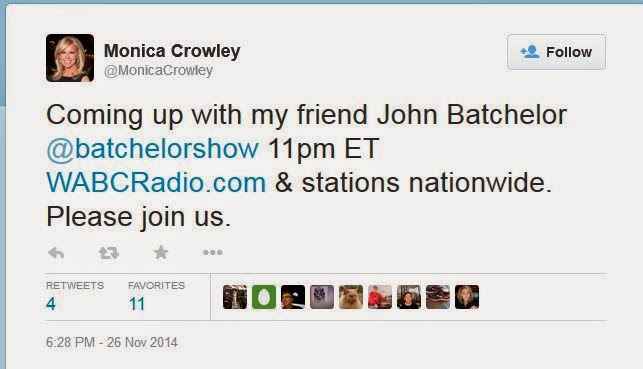
Those who listen to John Batchelor's show know that when he uses the term "nativists" as he did on Thanksgiving Eve, 11/26/14, he's not speaking about millionaires and billionaires who destroyed this country during 8 years of George Bush and 6 years of Obama. He refers to innocent Americans who while their betters sold the country out to the bare walls quietly paid their taxes, never so much as dropped a gum wrapper on the sidewalk, stupidly thought that like other countries, America should be able to have borders, knew that without borders you're not a country. These "nativists" don't want to be raped, murdered, have their children get diseases or even die from being forced to be among people from violent or primitive cultures who aren't willing to use flush toilets and leave soiled toilet paper laying around to spread more disease.
Monica Crowley was a guest on John Batchelor's Radio Show in the 11pm hour on Thanksgiving Eve 11/26/14. Batchelor opened the segment angrily with the word, "Nativists." He introduced Ms. Crowley who was to follow up on the topic of how so-called Republicans are reacting these days to Obama's executive amnesty. She began by wishing Mr. Batchelor and his audience a
Happy Thanksgiving then cheerily chatted her segment away without
commenting on or taking issue with Mr. Batchelor's use of the term
"nativists." So she deserves at least one scabie.
Image of a scabie.
----------------------------
Illegal alien unwillingness to use flush toilets is a continuing problem in combating the spread of disease:
10/6/14, "Disease plagues illegal immigrants; lack of medications, basic hygiene blamed," Washington Times, Stephen Dinan
"Communicable diseases continue to be a problem at the New Mexico
facility built to house illegal immigrant families surging across the
U.S.-Mexico border, and the immigrants themselves aren’t taking their
own health care very seriously, according to an audit released Monday....
"Previous reports had detailed some of the difficulties
of handling the surge, including the communicable diseases some brought,
such as scabies, lice or chickenpox.
And investigators found “unfamiliarity” with bathrooms resulted in unsanitary conditions,
including “exposure to human waste.”
Volunteers who have been at some of the facilities have reported that
the children and families would often try to throw used toilet paper
away,
rather than flush it down the toilet." (end of article)
-----------------------------------
More on "nativists:"
Why would the Bush administration "speak so insultingly, with such hostility of...concerned citizens?"
6/2/2007, "Too bad," Wall St. Journal, Peggy Noonan
"What political conservatives and on-the-ground Republicans must
understand at this point is that they are not breaking with the White
House on immigration. They are not resisting, fighting and thereby
setting down a historical marker....That's not what's happening. What conservatives and Republicans
must recognize is that the White House has broken with them. What
President Bush is doing, and has been doing for some time, is sundering a
great political coalition. This is sad, and it holds implications not
only for one political party but for the American future.
The White House doesn't need its traditional supporters anymore, because
its problems are way beyond being solved by the base. And the people in
the administration don't even much like the base. Desperate straits
have left them liberated, and they are acting out their disdain. Leading
Democrats often think their base is slightly mad but at least their
heart is in the right place. This White House thinks its base is stupid
and that its heart is in the wrong place.
For almost three years, arguably longer, conservative Bush supporters
have felt like sufferers of battered wife syndrome. You don't like
endless gushing spending, the kind that assumes a high and unstoppable
affluence will always exist, and the tax receipts will always flow in?
Too bad! You don't like expanding governmental authority and power? Too
bad. You think the war was wrong or is wrong? Too bad.
But on immigration it has changed from "Too bad" to "You're bad."
The president has taken to suggesting that opponents of his
immigration bill are unpatriotic -- they "don't want to do what's right
for America." His ally Sen. Lindsey Graham has said, "We're gonna tell
the bigots to shut up." On Fox last weekend he vowed to "push back."
Homeland Security Secretary Michael Chertoff suggested opponents
would prefer illegal immigrants be killed; Commerce Secretary Carlos
Gutierrez said those who oppose the bill want "mass deportation." Former
Bush speechwriter Michael Gerson said those who oppose the bill are
"anti-immigrant" and suggested they suffer from "rage" and "national
chauvinism."
Why would they speak so insultingly, with such hostility, of
opponents who are concerned citizens? And often, though not exclusively,
concerned conservatives? It is odd, but it is of a piece with, or a
variation on, the "Too bad" governing style. And it is one that has, day
by day for at least the past three years, been tearing apart the
conservative movement.
I suspect the White House and its allies have turned to name calling
because they're defensive, and they're defensive because they know they
have produced a big and indecipherable mess of a bill -- one that is
literally bigger than the Bible, though as someone noted last week, at
least we actually had a few years to read the Bible. The White House and its supporters seem to be marshalling
not facts but only sentiments, and self-aggrandizing ones at that. They
make a call to emotions -- this is, always and on every issue, the
administration's default position -- but not, I think, to seriously
influence the debate....
If they'd really wanted to help, as opposed to braying about their
own wonderfulness, they would have created not one big bill but a series
of smaller bills, each of which would do one big clear thing, the first
being to close the border. Once that was done -- actually and
believably done -- the country could relax in the knowledge that the
situation was finally not day by day getting worse. They could feel some
confidence. And in that confidence real progress could begin.
The beginning of my own sense of separation from the Bush
administration came in January 2005, when the president declared that it
is now the policy of the United States to eradicate tyranny in the
world, and that the survival of American liberty is dependent on the
liberty of every other nation. This was at once so utopian and so
aggressive that it shocked me. For others the beginning of distance
might have been Katrina and the incompetence it revealed, or the depth
of the mishandling and misjudgments of Iraq.
What I came in time to believe is that the great shortcoming of this
White House, the great thing it is missing, is simple wisdom. Just
wisdom -- a sense that they did not invent history, that this moment is
not all there is, that man has lived a long time and there are things
that are true of him, that maturity is not the same thing as cowardice,
that personal loyalty is not a good enough reason to put anyone in
charge of anything, that the way it works in politics is a friend
becomes a loyalist becomes a hack, and actually at this point in history
we don't need hacks.
One of the things I have come to think the past few years is that the
Bushes, father and son, though different in many ways, are great
wasters of political inheritance.
They throw it away as if they'd earned it and could do with it what
they liked. Bush senior inherited a vibrant country and a party at peace
with itself. He won the leadership of a party that had finally, at
great cost, by 1980, fought itself through to unity and come together on
shared principles. Mr. Bush won in 1988 by saying he would govern as
Reagan had. Yet he did not understand he'd been elected to Reagan's
third term. He thought he'd been elected because they liked him. And so
he raised taxes, sundered a hard-won coalition, and found himself
shocked to lose the presidency, and for eight long and consequential
years. He had many virtues, but he wasted his inheritance.
Bush the younger came forward, presented himself as a conservative,
garnered all the frustrated hopes of his party, turned them into
victory, and not nine months later was handed a historical trauma that
left his country rallied around him, lifting him, and his party bonded
to him. He was disciplined and often daring, but in time he sundered the
party that rallied to him, and broke his coalition into pieces. He
threw away his inheritance. I do not understand such squandering.
Now conservatives and Republicans are going to have to win back their
party. They are going to have to break from those who have already
broken from them. This will require courage, serious thinking and an
ability to do what psychologists used to call letting go. This will be
painful, but it's time. It's more than time."
.
Tuesday, December 2, 2014
Bosnian immigrant bludgeoned to death with hammers by teens of color in St. Louis. 3 Bosnians attacked Sunday by up to 5 teens of color. St. Louis Bosnians say they're being killed by African Americans. St. Louis cops say just 'wrong place, wrong time'
.
“We think it was wrong place, wrong time,” Jackson said."...
12/1/14, "Bosnian community in St. Louis outraged over fatal hammer attack," UPI.com, Gabrielle Levy, St. Louis
.
"The St. Louis
Bosnian community erupted into anger and demonstrations Sunday night
after a local man was murdered with hammers Sunday morning.
Two teen males, 15 and 16, were arrested Sunday, and a third, 17, turned himself in to city police headquarters Sunday night in connection to the death of Zemir Begic, 32.
Police say Begic was attacked around 1:15 a.m. in the Bevo Mill neighborhood by a group of teens who were damaging his car with hammers. When Begic confronted them, they turned their weapons on him, hitting him on the head, abdomen and face.
He was taken to St. Louis University hospital, where he later died.
Eyewitness Suad Nuranjkovic, 49, was in the passenger seat of Begic's car when at least five teens approached them with hammers. He says he was able to escape and hide in a parking lot across the street.
"I was afraid that if one of them had a gun, they were going to shoot me, so I didn't know what to do," he said.
Another, Seldin Dzananovic, 24, said the group [with hammers] approached him about an hour earlier, but he was able to fight them off, suffering cuts on his hands and neck.
While the incident has no connection to the ongoing unrest related to the death of Michael Brown in nearby Ferguson, the area is on a hair trigger.
At least 50 people, mostly Bosnians, blocked Gravois Ave. near Itaska Street Sunday night, accusing members of the black community of targeting Bosnians.
"It's every month that Bosnians are getting killed," a protester told KMOX. "We came here for freedom from the Serbs -- to get our freedom. But now, we're getting killed by African Americans. That's not fair."
Police said Begic's attackers were black, but the incident did not appear to be racially motivated, but likely a crime of opportunity.
"There is no indication that the gentleman last night was targeted because he was Bosnian," said St. Louis Police Chief Sam Dotson. "There's no indication that they knew each other."
A Go Fund Me page has raised nearly $12,000 to cover arrangements for Begic's funeral, set to take place in Iowa."
"One of the suspects, 17-year-old Robert Mitchell, has been charged with first-degree murder." photo via Fox News
12/2/14, "St. Louis’ Bosnian community sees hammer murder as hate crime," Fox News, Cristina Corbin
==============================
11/30/14, "Fatal hammer attack on Bosnian immigrant not racially motivated, St. Louis police say," St. Louis Post-Dispatch
"Detectives do not believe Begic’s Bosnian heritage or the color of his skin served as a motive in any way, police spokeswoman Schron Jackson said....
“We think it was wrong place, wrong time,” Jackson said."...
.
“We think it was wrong place, wrong time,” Jackson said."...
12/1/14, "Bosnian community in St. Louis outraged over fatal hammer attack," UPI.com, Gabrielle Levy, St. Louis
.
"St. Louis Bosnians protested after the hammer attack on Zemir Begic in the Bevo Mill neighborhood early Sunday morning."
Two teen males, 15 and 16, were arrested Sunday, and a third, 17, turned himself in to city police headquarters Sunday night in connection to the death of Zemir Begic, 32.
Police say Begic was attacked around 1:15 a.m. in the Bevo Mill neighborhood by a group of teens who were damaging his car with hammers. When Begic confronted them, they turned their weapons on him, hitting him on the head, abdomen and face.
He was taken to St. Louis University hospital, where he later died.
Eyewitness Suad Nuranjkovic, 49, was in the passenger seat of Begic's car when at least five teens approached them with hammers. He says he was able to escape and hide in a parking lot across the street.
"I was afraid that if one of them had a gun, they were going to shoot me, so I didn't know what to do," he said.
Another, Seldin Dzananovic, 24, said the group [with hammers] approached him about an hour earlier, but he was able to fight them off, suffering cuts on his hands and neck.
While the incident has no connection to the ongoing unrest related to the death of Michael Brown in nearby Ferguson, the area is on a hair trigger.
At least 50 people, mostly Bosnians, blocked Gravois Ave. near Itaska Street Sunday night, accusing members of the black community of targeting Bosnians.
"It's every month that Bosnians are getting killed," a protester told KMOX. "We came here for freedom from the Serbs -- to get our freedom. But now, we're getting killed by African Americans. That's not fair."
Police said Begic's attackers were black, but the incident did not appear to be racially motivated, but likely a crime of opportunity.
"There is no indication that the gentleman last night was targeted because he was Bosnian," said St. Louis Police Chief Sam Dotson. "There's no indication that they knew each other."
A Go Fund Me page has raised nearly $12,000 to cover arrangements for Begic's funeral, set to take place in Iowa."
"One of the suspects, 17-year-old Robert Mitchell, has been charged with first-degree murder." photo via Fox News
12/2/14, "St. Louis’ Bosnian community sees hammer murder as hate crime," Fox News, Cristina Corbin
==============================
11/30/14, "Fatal hammer attack on Bosnian immigrant not racially motivated, St. Louis police say," St. Louis Post-Dispatch
"Detectives do not believe Begic’s Bosnian heritage or the color of his skin served as a motive in any way, police spokeswoman Schron Jackson said....
“We think it was wrong place, wrong time,” Jackson said."...
.
Australia PM Tony Abbott has a pen and a phone, repurposes handout to UN jet setters from Australian taxpayers to better environmental use "ahead of Peru climate talks." New report says UN bureaucracy has spiraled out of control
.
"The U.N. has become a sprawling system with 15 autonomous agencies, 11 semi-autonomous funds and programs, and numerous other bodies. There is no central entity to oversee them all. The secretary-general, currently Ban Ki-moon, can try to coordinate their actions but he has no authority over many of them."
12/2/14, "Result! Coalition slashes funds to UN climate scroungers," Australian Climate Madness
"It’s a drop in the ocean, to be sure, but at least it is in the right direction. The ABC (Australian Broadcasting Corp.), naturally, is inconsolable:
"The Federal Government has slashed funding to a key United Nations environment agency by more than 80 per cent, stunning environmental groups ahead of a global climate change summit in Peru.
The ABC has learned the Government cut $4 million from the UN Environment Program (UNEP), which provides advice on environmental policies and climate change negotiations.
“Whether it’s air pollution, whether it’s ozone depleting substances, what’s happening in the world’s oceans, the conservation of biodiversity – for a relatively small amount, Australia benefits from leveraging well over $500 million in contributions that other countries make,” UNEP’s executive director Achim Steiner said.
Australia was due to contribute around $1.2 million this year, but has only offered $200,000.
Over the next four years it will scale back its funding by $4 million. (source)"
Only a few billion to go, then…" via Climate Depot
image from Australian Climate Madness, "Snouts out of the trough"
.
=====================
12/2/14, "Federal Government cuts funding to UN environment agency by over 80pc ahead of Peru climate talks," Australian Broadcasting Corp., abc.net.au, Jake Sturmer
"Environment Minister Greg Hunt said the Government had to "make choices in a difficult budget environment".
"I would imagine that most Australians would see putting $12 million into coral reef protection within our region and combating illegal logging of the great rainforests of the Asia-Pacific as a pretty good investment compared with $4 million for bureaucratic support within the UN system," Mr Hunt said."
=====================
=====================
UN has spiraled out of control, 15 autonomous agencies have no central authority, top seats on rights councils go to dictatorships, 51 million refugees-AP
12/1/14, "5 problems facing UN as it nears 70th anniversary," AP, Edith M. Lederer
==========================
==========================
UN personnel are immune from prosecution for any crime, free to put US taxpayer dollars in Swiss bank accounts or spend them "renovating a guesthouse:"
4/16/09, “Report: U.N. spent U.S. funds on shoddy projects,” USA Today, Ken Dilanian
Do UN “agencies have immunity if they siphon (their U.S. grants) all off into Swiss banks? Is that accurate? They will be totally immune, no matter what they do with the money?” “My understanding is, yes,” Gambatesa replied.” (4th parag. from end)
…"The Afghanistan country director for the U.N. Office for Project Services (UNOPS), which served as the contractor on the project for the U.N. Development Program (UNDP) spent about $200,000 in U.S. money to
renovate his guesthouse. Witness names were withheld by USAID.” (parag. 7)
“Federal prosecutors in New York City were forced to drop criminal and civil cases because the U.N. officials have immunity.” (parag. 4)
=============================
.
Comment: UN personnel are unelected, unaccountable, can commit a crime anywhere on earth without fear of prosecution (parag. 4). US taxpayer money flows to it on a no strings basis, can be used for any purpose, even put in a Swiss bank account without consequence (4th parag. from end). US taxpayer money has been used to renovate a UN employee's guest house (parag. 7) without consequence.
The UN is legal organized crime enabled by US taxpayers.
===============
1/11/12, "UN and EU: Rich and Unaccountable — “A Vast Enterprise of Looting”," SPPI, Dennis Ambler
==========================
.
"The U.N. has become a sprawling system with 15 autonomous agencies, 11 semi-autonomous funds and programs, and numerous other bodies. There is no central entity to oversee them all. The secretary-general, currently Ban Ki-moon, can try to coordinate their actions but he has no authority over many of them."
---------------------------------------
.
.
"It’s a drop in the ocean, to be sure, but at least it is in the right direction. The ABC (Australian Broadcasting Corp.), naturally, is inconsolable:
"The Federal Government has slashed funding to a key United Nations environment agency by more than 80 per cent, stunning environmental groups ahead of a global climate change summit in Peru.
The ABC has learned the Government cut $4 million from the UN Environment Program (UNEP), which provides advice on environmental policies and climate change negotiations.
“Whether it’s air pollution, whether it’s ozone depleting substances, what’s happening in the world’s oceans, the conservation of biodiversity – for a relatively small amount, Australia benefits from leveraging well over $500 million in contributions that other countries make,” UNEP’s executive director Achim Steiner said.
Australia was due to contribute around $1.2 million this year, but has only offered $200,000.
Over the next four years it will scale back its funding by $4 million. (source)"
Only a few billion to go, then…" via Climate Depot
image from Australian Climate Madness, "Snouts out of the trough"
.
=====================
12/2/14, "Federal Government cuts funding to UN environment agency by over 80pc ahead of Peru climate talks," Australian Broadcasting Corp., abc.net.au, Jake Sturmer
"Environment Minister Greg Hunt said the Government had to "make choices in a difficult budget environment".
"I would imagine that most Australians would see putting $12 million into coral reef protection within our region and combating illegal logging of the great rainforests of the Asia-Pacific as a pretty good investment compared with $4 million for bureaucratic support within the UN system," Mr Hunt said."
=====================
=====================
UN has spiraled out of control, 15 autonomous agencies have no central authority, top seats on rights councils go to dictatorships, 51 million refugees-AP
12/1/14, "5 problems facing UN as it nears 70th anniversary," AP, Edith M. Lederer
"The world has changed dramatically since the
United Nations was established after World War II but the organization
has not adapted to reflect the 21st century....
.
At its
inception, the U.N. had 51 member states. It now has 193, many of them
clamoring for more clout. All countries are represented in the General
Assembly, but that body can only pass non-binding resolutions.....
The
U.N. has become a sprawling system with 15 autonomous agencies, 11
semi-autonomous funds and programs, and numerous other bodies. There is
no central entity to oversee them all. The secretary-general, currently
Ban Ki-moon, can try to coordinate their actions but he has no authority over many of them.
The cumbersome structure
was recently blamed for the World Health Organization's delay in
recognizing the Ebola epidemic. The WHO's country directors in Africa
report to the Africa regional director, not WHO headquarters in Geneva.
And the WHO's director in Geneva does not report to the
secretary-general in New York..
The
U.N. is almost constantly asking its member states to contribute troops
for its far-flung peacekeeping mission, currently numbering 16. The
number of peacekeepers has risen to a record 130,000 - compared to
11,000 at the end of the Cold War - but the system is under severe
strain. More than 100 peacekeepers have died this year and dozens have
been taken captive.
The world's refugee
population has soared amid a growing list of humanitarian crises. The
U.N. refugee agency is trying to help over 51 million people forced from
their homes and displaced inside or outside their country, the highest
figure since the U.N. began collecting that data in the early 1950s. The
U.N. humanitarian office is tackling a record of four top-level
emergencies - in Africa and the Mideast - as well as Ebola....
All 193 member states
contribute to the U.N.'s regular budget and a separate peacekeeping
budget, but some countries are chronically behind on their payments. In
early November, members owed about $3.5 billion for regular operations
and peacekeeping.
There is widespread behind-the-scenes jockeying for top jobs in the U.N. Secretariat and U.N. agencies, not to mention seats on key bodies like the Human Rights Council and the Security Council. Every country belongs to a regional group that lobbies to ensure it is well represented. There is often criticism that those who get the seats are not the best qualified, such as dictatorships elected to the rights council."
.
There is widespread behind-the-scenes jockeying for top jobs in the U.N. Secretariat and U.N. agencies, not to mention seats on key bodies like the Human Rights Council and the Security Council. Every country belongs to a regional group that lobbies to ensure it is well represented. There is often criticism that those who get the seats are not the best qualified, such as dictatorships elected to the rights council."
.
==========================
==========================
UN personnel are immune from prosecution for any crime, free to put US taxpayer dollars in Swiss bank accounts or spend them "renovating a guesthouse:"
4/16/09, “Report: U.N. spent U.S. funds on shoddy projects,” USA Today, Ken Dilanian
Do UN “agencies have immunity if they siphon (their U.S. grants) all off into Swiss banks? Is that accurate? They will be totally immune, no matter what they do with the money?” “My understanding is, yes,” Gambatesa replied.” (4th parag. from end)
…"The Afghanistan country director for the U.N. Office for Project Services (UNOPS), which served as the contractor on the project for the U.N. Development Program (UNDP) spent about $200,000 in U.S. money to
renovate his guesthouse. Witness names were withheld by USAID.” (parag. 7)
“Federal prosecutors in New York City were forced to drop criminal and civil cases because the U.N. officials have immunity.” (parag. 4)
=============================
.
Comment: UN personnel are unelected, unaccountable, can commit a crime anywhere on earth without fear of prosecution (parag. 4). US taxpayer money flows to it on a no strings basis, can be used for any purpose, even put in a Swiss bank account without consequence (4th parag. from end). US taxpayer money has been used to renovate a UN employee's guest house (parag. 7) without consequence.
The UN is legal organized crime enabled by US taxpayers.
===============
1/11/12, "UN and EU: Rich and Unaccountable — “A Vast Enterprise of Looting”," SPPI, Dennis Ambler
==========================
.
UN has spiraled out of control, 15 autonomous agencies have no central authority, top seats on rights councils go to dictatorships, 51 million refugees-AP
.
12/1/14, "5 problems facing UN as it nears 70th anniversary," AP, Edith M. Lederer
"The world has changed dramatically since the
United Nations was established after World War II but the organization
has not adapted to reflect the 21st century....
At its
inception, the U.N. had 51 member states. It now has 193, many of them
clamoring for more clout. All countries are represented in the General
Assembly, but that body can only pass non-binding resolutions....
The
U.N. has become a sprawling system with 15 autonomous agencies, 11
semi-autonomous funds and programs, and numerous other bodies. There is
no central entity to oversee them all. The secretary-general, currently
Ban Ki-moon, can try to coordinate their actions but he has no authority over many of them.
The cumbersome structure
was recently blamed for the World Health Organization's delay in
recognizing the Ebola epidemic. The WHO's country directors in Africa
report to the Africa regional director, not WHO headquarters in Geneva.
And the WHO's director in Geneva does not report to the
secretary-general in New York.
The
U.N. is almost constantly asking its member states to contribute troops
for its far-flung peacekeeping mission, currently numbering 16. The
number of peacekeepers has risen to a record 130,000 - compared to
11,000 at the end of the Cold War - but the system is under severe
strain. More than 100 peacekeepers have died this year and dozens have
been taken captive.
The world's refugee
population has soared amid a growing list of humanitarian crises. The
U.N. refugee agency is trying to help over 51 million people forced from
their homes and displaced inside or outside their country, the highest
figure since the U.N. began collecting that data in the early 1950s. The
U.N. humanitarian office is tackling a record of four top-level
emergencies - in Africa and the Mideast - as well as Ebola....
All 193 member states
contribute to the U.N.'s regular budget and a separate peacekeeping
budget, but some countries are chronically behind on their payments. In
early November, members owed about $3.5 billion for regular operations
and peacekeeping.
There is widespread behind-the-scenes jockeying for top jobs in the U.N. Secretariat and U.N. agencies, not to mention seats on key bodies like the Human Rights Council and the Security Council. Every country belongs to a regional group that lobbies to ensure it is well represented. There is often criticism that those who get the seats are not the best qualified, such as dictatorships elected to the rights council."
==========================
==========================
UN personnel are immune from prosecution for any crime, free to put US taxpayer dollars in Swiss bank accounts or spend them "renovating a guesthouse:"
4/16/09, “Report: U.N. spent U.S. funds on shoddy projects,” USA Today, Ken Dilanian
Do UN “agencies have immunity if they siphon (their U.S. grants) all off into Swiss banks? Is that accurate? They will be totally immune, no matter what they do with the money?” “My understanding is, yes,” Gambatesa replied.” (4th parag. from end)
…"The Afghanistan country director for the U.N. Office for Project Services (UNOPS), which served as the contractor on the project for the U.N. Development Program (UNDP) spent about $200,000 in U.S. money to
renovate his guesthouse. Witness names were withheld by USAID.” (parag. 7)
“Federal prosecutors in New York City were forced to drop criminal and civil cases because the U.N. officials have immunity.” (parag. 4)
=============================
.
Comment: UN personnel are unelected, unaccountable, can commit a crime anywhere on earth without fear of prosecution (parag. 4). US taxpayer money flows to it on a no strings basis, can be used for any purpose, even put in a Swiss bank account without consequence (4th parag. from end). US taxpayer money has been used to renovate a UN employee's guest house (parag. 7) without consequence.
The UN is legal organized crime enabled by US taxpayers.
===============
1/11/12, "UN and EU: Rich and Unaccountable — “A Vast Enterprise of Looting”," SPPI, Dennis Ambler
==========================
==========================
UN personnel are immune from prosecution for any crime, free to put US taxpayer dollars in Swiss bank accounts or spend them "renovating a guesthouse:"
4/16/09, “Report: U.N. spent U.S. funds on shoddy projects,” USA Today, Ken Dilanian
Do UN “agencies have immunity if they siphon (their U.S. grants) all off into Swiss banks? Is that accurate? They will be totally immune, no matter what they do with the money?” “My understanding is, yes,” Gambatesa replied.” (4th parag. from end)
…"The Afghanistan country director for the U.N. Office for Project Services (UNOPS), which served as the contractor on the project for the U.N. Development Program (UNDP) spent about $200,000 in U.S. money to
renovate his guesthouse. Witness names were withheld by USAID.” (parag. 7)
“Federal prosecutors in New York City were forced to drop criminal and civil cases because the U.N. officials have immunity.” (parag. 4)
=============================
.
Comment: UN personnel are unelected, unaccountable, can commit a crime anywhere on earth without fear of prosecution (parag. 4). US taxpayer money flows to it on a no strings basis, can be used for any purpose, even put in a Swiss bank account without consequence (4th parag. from end). US taxpayer money has been used to renovate a UN employee's guest house (parag. 7) without consequence.
The UN is legal organized crime enabled by US taxpayers.
===============
1/11/12, "UN and EU: Rich and Unaccountable — “A Vast Enterprise of Looting”," SPPI, Dennis Ambler
==========================
.
Monday, December 1, 2014
GOP and Obama expanding amnesty without creating new jobs merely increases misery and poverty-Joel Kotkin, Daily Beast. 'In Praise of Huddled Masses' with scabies
.
7/3/1984, "In Praise of Huddled Masses," Wall St. Journal Editorial calling for open borders.
===================
11/21/14, "Legal but Still Poor: The Economic Consequences of Amnesty," Joel Kotkin, The Daily Beast
With
his questionably Constitutional move to protect America’s vast
undocumented population, President Obama has provided at least five
million immigrants, and likely many more, with new hope for the future.
But at the same time, his economic policies, and those of the
progressive wing of the Democratic Party, may guarantee that many of
these newly legalized Americans will face huge obstacles trying to move
up in a society creating too few opportunities already for its own
citizens, much less millions of the largely ill-educated and unskilled
newcomers.
Democratic Party operatives, and their media allies, no doubt see in the legalization move a step not only to address legitimate human needs, but their own political future. With the bulk of the country’s white population migrating rapidly to the GOP, arguably the best insurance for the Democrats is to accelerate the racial polarization of the electorate. It might be good politics but we need to ask: what is the fate awaiting these new, and prospective, Americans?
In previous waves of immigration, particularly during the early 20th Century, there were clear benefits for both newcomers and the economy. A nation rapidly industrializing needed labor, including the relatively unskilled, and, with the help of the New Deal and the growth of unions, many of these newcomers (including my own maternal grandparents) achieved a standard of living, which, if hardly affluent, was at least comfortable and moderately secure.
Demand for labor remained strong during the big immigrant wave of the 1980s until the Great Recession. The country was building houses at a rapid clip, which required a large amount of immigrant labor. Service industries, particularly before the onset of digital systems, such as ipads for ordering, that replace human staff in fast-food restaurants, tend to hotels and provide personal services, although often at low wages.
More recently, this wave of undocumented migration has diminished, as economic prospects, particularly for the low-skilled, have weakened. Yet the undocumented population remains upwards eleven million. Largely unskilled and undereducated, roughly half of adults 25 to 64 in this population have less than a high-school education compared to only 8 percent of the native born. Barely ten percent have any college, one third the national rate.
Well into the post-2008 recovery, the country suffers from rates of labor participation at a 36 year low. Many jobs that were once full-time are, in part due to the Affordable Care Act, now part-time, and thus unable to support families. Finally there are increasingly few well-paying positions—including in industry—that don’t require some sort of post-college accreditation.
Sadly, the legalization of millions of new immigrants could make all these problems worse, particularly for Latinos already here and millions of African-Americans.
African-American unemployment is now twice that of whites. The black middle class, understandably proud of Obama’s elevation, has been losing the economic gains made over the past thirty years.
Latino-Americans have made huge strides in previous decades, but now are also falling behind, with a gradual loss of income relative to whites. Poverty among Latino children in America has risen from 27.5 percent in 2007 to 33.7 percent in 2012, an increase of 1.7 million minors.
Logically, many Latinos and African-Americans might suspect that amnesty won’t be a great deal for them. There are occasional signs of disquiet. A recent Pew survey found that not only half of all whites, but nearly two-fifths of African Americans and roughly even a third of Hispanics approved of increased deportations of the undocumented. A Wall Street Journal-NBC poll found that well less than half of Latinos supported the President’s action.
This ambivalence may reflect the reality that legalization of the undocumented may be felt hardest in those places, such as California, that have attracted the most newcomers, and also have highly developed welfare states. Today public agencies in Los Angeles, with an estimated one million undocumented immigrants, are bracing from large increases in the demand for state provided services.
One LA Supervisor estimates the County, facing “an already impossible fiscal dilemma,” will need to spend an additional $190 million, without hope of federal compensation, on the newly legalized population.
Ultimately, the newest migrants will be competing with existing residents—particularly poorer ones—not only for jobs but also social services.
The President’s action on immigration requires a profound shift in economic policy, particularly in the large urban centers where most undocumented are clustered, to avoid creating a squeeze on scarce jobs and services. But Obama’s other big agenda—addressing climate change—has slowed the expansion of fossil fuel development. Meanwhile, it’s the energy sector that creates precisely the kinds of high-paying blue collar jobs, averaging upwards of $100,000 annually, that immigrants might be eager to fill and could give low unskilled workers a foothold into the middle class.
Similarly, efforts by Obama’s allies at Federal agencies like HUD to encourage dense housing and discourage suburban growth means far less construction employment, one of the largest generators of good blue collar jobs and opportunities.
Ironically, the places where the cry for amnesty has been the loudest—New York, San Francisco, Los Angeles, and Chicago—also tend to be those places that have created the least opportunity for the urban poor. This is in part due to the fact that these areas have tended to de-industrialize the most rapidly, discourage fledgling grassroots businesses through high taxes, environmental and housing, regulations.
Whatever their noble intentions, these cities generally suffer the largest degree of income inequality, notes a recent Brookings study. In fact, according to an analysis by Mark Schill at the Praxis Strategy Group, African-American incomes in New York are barely half those of whites and, in San Francisco somewhat below half. In contrast, cities with broader economies like Dallas and Houston, have black populations earning sixty five percent of white incomes. Similarly, Latinos in Boston, New York, Philadelphia and San Francisco do far worse, relative to incomes, than their Sunbelt counterparts, compared to whites.
These trends could worsen in precisely those areas with the biggest concentrations of undocumented immigrants covered by Obama’s executive order.
Take, for example, the borough of the Bronx in New York City. The most Latino of all New York’s counties, in the Bronx, roughly one in three households live in poverty, the highest rate of any large urban county.
In the country. It’s doubtful that legalization absent job growth will improve conditions , as it adds more potential claimants for local benefits without creating new income sources.
For reasons that can’t be purely economic, most Latino political leaders, and much of the group’s electorate, are in favor of policies that, over time, could doom prospects for those who receive amnesty. Of course, there are other factors that play into support for these policies, like the emotional pull to reunite families, but whatever their appeal such measures could leave the very people they are meant to help as legal paupers.
My adopted home region of Southern California has seen an almost 14% drop in high-wage blue-collar jobs since 2007. Deindustrialization has continued, and construction employment lagged, even while the country as a whole, sparked by more secure and now cheaper energy supplies, has seen industrial production improve since 2010.
Herein lies the great dilemma then for the advocates of amnesty. In much of the country, and particularly the blue regions, they will find very few decent jobs but often a host of programs designed to ease their poverty. The temptation to increase the rolls of the dependent—and perhaps boost Democratic turnouts—may prove irresistible for the local political class.
So what should we do under these circumstances? Constitutional arguments aside, there do seem to be some better ways to create conditions for upward mobility among newcomers.
Higher minimum wages may help some of the legal residents, but arguably at the cost of new jobs for others including the newly amnestied. However popular with most voters, such redistributive measures will not address the fundamental economic challenge posed by amnesty.
Perhaps a sounder strategy would be to adopt policies that encourage broad-based economic growth, including energy, manufacturing, logistics and home construction. This would, of course, require some moderation of regulatory standards, particularly in reference to climate change.
The President’s recent deal with China, which essentially allows the Chinese to keep boosting emissions until 2030 while we reduce ours steeply, could make things worse. In some states like California, where the global warming consensus is beheld with theological rigidity,
"green" anti-suburban policies largely
guarantee that most of the urban poor
will never enter the middle class.
In San Francisco, Boston and New York, the percentage of Latino and black homeowners is roughly one-third to one-half that seen in redder regions like Houston, Dallas, Phoenix and Atlanta.
In essence, the deepest blue states have created the worst of all conditions for the urban poor, and will be particularly tough on undocumented residents granted amnesty.
All this suggests that, if we are to make new Americans economically successful, we need to concentrate not on racial redress but find ways to spark broad based economic growth. Increasing use of inexpensive natural gas, for example, would not only help continue to reduce emissions but would spark an industrial expansion that would create more blue collar jobs. Similarly, policies that allowed for affordable, energy efficient new homes could create not only more blue collar employment possibilities, but a brighter future for young families, many of whom are themselves immigrants or their children.
The current amnesty could benefit both the country overall as well as recent immigrants if it is tacked to a broad based economic growth strategy. But that doesn’t seem to be in the cards. Instead, continuing policies that inhibit broad-based economic growth are increasing the numbers of Americans who must depend on government, not the economy, to take care of themselves and their families."
==========================
Among comments to Daily Beast article:
====================
"DanKimble "We need to ask: what is the fate awaiting these new, and prospective, Americans?"
Sorry, everything I hear from the main stream media on the illegal immigration issue is as wrongly focused as your words above.
The real question to ask is: What is the fate awaiting native born Americans, as well as legal immigrants from the essentially open border policies the democrat5 party wishes to impose upon the nation (surely, the democrats strategy is to gain millions of new democrat voters, and stack the voting deck against the native born Americans so that the democrat party becomes the unbeatable majority party).
Obviously, the importation of millions of poor people from third world countries into America lowers the wages of native born Americans."...
.
7/3/1984, "In Praise of Huddled Masses," Wall St. Journal Editorial calling for open borders.
===================
11/21/14, "Legal but Still Poor: The Economic Consequences of Amnesty," Joel Kotkin, The Daily Beast
"Expanding
amnesty to undocumented immigrants without creating new jobs is a
recipe for keeping new Americans poor and dependent on social services.
.
.
Democratic Party operatives, and their media allies, no doubt see in the legalization move a step not only to address legitimate human needs, but their own political future. With the bulk of the country’s white population migrating rapidly to the GOP, arguably the best insurance for the Democrats is to accelerate the racial polarization of the electorate. It might be good politics but we need to ask: what is the fate awaiting these new, and prospective, Americans?
In previous waves of immigration, particularly during the early 20th Century, there were clear benefits for both newcomers and the economy. A nation rapidly industrializing needed labor, including the relatively unskilled, and, with the help of the New Deal and the growth of unions, many of these newcomers (including my own maternal grandparents) achieved a standard of living, which, if hardly affluent, was at least comfortable and moderately secure.
Demand for labor remained strong during the big immigrant wave of the 1980s until the Great Recession. The country was building houses at a rapid clip, which required a large amount of immigrant labor. Service industries, particularly before the onset of digital systems, such as ipads for ordering, that replace human staff in fast-food restaurants, tend to hotels and provide personal services, although often at low wages.
More recently, this wave of undocumented migration has diminished, as economic prospects, particularly for the low-skilled, have weakened. Yet the undocumented population remains upwards eleven million. Largely unskilled and undereducated, roughly half of adults 25 to 64 in this population have less than a high-school education compared to only 8 percent of the native born. Barely ten percent have any college, one third the national rate.
This workforce is being legalized at a time of unusual economic distress for the working class.
Well into the post-2008 recovery, the country suffers from rates of labor participation at a 36 year low. Many jobs that were once full-time are, in part due to the Affordable Care Act, now part-time, and thus unable to support families. Finally there are increasingly few well-paying positions—including in industry—that don’t require some sort of post-college accreditation.
Sadly, the legalization of millions of new immigrants could make all these problems worse, particularly for Latinos already here and millions of African-Americans.
African-American unemployment is now twice that of whites. The black middle class, understandably proud of Obama’s elevation, has been losing the economic gains made over the past thirty years.
Latino-Americans have made huge strides in previous decades, but now are also falling behind, with a gradual loss of income relative to whites. Poverty among Latino children in America has risen from 27.5 percent in 2007 to 33.7 percent in 2012, an increase of 1.7 million minors.
Logically, many Latinos and African-Americans might suspect that amnesty won’t be a great deal for them. There are occasional signs of disquiet. A recent Pew survey found that not only half of all whites, but nearly two-fifths of African Americans and roughly even a third of Hispanics approved of increased deportations of the undocumented. A Wall Street Journal-NBC poll found that well less than half of Latinos supported the President’s action.
This ambivalence may reflect the reality that legalization of the undocumented may be felt hardest in those places, such as California, that have attracted the most newcomers, and also have highly developed welfare states. Today public agencies in Los Angeles, with an estimated one million undocumented immigrants, are bracing from large increases in the demand for state provided services.
One LA Supervisor estimates the County, facing “an already impossible fiscal dilemma,” will need to spend an additional $190 million, without hope of federal compensation, on the newly legalized population.
Ultimately, the newest migrants will be competing with existing residents—particularly poorer ones—not only for jobs but also social services.
The President’s action on immigration requires a profound shift in economic policy, particularly in the large urban centers where most undocumented are clustered, to avoid creating a squeeze on scarce jobs and services. But Obama’s other big agenda—addressing climate change—has slowed the expansion of fossil fuel development. Meanwhile, it’s the energy sector that creates precisely the kinds of high-paying blue collar jobs, averaging upwards of $100,000 annually, that immigrants might be eager to fill and could give low unskilled workers a foothold into the middle class.
Similarly, efforts by Obama’s allies at Federal agencies like HUD to encourage dense housing and discourage suburban growth means far less construction employment, one of the largest generators of good blue collar jobs and opportunities.
Ironically, the places where the cry for amnesty has been the loudest—New York, San Francisco, Los Angeles, and Chicago—also tend to be those places that have created the least opportunity for the urban poor. This is in part due to the fact that these areas have tended to de-industrialize the most rapidly, discourage fledgling grassroots businesses through high taxes, environmental and housing, regulations.
Whatever their noble intentions, these cities generally suffer the largest degree of income inequality, notes a recent Brookings study. In fact, according to an analysis by Mark Schill at the Praxis Strategy Group, African-American incomes in New York are barely half those of whites and, in San Francisco somewhat below half. In contrast, cities with broader economies like Dallas and Houston, have black populations earning sixty five percent of white incomes. Similarly, Latinos in Boston, New York, Philadelphia and San Francisco do far worse, relative to incomes, than their Sunbelt counterparts, compared to whites.
These trends could worsen in precisely those areas with the biggest concentrations of undocumented immigrants covered by Obama’s executive order.
Take, for example, the borough of the Bronx in New York City. The most Latino of all New York’s counties, in the Bronx, roughly one in three households live in poverty, the highest rate of any large urban county.
In the country. It’s doubtful that legalization absent job growth will improve conditions , as it adds more potential claimants for local benefits without creating new income sources.
For reasons that can’t be purely economic, most Latino political leaders, and much of the group’s electorate, are in favor of policies that, over time, could doom prospects for those who receive amnesty. Of course, there are other factors that play into support for these policies, like the emotional pull to reunite families, but whatever their appeal such measures could leave the very people they are meant to help as legal paupers.
My adopted home region of Southern California has seen an almost 14% drop in high-wage blue-collar jobs since 2007. Deindustrialization has continued, and construction employment lagged, even while the country as a whole, sparked by more secure and now cheaper energy supplies, has seen industrial production improve since 2010.
Herein lies the great dilemma then for the advocates of amnesty. In much of the country, and particularly the blue regions, they will find very few decent jobs but often a host of programs designed to ease their poverty. The temptation to increase the rolls of the dependent—and perhaps boost Democratic turnouts—may prove irresistible for the local political class.
So what should we do under these circumstances? Constitutional arguments aside, there do seem to be some better ways to create conditions for upward mobility among newcomers.
Higher minimum wages may help some of the legal residents, but arguably at the cost of new jobs for others including the newly amnestied. However popular with most voters, such redistributive measures will not address the fundamental economic challenge posed by amnesty.
Perhaps a sounder strategy would be to adopt policies that encourage broad-based economic growth, including energy, manufacturing, logistics and home construction. This would, of course, require some moderation of regulatory standards, particularly in reference to climate change.
The President’s recent deal with China, which essentially allows the Chinese to keep boosting emissions until 2030 while we reduce ours steeply, could make things worse. In some states like California, where the global warming consensus is beheld with theological rigidity,
"green" anti-suburban policies largely
guarantee that most of the urban poor
will never enter the middle class.
In San Francisco, Boston and New York, the percentage of Latino and black homeowners is roughly one-third to one-half that seen in redder regions like Houston, Dallas, Phoenix and Atlanta.
In essence, the deepest blue states have created the worst of all conditions for the urban poor, and will be particularly tough on undocumented residents granted amnesty.
All this suggests that, if we are to make new Americans economically successful, we need to concentrate not on racial redress but find ways to spark broad based economic growth. Increasing use of inexpensive natural gas, for example, would not only help continue to reduce emissions but would spark an industrial expansion that would create more blue collar jobs. Similarly, policies that allowed for affordable, energy efficient new homes could create not only more blue collar employment possibilities, but a brighter future for young families, many of whom are themselves immigrants or their children.
The current amnesty could benefit both the country overall as well as recent immigrants if it is tacked to a broad based economic growth strategy. But that doesn’t seem to be in the cards. Instead, continuing policies that inhibit broad-based economic growth are increasing the numbers of Americans who must depend on government, not the economy, to take care of themselves and their families."
==========================
Among comments to Daily Beast article:
====================
Sorry, everything I hear from the main stream media on the illegal immigration issue is as wrongly focused as your words above.
The real question to ask is: What is the fate awaiting native born Americans, as well as legal immigrants from the essentially open border policies the democrat5 party wishes to impose upon the nation (surely, the democrats strategy is to gain millions of new democrat voters, and stack the voting deck against the native born Americans so that the democrat party becomes the unbeatable majority party).
Obviously, the importation of millions of poor people from third world countries into America lowers the wages of native born Americans."...
.
US greenhouse gas emissions plunge 2007-2012 per EPA report
.
4/15/14, "Inventory of US greenhouse gas emissions and sinks,1990-2012," epa.gov
"Annual greenhouse gas emissions relative to 1990, Figure ES-3"
Figure E-3, page E-5
==============================
"National Greenhouse Gas Emissions Data," epa.gov
"About the Emissions Inventory"
"EPA develops an annual report called the Inventory of U.S. Greenhouse Gas Emissions and Sinks (Inventory). This report tracks total annual U.S. emissions and removals by source, economic sector, and greenhouse gas going back to 1990. EPA uses national energy data, data on national agricultural activities, and other national statistics to provide a comprehensive accounting of total greenhouse gas emissions for all man-made sources in the United States. EPA also collects greenhouse gas emissions data from individual facilities and suppliers of certain fossil fuels and industrial gases through the Greenhouse Gas Reporting Program. The most recent Inventory report is available for download at the bottom of this page.
The national greenhouse gas inventory is submitted to the United Nations in accordance with the Framework Convention on Climate Change
.
In preparing the annual emissions inventory report, EPA collaborates
with hundreds of experts representing more than a dozen U.S. government
agencies, academic institutions, industry associations, consultants
and environmental organizations."
===================
"Annex 7 (PDF) (29 pp., 664 KB) - Uncertainty."
.
4/15/14, "Inventory of US greenhouse gas emissions and sinks,1990-2012," epa.gov
"Annual greenhouse gas emissions relative to 1990, Figure ES-3"
Figure E-3, page E-5
==============================
"National Greenhouse Gas Emissions Data," epa.gov
"About the Emissions Inventory"
"EPA develops an annual report called the Inventory of U.S. Greenhouse Gas Emissions and Sinks (Inventory). This report tracks total annual U.S. emissions and removals by source, economic sector, and greenhouse gas going back to 1990. EPA uses national energy data, data on national agricultural activities, and other national statistics to provide a comprehensive accounting of total greenhouse gas emissions for all man-made sources in the United States. EPA also collects greenhouse gas emissions data from individual facilities and suppliers of certain fossil fuels and industrial gases through the Greenhouse Gas Reporting Program. The most recent Inventory report is available for download at the bottom of this page.
The national greenhouse gas inventory is submitted to the United Nations in accordance with the Framework Convention on Climate Change
===================
"Annex 7 (PDF) (29 pp., 664 KB) - Uncertainty."
.
Subscribe to:
Posts (Atom)